Monthly Archives: July 2013

Association of Alumnae Colloquium – October 10, 2013

SAVE the DATE!

Penn’s Association of Alumnae will be hosting a Colloquium on Thursday evening, October 10, 2013.  The colloquium will be the culmination of the Association’s year-long celebration of 100 years, the theme of which is  “Honoring the Past and Engaging the Future”.  The details of the event are still being fine-tuned, but some information has been confirmed and is listed below . . .

ASSOCIATION OF ALUMNAE COLLOQUIUM
Thursday, October 10, 2013
On Campus Location  – TBD

5:00-5:30 pm:  Registration

5:30-6:30 pm:  Presentations by three brilliant Penn alumnae . . .

  • Dr. Angela Duckworth, G03 GR06
  • Dr. Beverly Emanuel, CW62 GR72

  • Salamishah Tillet, C96 G04

Q&A Session

6:30-8:00 pm:  Post-panel Reception

SAVE the DATE!

Leave a comment

Filed under Association of Alumnae, Campus Fashion, Events, Kristina C., Notable Alumni, Uncategorized

Penn Alumni Travel: Cruising the Dalmatian Coast

Author: Professor David Wallace, Penn Department of English

Our Penn Alumni Travel group met up at Venice on Friday June 21st to sail down the Adriatic, along the Dalmatian coast, and to visit the beautiful seaside cities of Croatia, mostly, and Montenegro. Our vessel was L’Austral, a French ship based in Marseilles with French officers—and a French chef, French baker, and French pastry maker. Following the mandatory lifeboat drill, we set sail at 6:30 PM, when the colors of Venice, lit by western light slanting across the lagoon, are at their most beautiful.
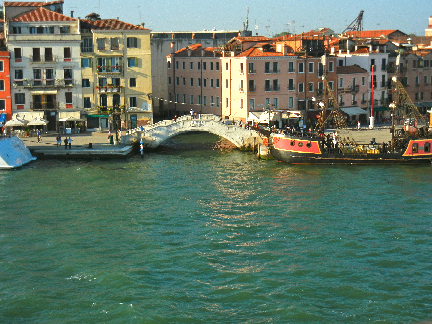
Beautiful Venice.

Beautiful Venice

After dinner, we were able to observe the sun setting magnificently into the ocean behind us, reassuring proof that we were heading due west.

PIC 2

I gave the first of the lectures offered on this cruise, calling it “On Heading East Out of Venice. ” Attendance at this and all other lectures during the week was remarkably high; our highly-educated alums were clearly thirsty for knowledge, and keen to open discussions that carried on all week. One very timely question was: how do the people of Croatia feel about joining the European Union next week? We resolved to try and find out by asking as many questions of our guides, and the people we met, as possible. Another question: What is at stake in the term “Dalmatian coast’?” Italians have long mixed with Slavs in this region, and many of them clearly believed, up to World War II, that “Dalmatia” should properly be seen as part of a greater Italian, once Roman, Empire. I thus talked of the ways in which this coastal strip had long been fought for between rival powers, and that its location midway between the empires of Rome and Constantinople, western Catholic and Eastern Orthodox Christianity, made this inevitable. So, although more recent conflicts involving Croatia, Serbia, and Bosnia continue to grab the headlines, the medieval coastal cities that we were to explore, I suggested, will be marked by signs of more ancient struggles.

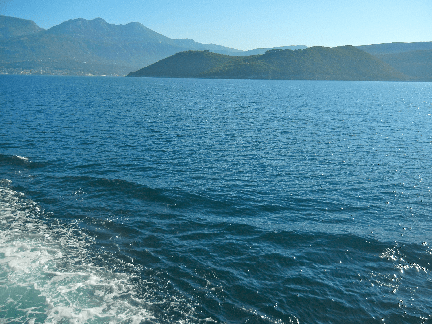
The weather during this trip was beautiful; warm but not oppressively so, with a gentle wind and just one thunderstorm late in the week. The water was so calm that you had little sense of motion: indeed, sometimes you needed to look out of the window to realize that the boat was actually in motion.  But the passing landscapes were so beautiful it was always a good idea to check.
PIC 3

We sometimes docked in harbors and sometimes dropped anchor offshore; small boats or “tenders” moved us easily to the quayside. The coastal colors of the houses were stunning, especially when set against clear blue skies.

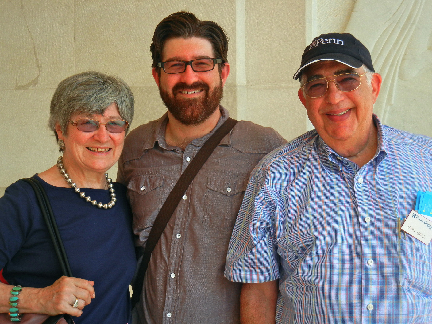
Our first port of call was Split, where two of our Penn alums had a most happy rendezvous: Eric and Katherine Gall met up with their son, Dan. Eric, a distinguished physician, works full time (after retirement!) in Tuscon, Arizona. Katherine is Croatian, and their son Dan has settled in Split and married a local girl while working for a Human Rights organization. Dan joined us for the visit to the marvelous Meštrović museum, and the family made plans to meet up after the cruise.
PIC 4

The Galls meet up in Split.

At Split, we explored the remains of the vast palace of the Roman Emperor Diocletian, which faces the harbor. Diocletian spared no expense in building this palace, using the lustrous white stone from the island of Brač, and importing marble from Greece and Italy, and columns and sphinxes from Egypt. Some 3,000 people lived here in some 220 buildings; there were 16 rectangular guard towers. Diocletian was born locally of parents who may have been slaves, and he worked his way up through the Roman military. He ruled as Roman emperor for twenty-one years, but decided to return to his native Dalmatia for his retirement. He was one of the few Emperors of the third and fourth centuries to die of natural causes, and the first in the history of the Empire to retire voluntarily; and he retired to Split.

Diocletian was a notorious persecutor and torturer of Christians: in Serbian mythology he is remembered not as Diocletian but as Dukljan, the adversary of God. Christianity did make progress in Dalmatia, and in c. 347 CE one of the most influential figures in Christian history was born there. This was St Jerome, who was to translate the Bible into Latin in a form, the Vulgate, that was to be standard for Christendom for a thousand years, and for Roman Catholics even longer.  The Roman and Roman Catholic status of Split thus seemed very strongly established as we walked among the ruins of Diocletian’s palace.
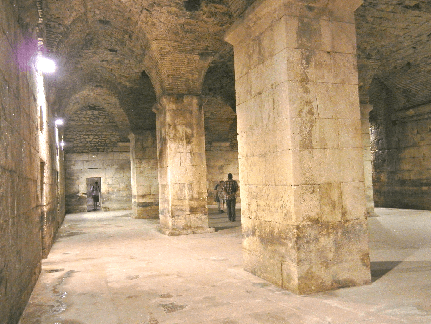
The ruins of Diocletian's palace.

The ruins of Diocletian’s palace.

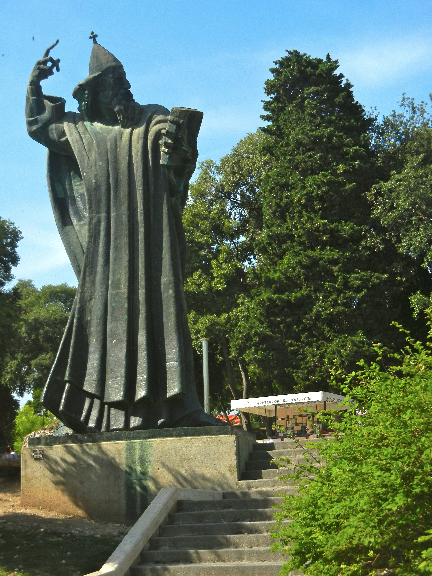
But Slavic claims to the locality were made firmly evident by a giant modern statue, located strategically right by the Golden Gate of Diocletian’s palace. The toe of this huge statue, we discovered, is well worn, because rubbing it brings good luck.

PIC 6

The figure represented below is Gregor Ninski: he’s holding a book with one hand, and making a defiant gesture with the other. He was a bishop who conducted Catholic church services in the Croatian language, rather than in Latin, following an Assembly in the year 926.

PIC 7

The earlier Croats had accepted the authority of the Byzantine empire, governed from Constantinople, but under Charlemagne, who was crowned Holy Roman Emperor at Rome in 800, they were intensively exposed to Roman Catholic Christianity; there were mass baptisms in the ninth century. Croatia today is still predominantly Roman Catholic (88 %); 4.4% of Croatians are Serbian Orthodox, with 5.2% unaffiliated.

Catholics will know that Roman Catholics had to wait a long time to hear mass celebrated in their own, native languages: until the 1960s, in fact, and Vatican II. So this was a precocious bid by Gregory of Nin to let Croatians have their own liturgical language, and of course, Rome did not approve. Gregor also wanted to weaken ties with Rome, to establish a church governed chiefly by local Croatian bishops, and to make the archbishopric of Split the effective center of religious authority. He celebrated mass in the local language, and also advocated married clergy and opposed the Roman alphabet, preferring the use of Glagolica, the local script (the term comes from the verb glagoliti, which means ‘to speak’).

Glagolitic script is first associated with the saints Cyril and Methodius from the Greek city of Thessaloniki. They were sent south by the Emperor of Byzantium in 862 to make converts to Greek Orthodox Christianity among Slavs. Some of their followers traveled further, into Dalmatian and Croatia—where their script, Glagolitic, was adopted and slightly modified. It was this script that Gregory of Nin wanted to substitute for the usual Latin of the Roman Catholic church. What’s amazing is that eventually this was allowed to happen: not in Gregory’s lifetime, but 300 years later. It was in the year 1248 that Pope Innocent IV gave the Croats of southern Dalmatia the unique privilege of using their own preferred script and liturgical language for the Roman Catholic rite—and eventually, this privilege spread right along the coast. Some of the Glagolitic missals or liturgical books were even produced in Rome. This is something that the papacy really did not allow anywhere else before Vatican II, in the 1960s. This is why Gregory of Nin is revered as a pro-typical nationalist leader of the Croatian people.

I think, then, that the placing of that statue of Gregory of Nin by the Golden Gate of Diocletian’s palace, at Split, was a piece of genius. It says, yes, the heritage of Rome forms a vital part of our identity, and we are pleased to acknowledge our local Roman emperor, who grew up right here. But we are also Catholic Slavs who won the right, long before any other nation in Roman Catholic Europe, to worship on our own terms, in our own language: we have written our own history in our own language in a script that we invented.

We had thus seen and learned a great deal on our first full day. We were very happy to gather as a group of Penn alums for cocktails in the beautiful evening light, after visiting Kotar, and then to have dinner together.
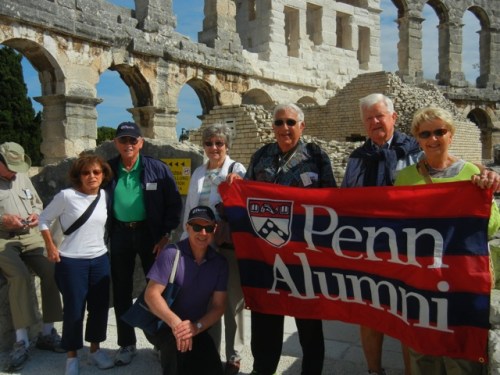
Dalmatian Coast 1

Penn Alumni with faculty host Professor David Wallace.

Our explorations  at Split helped us make sense of everything seen later in the cruise. The further south we sailed, we realized, the more Mediterranean and easy-going things felt, and the more observantly religious. Locals along the way told us that, yes, they might well cheer for the Croatian football team (which had recently beaten Serbia), but that life along the Dalmatian coast was very different from that in Zagreb, the capital. And since these coastal towns are back by very high, almost impenetrable mountains their life really did unfold along the coast. Thus to visit these beautiful small cities by boat was really the only way to travel, the only way to make sense of them, to experience them as people had for thousands of years.

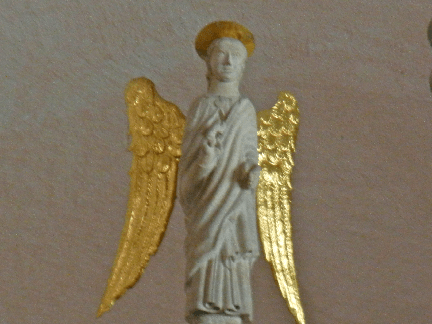
The southernmost point of our voyage brought us to Kotor, Montenegro, a beautiful and ancient city in a proudly independent land. The cathedral of St. Tryphon is a beautiful Romanesque space, with gold-winged angels.
PIC 8

Gold-winged angel in the cathedral of St. Tryphon.

Steps lead from the edge of the city upwards to a fortress, from which the flag of Montenegro proudly flies.

PIC 9

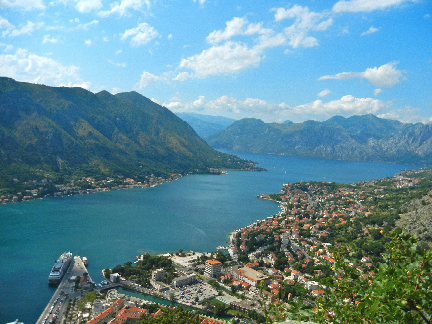
It was possible to look down from this great height and spot our boat in the bay, tiny in the distance.
PIC 10

View of Kotor, Montenegro.

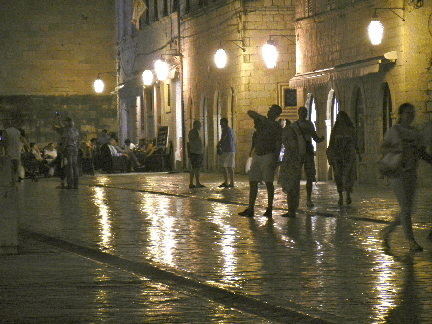
We arrived at Dubrovnik, for many centuries known as Ragusa, late on the same evening: it was possible to go ashore and explore the city by night. I went ashore with Penn alum (and west Philadelphia native) Bob Tollen, and his wife, Bryn Mawr alumna, Ellen. The polished marble of the streets was illuminated by the streetlights, giving the romantic effect of water. We made the formal tour the following day.
PIC 11

At some of our stops the locals told us of rather panicked preparations for EU membership: such as the cutting down of woodland and the planting of vines, before the EU forbade or put a quota on wine production. On the journey back west, between coastal towns, there was a remarkably informative “village meeting,” in which three locals spoke of recent history and speculated on the future. It was noticeable that the older two speakers were nervous about joining the EU, but the youngest of them, a teacher, seemed more optimistic; and his pupils, too, he said, were more excited than alarmed. Croatians are clearly worried about losing measures of protection for their traditional industries, such as shipbuilding. But the clearest demonstration of entrepreneurial spirit was shown by young girls at Rovinj, our last port of call, who were selling spectacular sea shells they had collected themselves; they must have been about eight years old.

All the Penn alums showed great loyalty in coming to my last lecture—given at 9:15 PM, after the captain’s farewell banquet. I tried to help us imagine what it might mean to approach Venice as travelers from the past, hoping for the right wind, knowing that if we made it back we would achieve great prestige in our communities: for not all travelers who headed east from Venice were expected to return, and those who intended to sail had to settle their affairs before leaving home. I proposed the music used by  Viscont in his film of Thomas Mann’s Death in Venice as appropriate for heralding our arrival: the adagio from Mahler’s fifth symphony.  And I ended with a collective pop quiz on everything learned over the last week, in lectures and from local guides.  I threatened to have the captain turn the boat around should the alums flunk this test, but they passed with flying colors.  The weather finally turned cloudy and cooler, but we arrived safely and our marvelous journey along the Dalmatian coast was at an end. When stories about Croatia began appearing the following week, as it joined the European Union on July 1st, we all felt able to empathize with its hopes and fears. And we know that, whatever the future holds, they are blessed with coastal towns of ancient pedigree and stunning beauty: even washing on a clothes line looks poetic:

PIC 12

[Penn Alumni Travel will be heading back to the Dalmatian Coast and the Adriatic Sea next year. Click here for more information about our Adriatic Antiquities cruise (June 26-July 9, 2014) with Classics Professor Ralph Rosen. Professor David Wallace will also be joining us next year as a faculty host on the tour, In the Wake of the Vikings (June 13-21, 2014).]

1 Comment

Filed under Faculty perspective, Penn Alumni Travel, Travel, Uncategorized

A Hot Day at the Morris Arboretum

Author: Lillian Gardiner, GEd’11

Morris Arboretum, owned by Penn, is 92 acres of lush gardens about 30 minutes north of the University. After 3 years of telling myself I should go see it, I finally made the trek out there on July 4.

I was blown away by the beauty and peacefulness of the place. There were art displays throughout, along with rose gardens, a swan pond, a log cabin, and a toy train exhibit. Check out their website for upcoming classes, lectures and events. Penn Card Holders get in for free, so no excuses!

Nest

That’s me! Just chillin’ in the canopy 50ft above ground.

photo 1

Blue eggs in a nest from the Out on a Limb tree adventure.

photo 2

Stone stairway nestled behind a rose garden.

photo 3

Part of the super cool Garden Railroad.

photo 5

Just walked through the grotto below a statue of Mercury. Look at the state of wonder I’m in.

Leave a comment

Filed under Alumni Perspective, Campus Life, Lillian G.

Museum Hopping on Constitution Ave.

Author: Gabriela Coya, C’14

I can’t believe I’ve been in DC for six weeks already and only have four more weeks to go.

Since I last checked in, I’ve made it a bigger priority to visit museums, as there are so many within walking distance that are so amazing. (And even free!)

My first stop was the Newseum. This one did have an admission fee, but it was definitely worth every penny. It was a blast to go with fellow Daily Pennsylvanian staff members whom enjoyed the exhibits just as much — and perhaps even more — than I did.

Photo1

The Newseum is also home to the largest display of unaltered portions of the Berlin Wall.

Photo2

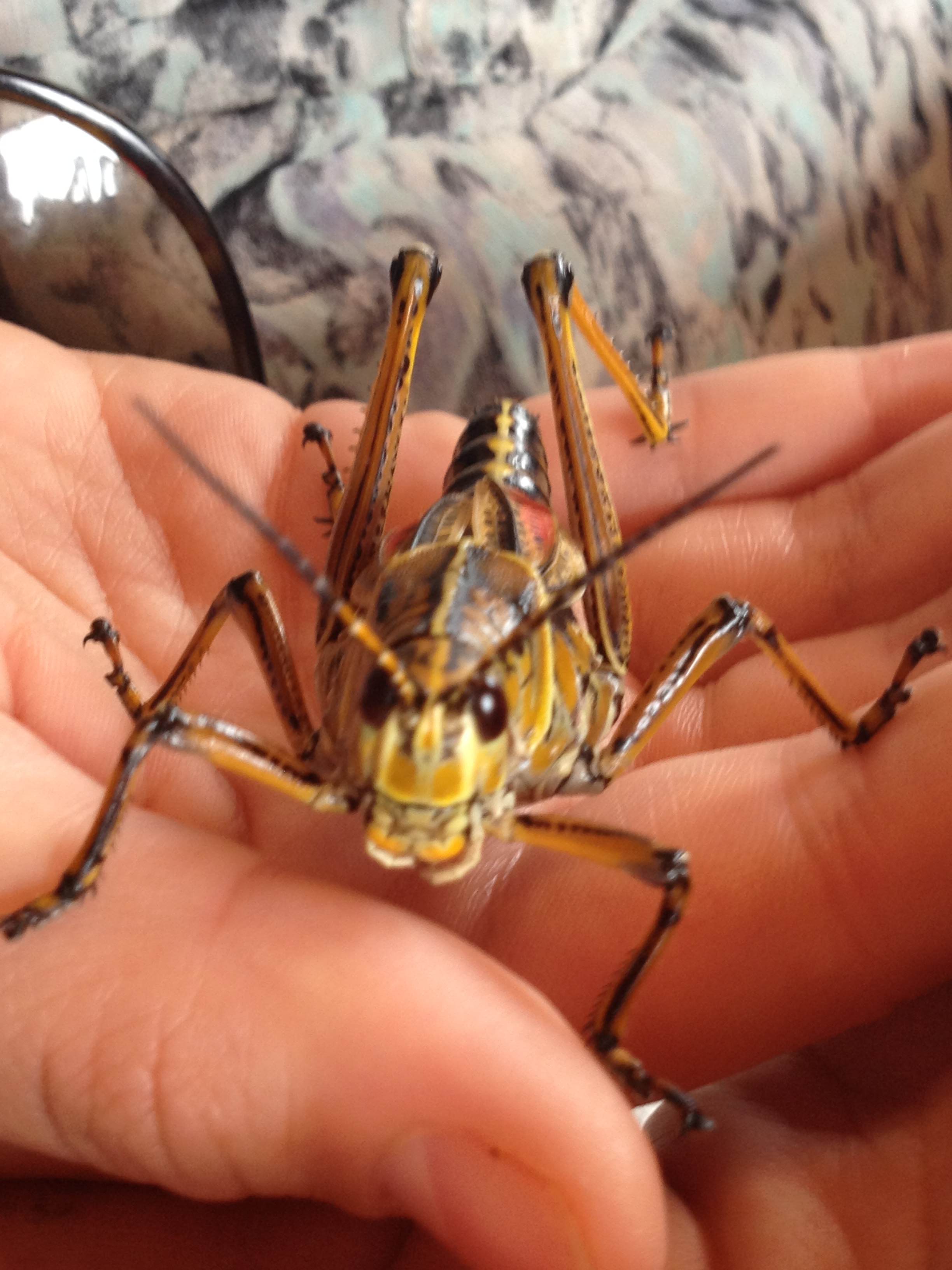
After visiting the Newseum, I also made sure to go to the Smithsonian Museums, such as the National Museum of Natural History. My friends and I got to relive our childhoods and hold critters like this big grasshopper and caterpillars.

Photo3

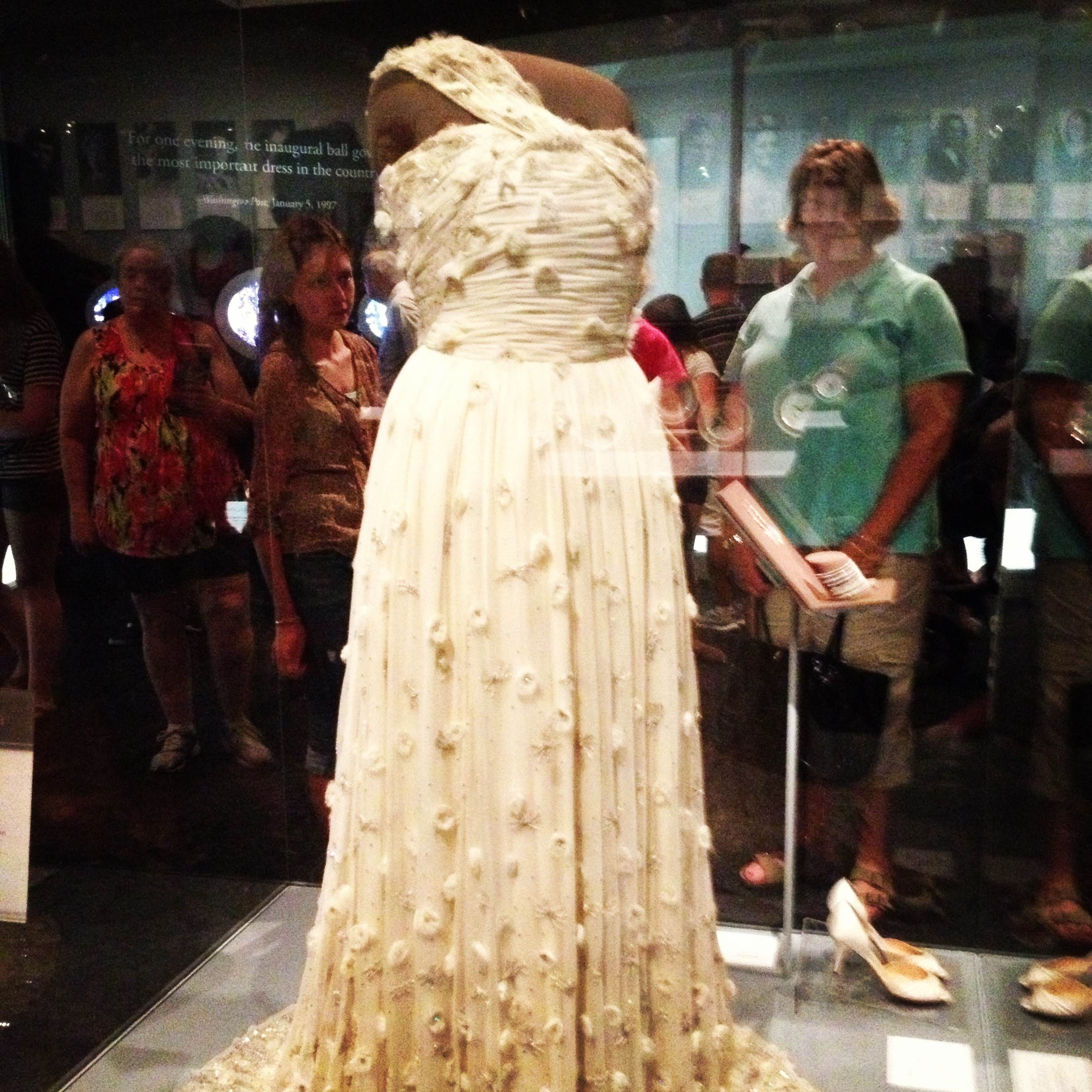
After being there for a few hours, we visited the National Museum of American History a few blocks away, where we saw Michelle Obama’s Alexander McQueen inauguration gown and Dorothy’s original ruby slippers from “The Wizard of Oz.”

Photo4

Photo5

Coming up this month: possibly a Nats vs. Mets game with fellow Penn students in Washington!

Leave a comment

Filed under Gabriela C., Student Perspective

Locust Walk Talk: Better Late than Never – Class of 1995 in San Francisco

Author: Casey Ryan, C’95

I called out of work today due to a headache.  I was able to sleep it off and I’m feeling better now.  However, I forgot that it was my day for a blog entry.

So really short, I’m going to share with you some of my pictures from San Francisco.  I went to the City for the Fourth of July to celebrate the 40th birthday year of the Class of 1995.  Our trip, called San Fran 73-13, was put together by Susan Webner, W’95 and Sara Golomb, C’95.

Look forward to a more detailed write up soon.

The view of the Golden Gate Bridge from Saturday’s bike ride.

A panoramic view of the Ferry Building interior

Fresh Cheese at the Farmer’s Market.

photo(9)

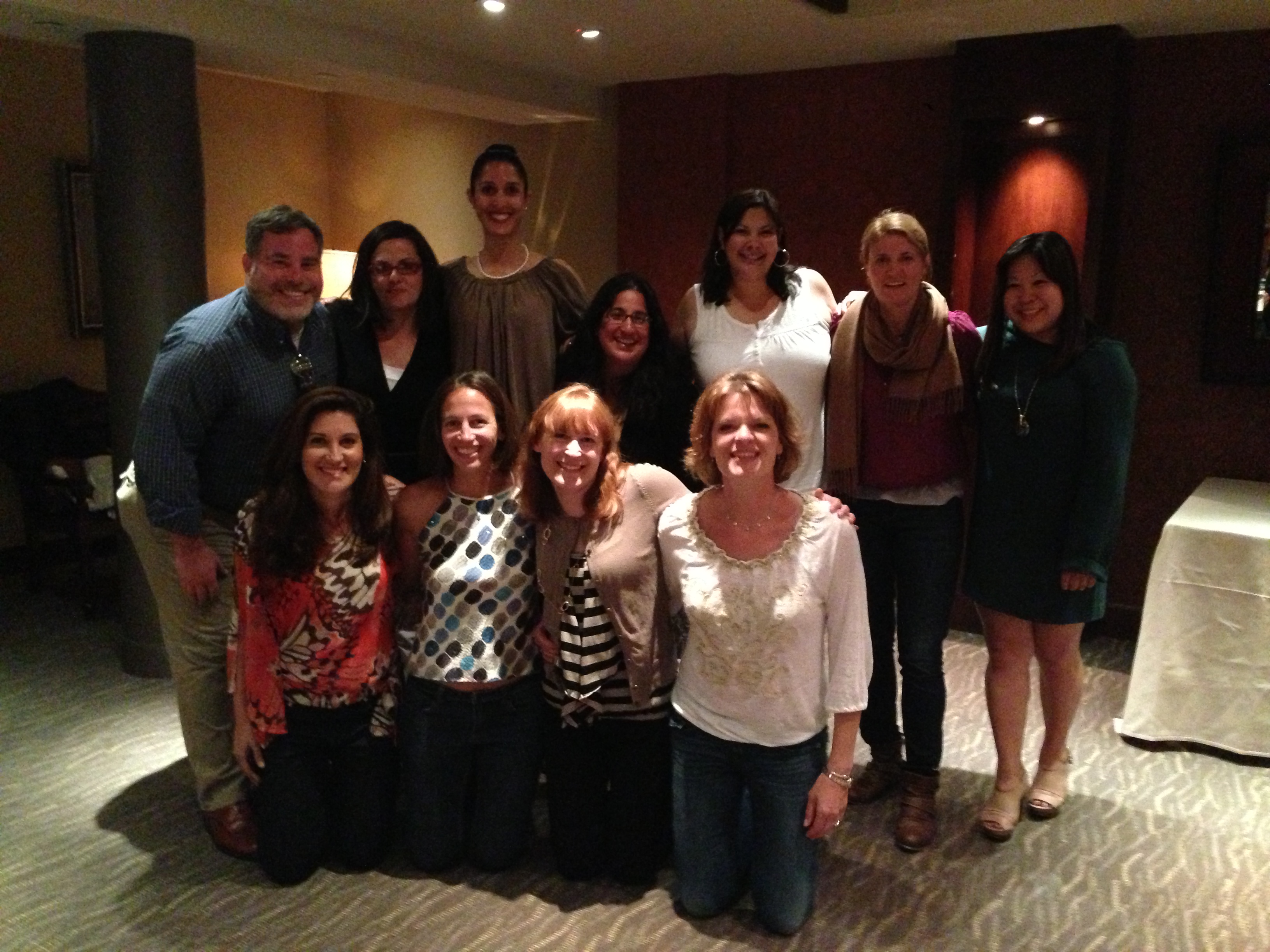
Most of the trip attendees, a ton from the Class of 1995.

A selfie, in the Presidio, at the Off the Grid, food truck picnic. Gotta like a place named after you.

We had a great time and we’re looking forward to meeting up again before we return to campus in 2015 for our 20th reunion.


Leave a comment

Filed under 20th Reunion, Casey R., Class of 1995, Locust Walk Talk, Reunions

Penn Alumni Travel: Italian Inspirations

Author: Professor Michael Gamer, Penn Department of English

All roads may lead to Rome, but ours this spring instead took that ancient city as our starting point — perhaps because the Penn Alumni Travel Italian Inspirations tour went not by land but by sea. After an overnight stay amidst Romans celebrating independence day (the Festa della Liberazione), we took the train to Civitavecchia and boarded the Riviera, operated by Oceania cruise lines. This was no Carnival Cruise. The Riviera was medium-sized and elegant, its passengers primarily alumni groups like our own.

photo 4

Of the twenty-two schools represented on the cruise, only Penn and UCLA sent host professors, which made our groups (at times) objects of envy — at least so my co-travelers were kind enough to tell me ;-). Joking aside, I will say that, as a lecturer, I have never spoken to such large groups before. The ship’s main auditorium seated six to seven hundred people, and while speaking about the Grand Tour and its history I found fewer empty seats than I anticipated.

Indeed, in our way we were doing our own Grand Tour. Although at a much faster pace (seven days instead of seven or even seventeen months) and taking a somewhat different route from those taken by travelers 200-400 years ago. Rather than beginning in Milan and heading south before circling back to Venice, our tour engaged in something closer to Lord Byron’s travels of 1809-10, when all of Europe was either at war or under the dominion of Napoleon Bonaparte. Byron, therefore, was forced to do most of his traveling by sea, hopping around the Mediterranean from port to port, gathering antiquities and swimming whenever possible. He was engaging in a time-honored tradition by doing so; since the ancient Phoenicians, the Mediterranean has been southern Europe’s freeway, traveling by sea always an easier proposition than traveling by land.

In our case, we headed from Rome south to Sorrento, where some of us saw Mount Vesuvius and others Pompeii before sampling the local limoncello and watching the sun set over Capri. By the time we awakened the next morning, we were nearing Taormina on the island of Sicily, home of that other great Italian volcano, Mount Etna, pictured here in the background of Taormina’s beautiful amphitheater:

photo 5

Some of you reading this post will have traveled by cruise ship before. I had not — and there is something magical about waking up to find yourself in a new place. In our case, days three and four found us arrived at the islands of Zakynthos and Corfu, respectively, followed in the course of the week by the stunning cities of Dubrovnik and Venice, where we disembarked for good. Though I have traveled many times in Italy, these Greek and Croatian stops were entirely new to me, and a real pleasure. They possess a color palate unlike Italy, something at once stripped down and sparkling. There is something at once stark and beautiful about the coastline and buildings, the contrast of blue water next to white cliffs and houses.

Zakynthos 1

Zakynthos 2

Of course, nothing quite ever can prepare you for Venice, whether you’ve been there a hundred times or never. After six days of superb touring, that final day we all scattered to wander this wonderful city on our own. Some of us to San Marco; others to the Accademia, the Guggenheim, and other museums; and still others just wandering the narrow calle, trying to get lost. And, so far as I know, none of us quite felt moved enough to copy Byron’s exploit of swimming through the canals.

Venice

I will confess, though, that for me all roads did end up leading back to Rome: after saying goodbye to my fellow Penn Alumni Travelers I spent a few days there, soaking up the sun, revisiting old sites and taking in new ones. I can hardly wait to return in October 2014 — this time touring overland with the Flavors of Tuscany tour in October 2014. Hope to see you there!

1 Comment

Filed under Faculty perspective, Penn Alumni Travel, Travel

Hamilton Walk in the Summertime

Author: Stephanie Yee, C08

When I’m walking around campus, sometimes I stop and think, “This is the life.” We are so lucky to have such a beautiful campus. The sunshine, exquisite architecture, and perfectly green trees make summers at Penn so wonderful. Here is a snapshot of a perfect summer afternoon. Hamilton Walk is usually crowded with students rushing to and from classes, but it’s calm and quiet during the summertime. The Leidy Laboratories of Biology is on the left, and you can see a little bit of The Quad on the right. Seriously, this is the life.

IMG_20130620_175900

Leave a comment

Filed under Alumni Perspective, Campus Life, Stephanie Y.

Penn Quakers Pounce and Reality TV Saves Lives

Author: Lisa Ellen Niver, CAS’89

Studying at the University of Pennsylvania, I learned fast and worked hard. As my studies focused on science and liberal arts, I never took a class in finance even though The Wharton School is renowned the world over for business. While watching Shark Tank on television, I feel that I am finally getting an education in economics.

Several of my favorite things (University of Pennsylvania and Shark Tank) came together when Ryan Frankel and Kunal Sarda appeared on Shark Tank to seek funding for their app, VerbalizeIt.

These Wharton School Grads bonded over their travel disasters and decided to make a difference. They have taken a lesson from Ben Franklin who said, “Tell me and I forget. Teach me and I remember. Involve me and I learn.” Their medium for communication is a translation platform that “promotes cultural exploration and global trade while also creating employment opportunities for the vast network of multilingual individuals across the world.”

After Frankel was sick in China and unable to get medicine due to the significant language barrier, he knew travelers needed help. Together with Sarda, he created a reasonable priced service staffed with real people and crowdsourced for translation services. This multilingual platform not only provides assistance to individuals but now is also a full service translation solution for global businesses to communicate with international customers. VerbalizeIt can assist companies that want a fully multilingual call center or to translate a fifty page PowerPoint presentation. They can assist with translating video into multiple languages. They are ready to help any company be truly global!

As the planet continues to feel smaller due to globalization and increased access to travel opportunities, we have greater opportunities for misunderstanding. Frankel and Sarda survived their misfortunes and in creating VerbalizeIt are helping others enjoy their travels more and create connections through understanding. With their partnership with Rosetta Stone, they are raising money for Children International. It is possible to make money, do good and make a difference.

Frankel told me that being on Shark Tank “was a good experience as it forces you to answer questions and build your business in a way that you have to do anyway.” His advice to fellow Wharton students reminded me of the books, The Lean Start-Up and Running Lean. “Don’t test ideas in a vacuum. Don’t be afraid to put your idea out there and see what happens. Make sure what you are building is viable by making a Minimal viable product and get data from customers.”

Talking to Frankel, I realized how much he learned at the Wharton School of Business and how much he has to offer the world. I love that nearly twenty-five years after my own graduation from the University of Pennsylvania I am still learning from fellow Penn students and even from reality television!

550438_495314753813001_489378650_n

Leave a comment

Filed under Alumni Perspective, Lisa Ellen Niver, Wharton

Penn Alumni Travel: Southwest National Parks

Author: Howard S. Freedlander, C‘67

A first-time trip to the Southwest National Parks with Penn Alumni Travel scored an A+ for my wife Liz and me. We came away, like so many others, simply awed by the natural wonders that daily greeted us and our group of 24 fellow travelers.

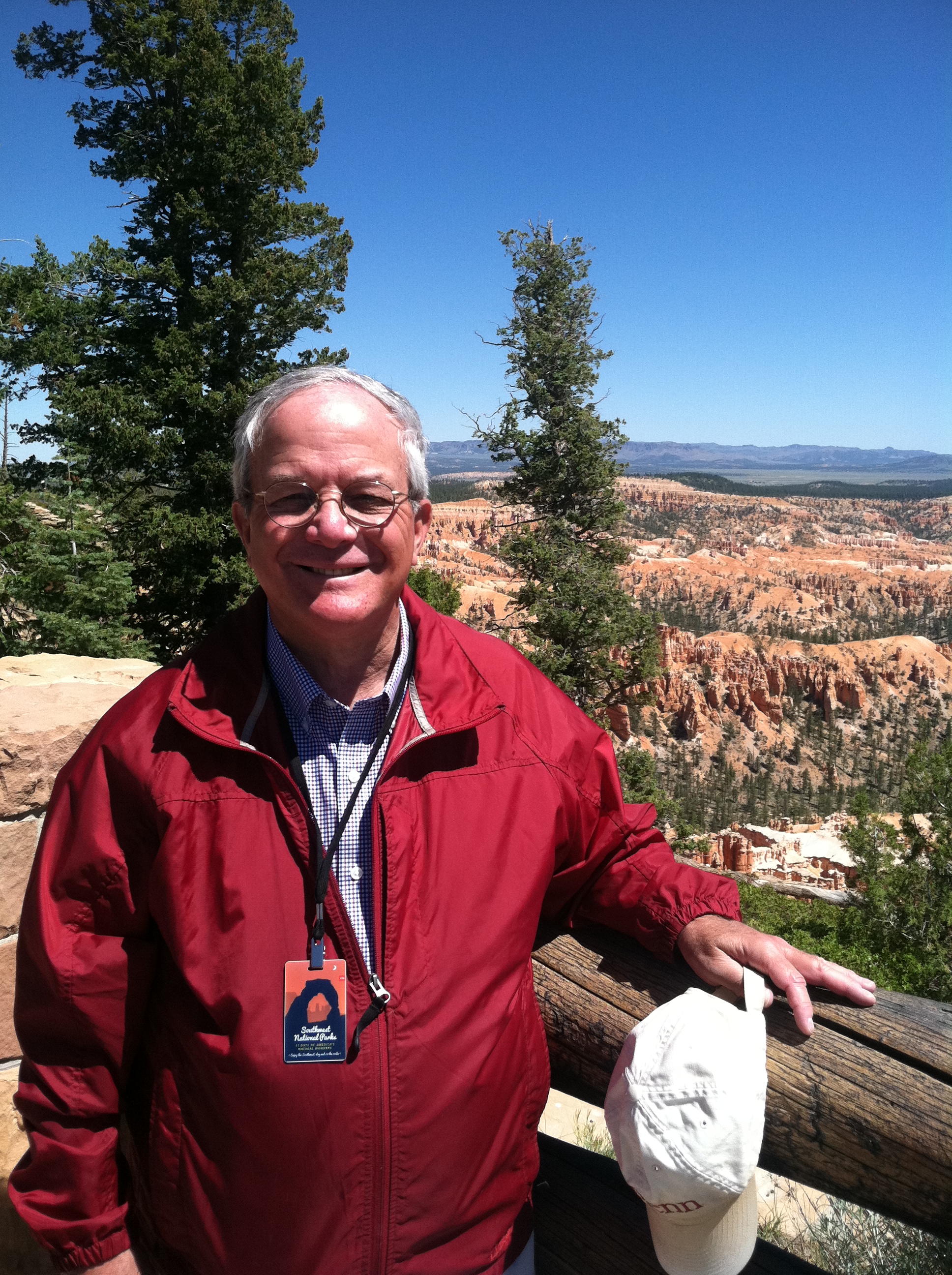
Portrait of the Author on his tour of the Southwest National Parks

Portrait of the Author on his tour of the Southwest National Parks

The sights and vantage points were overpowering at times—beginning with the incredible Grand Canyon and ending with the scenic, people-friendly Zion National Park. Liz and I discovered quickly that nothing we saw and experienced had any reference point to anything we knew on the East Coast. Certainly not the flat, waterway-dominated Eastern Shore of Maryland, where we live.

Never having gone on an organized tour, we were very impressed with Orbridge, the Seattle-based tour operator mainly serving alumni groups. I was amused when Derek Lundgren, the tour director, deliberately commented about Penn versus Penn State—and the wide difference between the two, as quickly asserted by me; he got the reaction he wanted. He was superb in communicating clearly and often with our group as we traveled from one site to another on a comfortable bus (or “coach” in tour talk).

My impressions, dutifully chronicled daily, provided a focus for me as I observed our nation’s truly incredible national parks, formed and re-reformed over millions of years. Suffice it to say that the force of nature left an indelible mark, enabling me to understand the need to preserve these natural wonders as best as humans can. Credit must go to Orbridge’s Amy Sheppard, assistant tour director, a constant source of geological, flora and fauna information during our nine days in the parks.

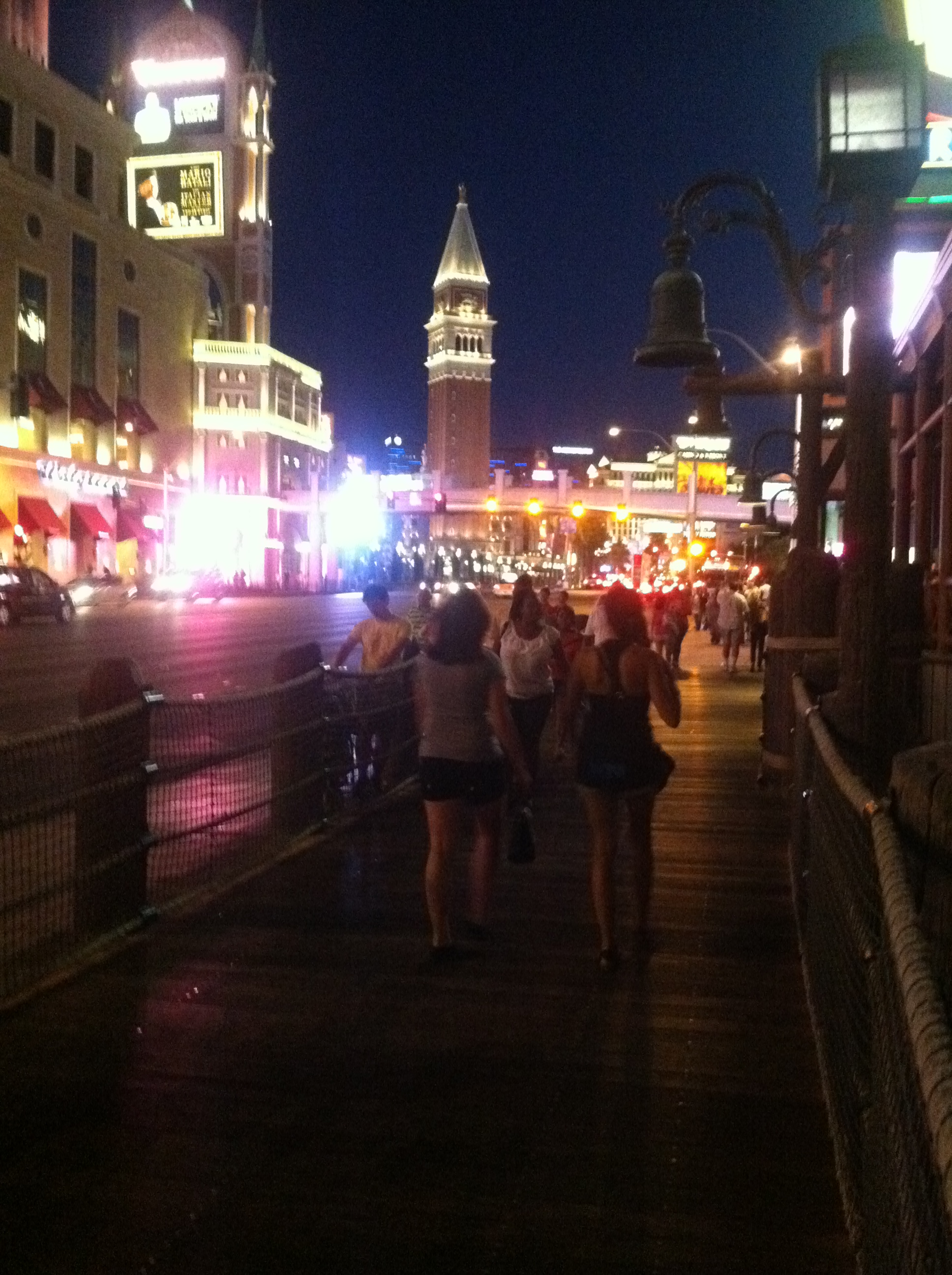
We started our adventure from Las Vegas, NV. Apart from the logistical necessity of using Las Vegas as a starting and end point, I think the artificial, hedonistic quality of this gambling mecca provided a start contrast to the solid realness of the Grand Canyon. See the awful before the awesome? Maybe. Standing at Lake Powell Point at sunset, we could marvel at the mélange of colors on the rock formations. If you let your imagination go wild, you could see natural mansions, chimneys and sculptures.

The Las Vegas Strip

The Las Vegas Strip

One of my favorite activities was rafting down the calm, soothing Colorado River, embarking from the Glen Canyon Dam. It seemed unreal to view the red-tinted sandstone walls, ranging in height from 700 to 1,400 feet, wondering about slowly tumbling rock. Construction of the dam in the 1960s was controversial then and still is; while interrupting the normal flow of the Colorado River, it also provides absolutely essential water to Phoenix, AZ and San Diego, CA. The tension between human needs and environmental purity is ever-present, in the West and the East.

The Grand Canyon

The Grand Canyon

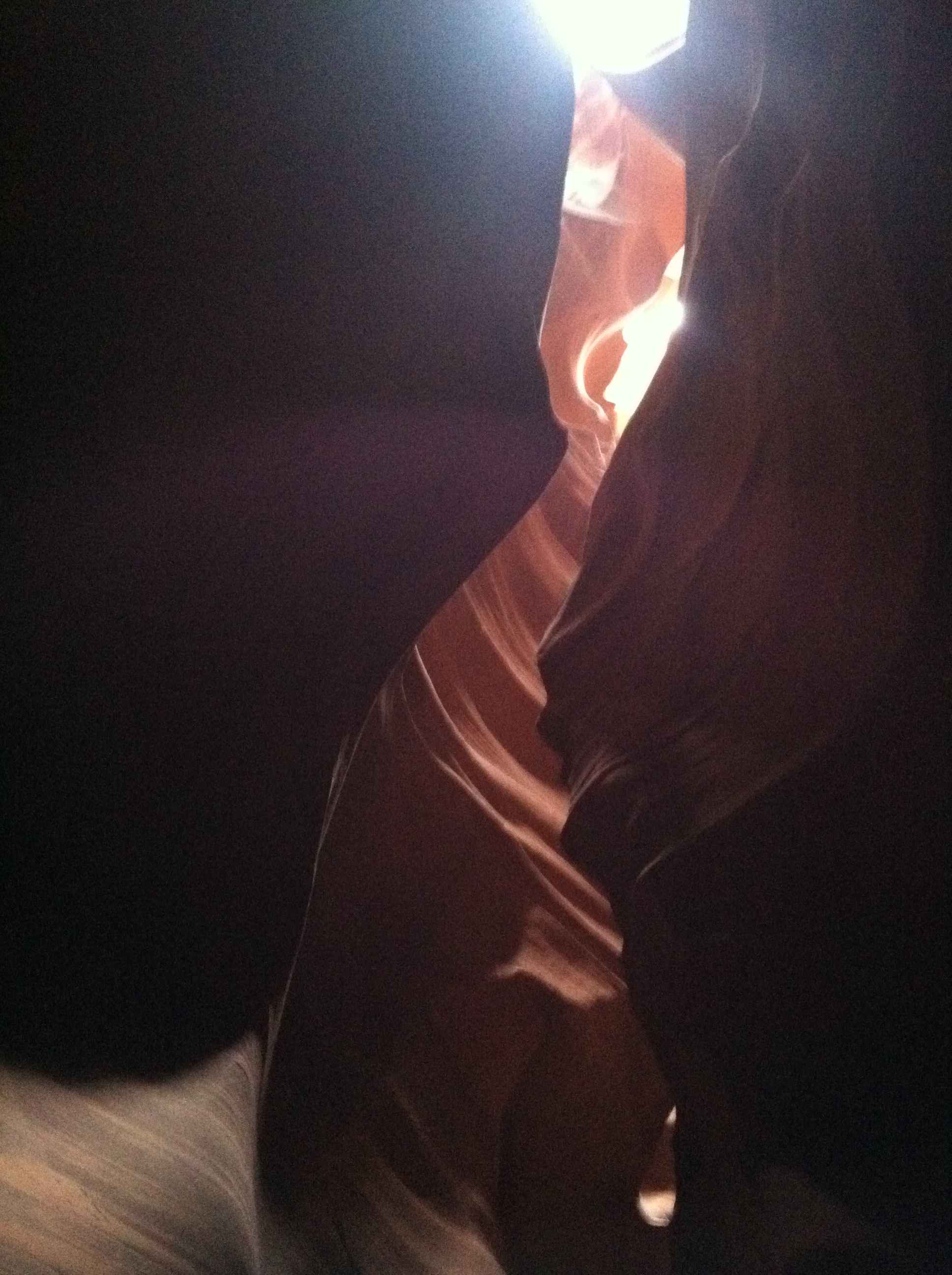
Time spent on the Navajo Reservation, visiting the striking Antelope Canyon Slot, the Navajo National Monument and Monument Valley (scene of several John Ford-produced movies featuring the iconic John Wayne), left me wanting to know more about the Navajo culture. Talks by two Navajo Native Americans, a woman and man, prompted me to think about the third-world nature of the living conditions of the reservation. We learned about the tension between the young and the old, the former seeking more economic development on the reservation and the latter determined to preserve the native culture.

Antelope Slot Canyon

Antelope Slot Canyon

In visiting Arches National Park in Utah, I became more aware of the changing environmental terrain as we continued on our Canyonlands tour. Viewing the arches, I realized that years of erosion may demolish the arches we saw, while creating others. I also was struck by the impact of tourism on this part of the United States—I counted three, maybe four tour buses. Yes, we too were “bus” people.

As we learned repeatedly, the Colorado River has played a major role in the area’s geological history, slicing through an uplifted plateau and changing the landscape over millions of years through its power and the sediment it carries. The influence of the Colorado River and its ecological balance, affected by dams, cannot be overstated. Like the Chesapeake Bay in our part of the country, it seems to be the throbbing heartbeat of the West.

My favorite resting place was the Red Cliffs Lodge in Moab, UT. It was just so comfortable and welcoming, offering wonderful views of the cliffs and river.

Our last two stops on our intensive tour were Bryce National Park and Zion National Park. Derek said he saved the best for the last. Perhaps he was right. The fractured cliffs at Bryce were magnificent, offering incomparable views and vantage points for us shutterbugs. The canyon, actually an amphitheater, was wondrous in its carved formations, reminiscent of China’s terra-cotta soldiers.

Bryce National Park

Bryce National Park

Nothing we had seen so far prepared us for Zion National Park, not because of its beauty and grandeur but instead because of its accessibility and people-friendly nature. You had to adjust your expectations and appreciate the slowly moving Virgin River, the wet cliffs and its hanging gardens and the serene walkway along the river. There were no “oohs and ahs” in Zion—simply an opportunity to sample and touch a national park.

Did I say anything about the weather? It was wonderful. And when it was hot, it was not excessively so.

Did I say anything about the group members? They were fun and funny, intelligent and inquisitive. And these well-traveled members seemed to have a similar motivation: after seeing the world, it was time to see a fascinating part of the United States.

Also—I can’t help myself—I discovered two Penn alumni, Marjorie Kitchell, class of 1964, and Dr. Art Brown, class of 1966. Marjorie joined the tour as a Case Western Law School alumna, while Art joined it through Temple, which his wife Debby attended. Another tour member, Dr. Ed Miller, did his internship and residency at the Penn Medical Center. And Liz and Robert Barone were the proud parents of a Penn 1998 graduate.

At our farewell dinner in Las Vegas, Marjorie Kitchell spoke eloquently about democracy and the openness of state and federal parks to all people, regardless of their economic status. She talked not only about the American but foreign visitors as well to the parks which we visited, able to enjoy the vistas and grandeur of the Southwest National Parks.

Marjorie’s message was compelling.

[Penn Alumni Travel will be visiting northern National Parks in 2014–Yellowstone, the Grand Tetons, and Mount Rushmore, among others. To view information about this tour or any of our 2014 destinations, click here. All photos in this blog were taken by Howard Freedlander.]
Leave a comment

Filed under Alumni Perspective, Guest blogger, Penn Alumni Travel, Travel

Happy Fourth of July from Penn Alumni

Author: Aimee LaBrie

Here’s an idea to start your holiday weekend:  why not plan your summer vacation around a visit back to Penn? I challenge you to return to  campus for a family photo scavenger hunt–get a picture of your dog on the Button, your child in the “O” of the LOVE Statue, you fleeing across Locust Walk, pursued by the numerous aggressive squirrels that dominate the green.  These are just some ideas; you can take photos of whatever you like as long as you show that you’re at Penn. Then, send the pictures to me at alabrie@upenn.edu and I’ll post them here.

In the interim, please enjoy a few pictures of Penn campus, courtesy of University Communications, and have a safe and happy Fourth of July!

Penn1 Penn2 penn3


Leave a comment

Filed under Aimee L., Campus Life