Author: Professor Arthur Waldron, Lauder Professor of International Relations, Department of History
Any trip, according to the great travel writer Lawrence Durrell, “begins with a moment of panic.” I and my family certainly felt that “panic” repeatedly in the days before we finally locked the front door and set out to join Penn Alumni Travel’s “Waterways of Russia” tour of which I was to be the leader. We knew this was going to be something new and memorable, but were a little nervous as well.
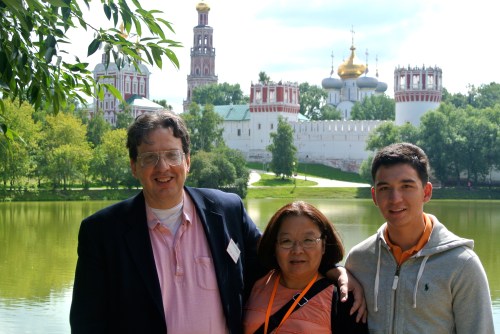
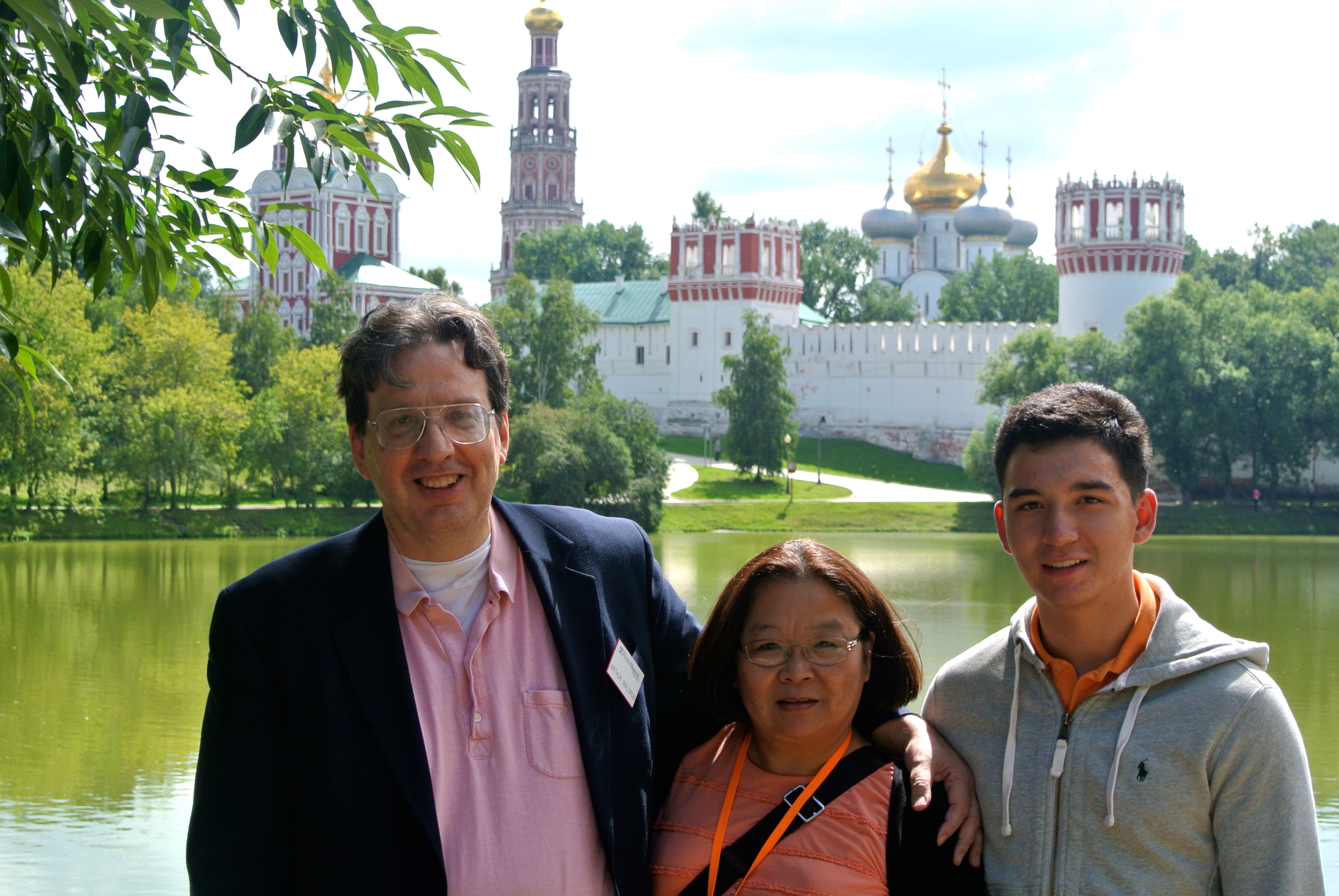
The Waldron family in Moscow.
As soon as we boarded our flight our feeling of panic turned into excitement and anticipation. We flew from Philadelphia to Frankfurt where we changed to the Lufthansa flight to Moscow. No more than two minutes after we boarded our new flight, a cheerful lady in the row just in front of us turned and looked carefully at me, extended her hand to me and said “Hi.” Then, turning to her husband, the said: “It’s okay, it’s him.” She had recognized me from the brief welcoming video that the Penn Alumni Travel department had sent to the members of our group, which had introduced me—and immediately the trip became real. This couple had flown in one day from Los Angeles –more than six thousand miles—to Moscow, and others in the group had performed similar feats. Nearly all the flights that day were late arriving at Domodedovo, a somewhat upgraded but still Soviet vintage airport. Nevertheless we had people to meet all of them, and transport to the Marriot Avrora Hotel, a few blocks behind the Kremlin, which would be our headquarters for the two nights of an optional pre-cruise visit to Moscow for which many had signed up.
By breakfast the next day, our first formal meeting, we had met many of the fifteen Penn group members, who were almost alarmingly rested and energetic, ready to give everything to what was on offer.
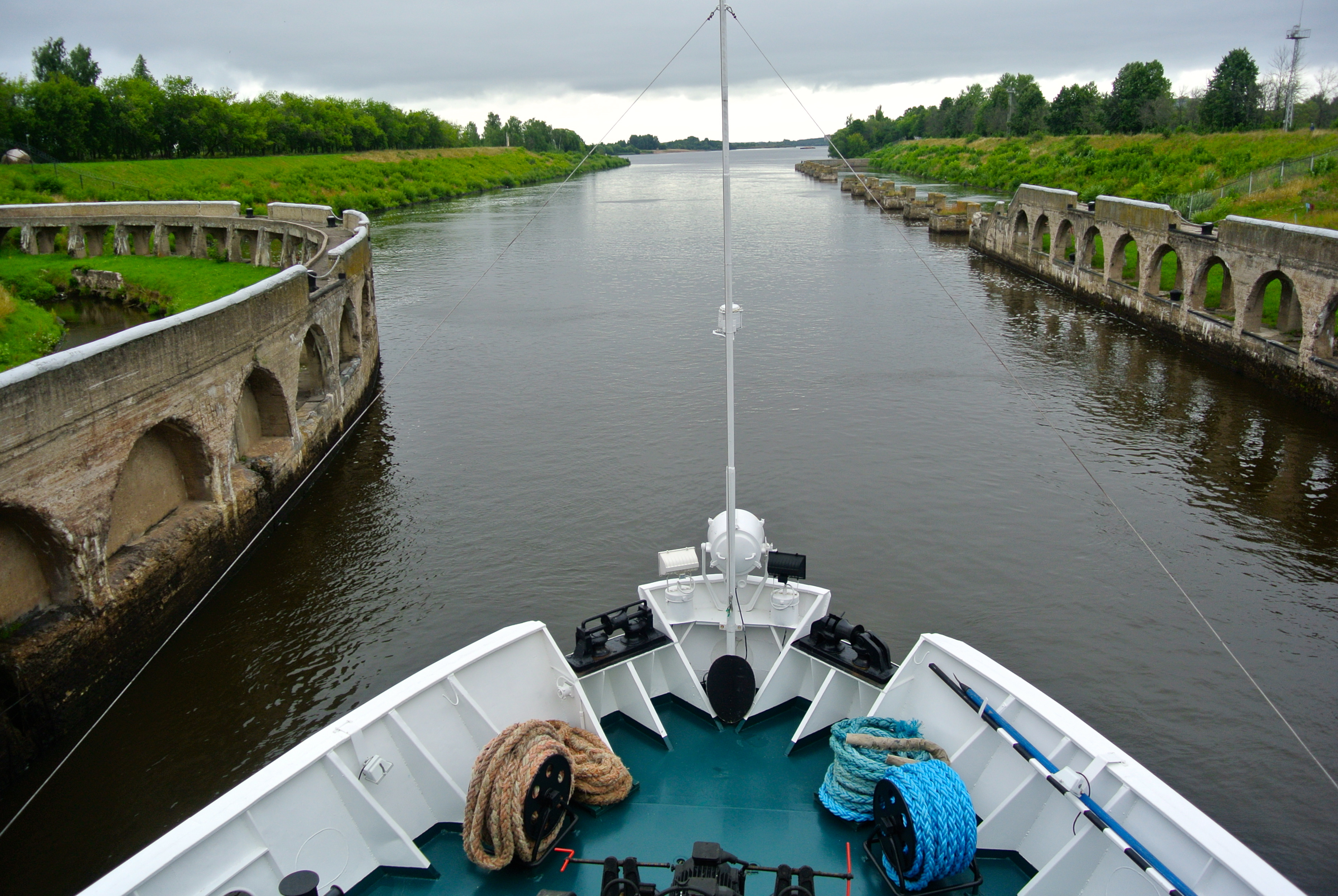
The object of the trip was to cruise from Moscow, Russia’s present capital, to St. Petersburg, capital from 1712-1918. We would travel by boat, the efficient and very comfortable Volga Dream. Embarking at the North River Terminal, built in 1937 on the Moscow River, some 393 feet above sea level, our voyage would arc from northeast and then to northwest over some 820 miles on the way to its final stopping point at the recent (1970) River Station of St. Petersburg on the Neva River, where the water is perhaps three feet above sea level. En route we would pass through eighteen locks and thirteen distinct but now connected rivers, reservoirs, or lakes.
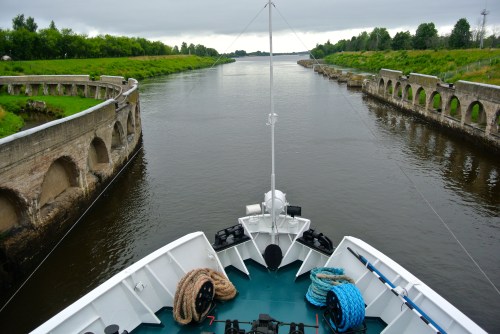
On the ship’s prow, traveling along the Russian waterways.
This voyage would take us far from the urban Russia familiar to most tourists, to what might be called “deep Russia.” This is the rural Russia of seemingly perfect villages, each up a grassy bank from the river, each with its onion-domed church, now beautifully restored, its one story wooden houses with their immaculate white curtains and often fussy fretwork decoration, its surrounding fields and sometimes muddy roads–all cradled in the seemingly primeval evergreen and birch forests—in all the sort of scene that in the Russians imagination must evoke “home,” even if it is never quite reached. It is also the land of remote but magnificent churches, monasteries, and other monuments, again best reached by water.
Here I should add as a caution that ours was a tourist route, albeit somewhat unusual, but in the business of entertaining foreigners, and that had we visited other places in Russia, particularly former Soviet industrial sites, such as the ore-mining centers of Magadan on the Sea of Okhotsk, worked by in the Stalinist period and after by slave labor, or Norilsk in the far north and even today closed to foreigners, our impressions might have been very different, though I doubt our cautiously upbeat tone would have been reversed.
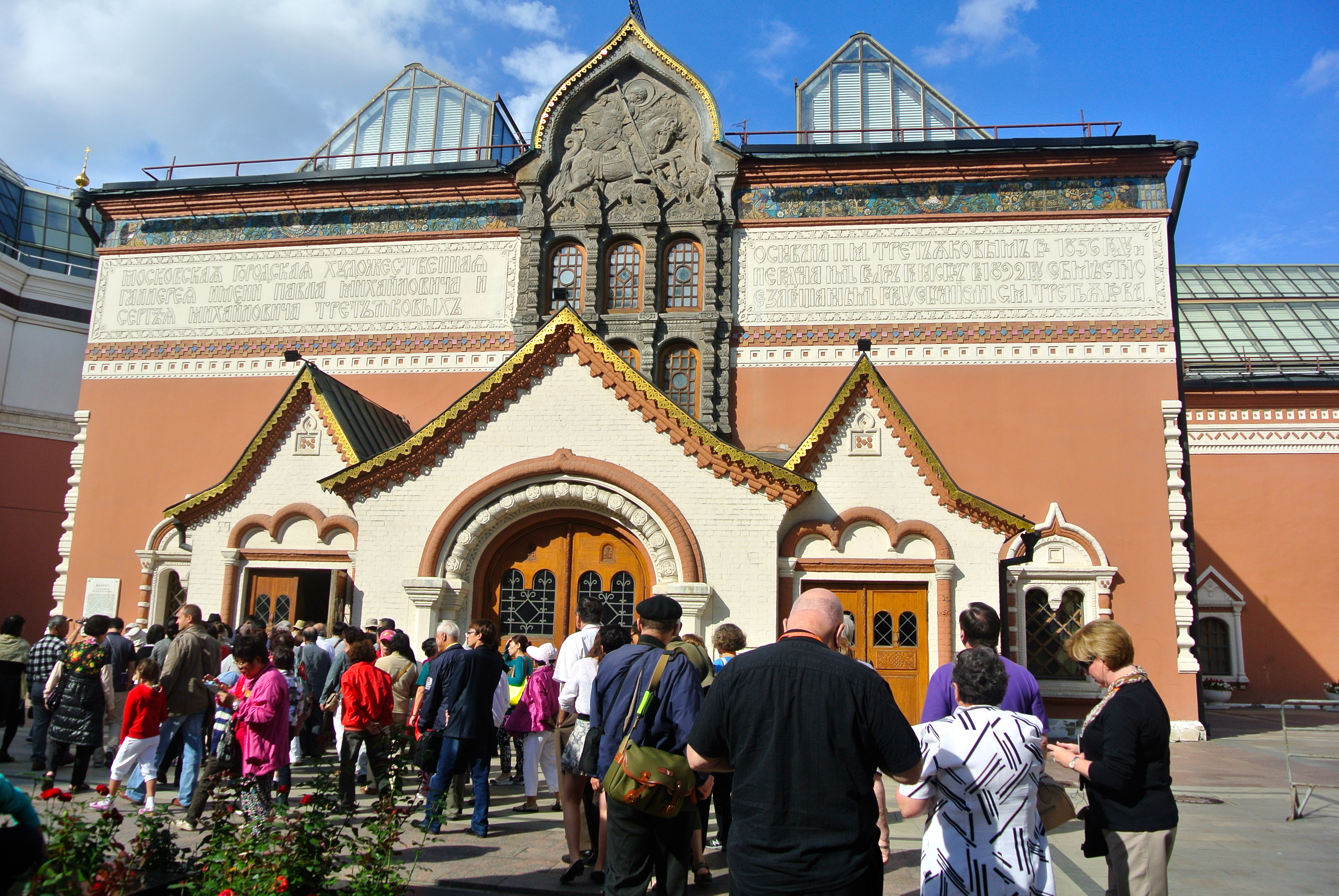
But first there were the two pre-embarkation days in Moscow. The first morning took us to the Tretyakov Gallery, the greatest treasure house of Russian art, assembled by a nineteenth century merchant. It contains too many masterpieces to mention, but among the most memorable were huge canvases by the radical turn of the last century realist Ilya Repin, portraits of the writers Chekhov, Dostoyevsky, and Tolstoy, as well as the great composer Mussorgsky. On the way out we passed through the Ikon gallery, which contained a precious mosaic from ancient Kiev, as well as several works of the celebrated Andrei Rublev.
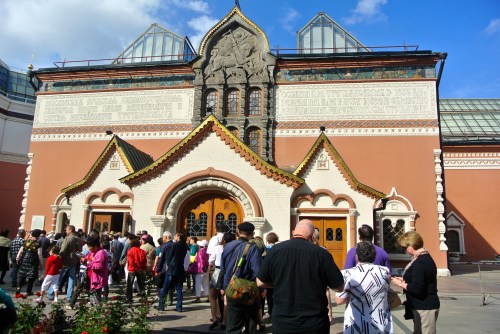
The Tretyakov Gallery in Moscow.
Somehow, in Moscow and elsewhere, we seemed to get the very best guides. I have been to Russia more than a few times, but never have I encountered such deeply knowledgeable experts.
We then had an afternoon “at leisure” which for some of our passengers meant visits to the other great art museums of Moscow, some crammed with masterpieces of early twentieth-century modern art. Others wandered in Red Square, where owing to the north latitude the evenings are almost endless—the so-called “white nights,” when the Russians come out in force for pure enjoyment—or explored the side streets with their restaurants, antique shops, and one historic site after another.
The following day we visited the Novodevichy Convent, perhaps the classic of Russian baroque, brick red, with beautiful towers, gardens, and a lake. Since its founding in the mid-sixteenth century, it has served political as well as religious purposes. It was a place of comfortable imprisonment for noble women, for example, the sister of Peter the Great, who had plotted against him. The Novodevichy cemetery contains the graves of many important Russians, ranging from Prokofiev and Shostakovich to the haunting memorial, with her young face beautifully sculpted, of Stalin’s tragic second wife, Nadezhda Alliluyeva, who shot herself, in despair, at the age of 31, to Khrushchev and Boris Yeltsin.
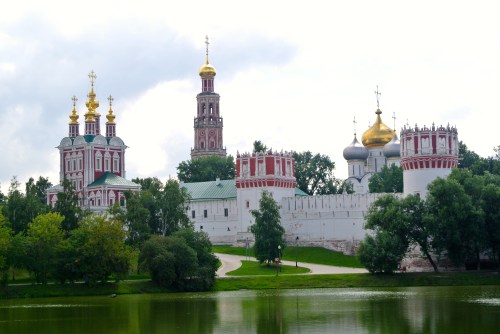
The very striking and beautiful Novodevichy Convent.
After this the “pre-tour” ended, we were transported directly by highway and then through an extensive park, to the somewhat distant, but remarkable, North River Terminal (a masterpiece of the Stalinist style, an oblong building decorated with a tracery of thin pillars and delicate balconies, all leading to a tower with a ruby-red star—now swathed with scaffolding for restoration), to embark on the Volga Dream. We were met by our Russian hosts with iced tea, and found our luggage already waiting for us in our well-appointed cabins. Our fifteen Penn alumni joined the rest of the tour, altogether ninety-six passengers, including groups from Columbia University, Johns Hopkins University, Mills College, and the National Trust for Historic Preservation. The passengers were uniformly impressive, resourceful, and (important on a cruise) faultlessly courteous to all. Some were seasoned world travelers, others less experienced, and one was a lady who, because of her husband’s health condition, had never before held a passport or left home in her life. All were full of real interest in the trip, not to mention asked tough and perceptive questions.
The first evening began with the Captain’s Reception in the large and comfortable Neva Lounge, which was followed by a fine dinner at which we were seated by group, although later most of the time people sat where they wanted. This first night on board, we slept in great comfort knowing that no fewer than fifty-five staff were there to look after us.
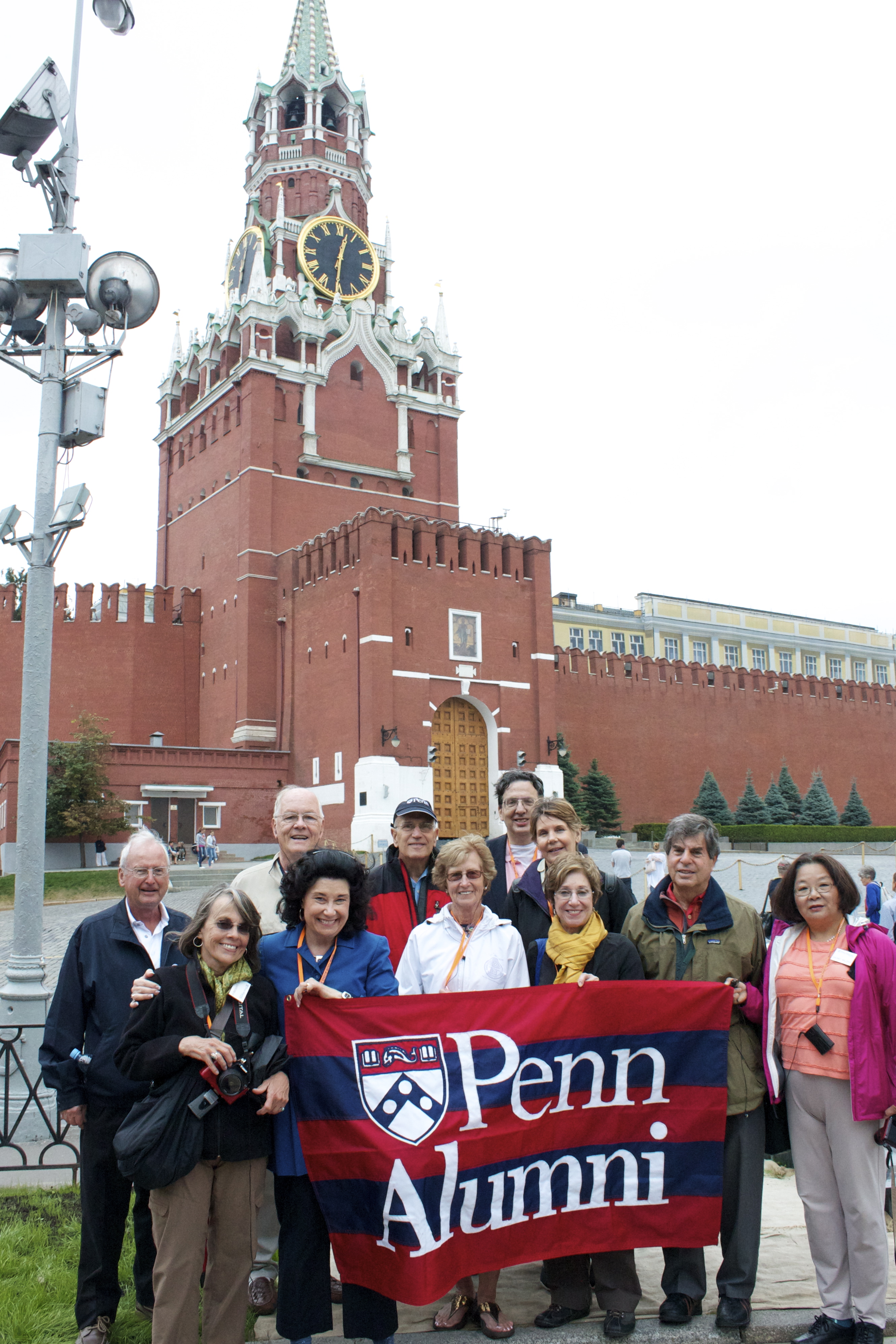
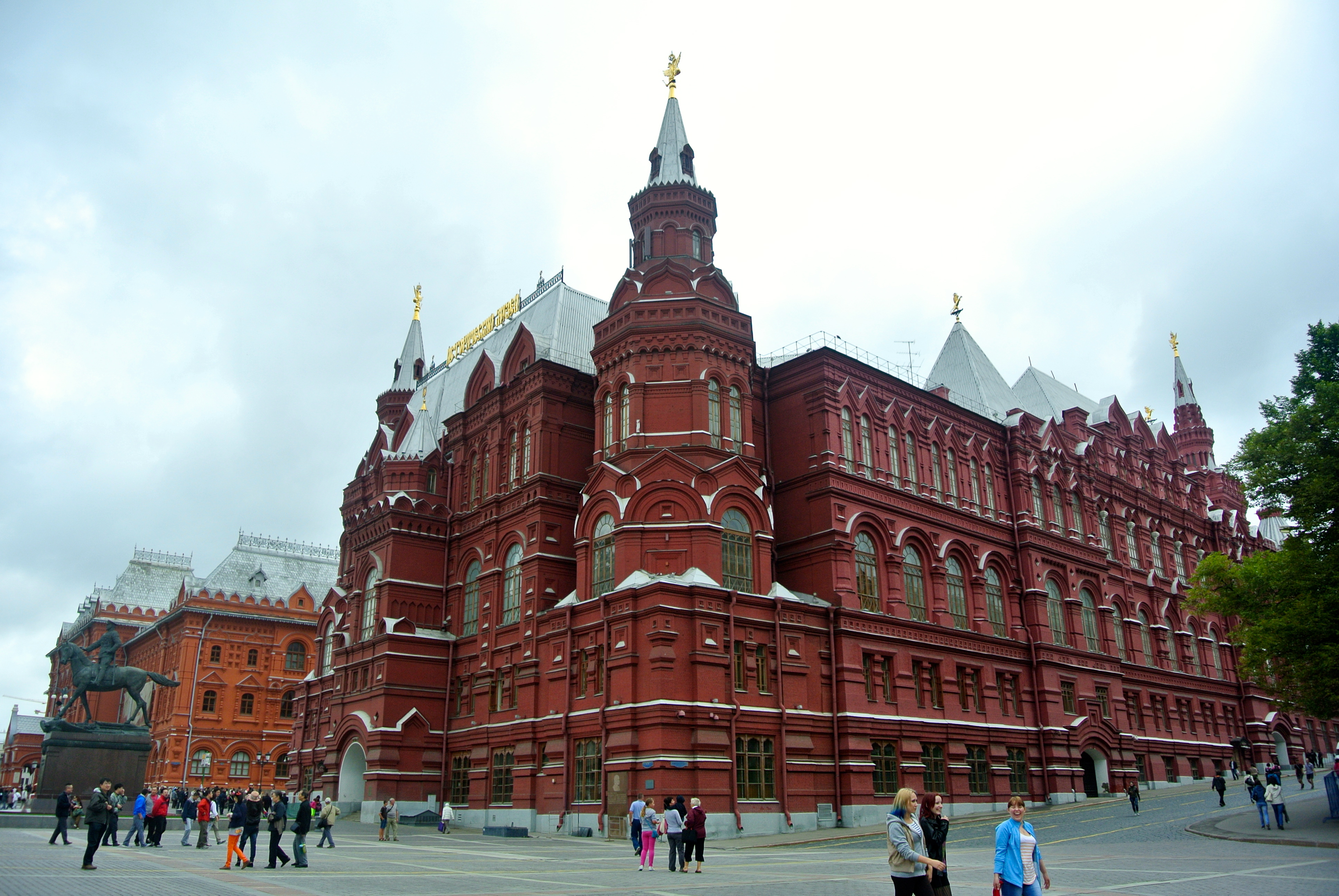
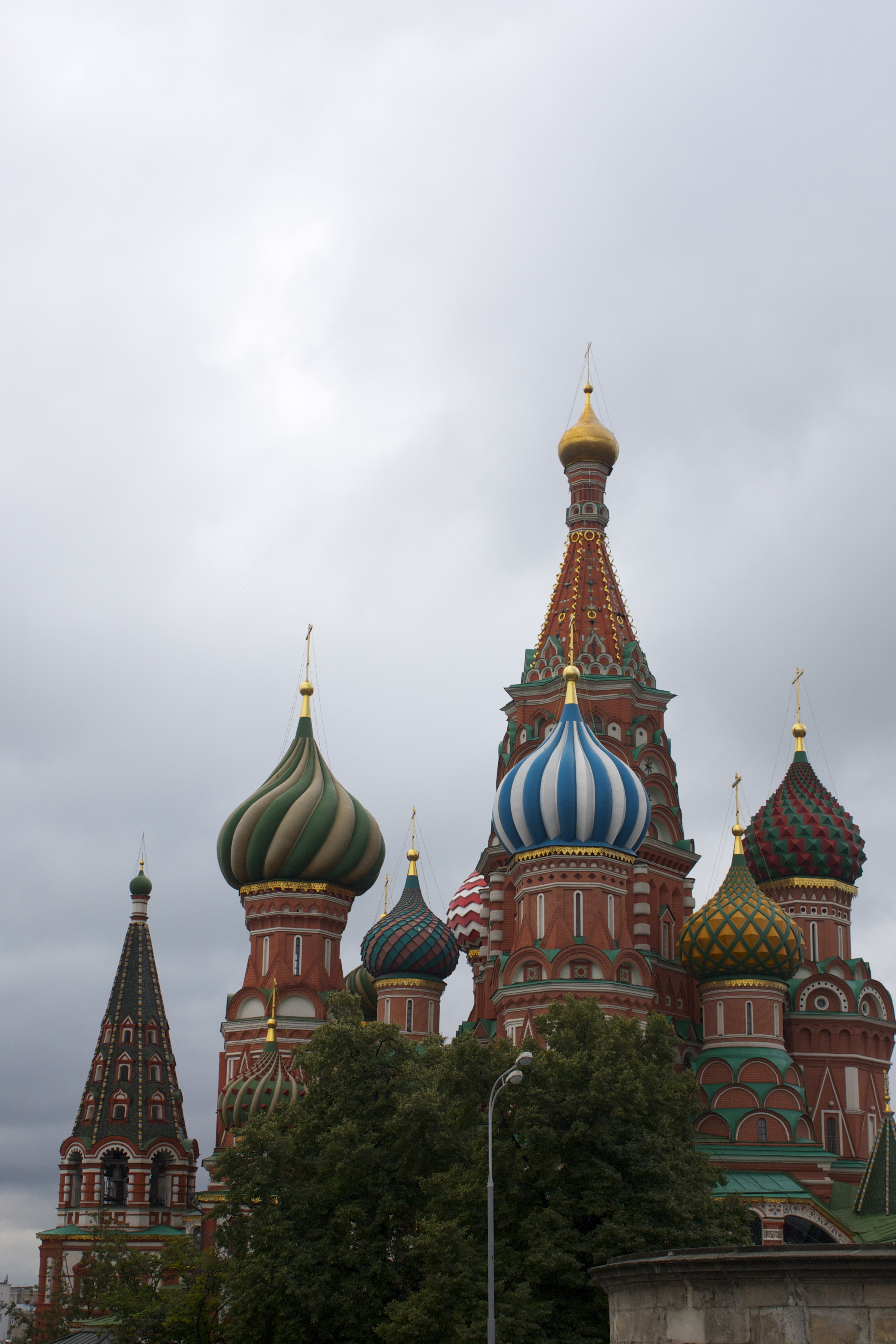
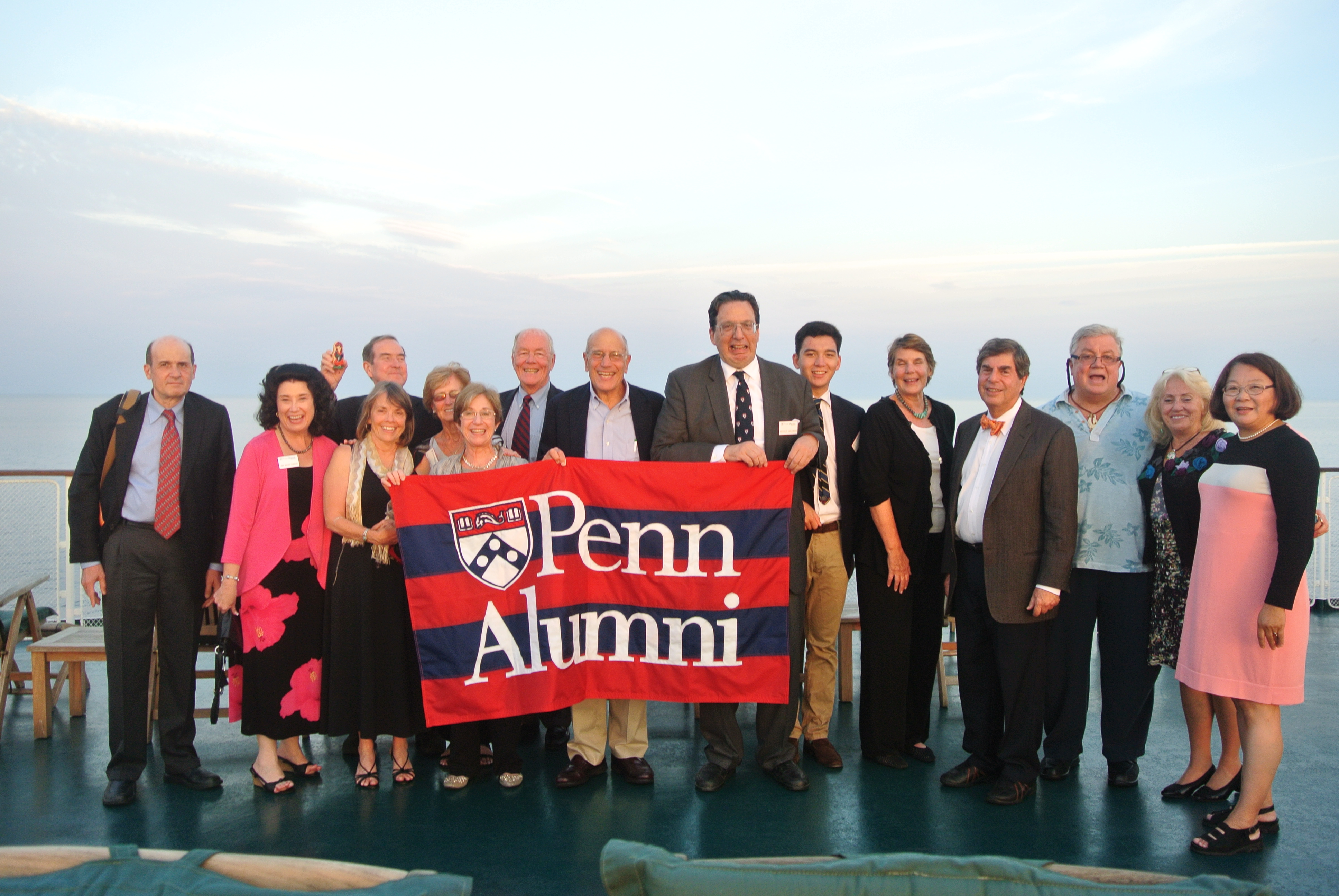
The next day was perhaps the busiest of the entire cruise: the Moscow city tour. It filled the full day and quite literally not a second was wasted. We started with Red Square (an old name: “Red” can mean “beautiful” in Russian). For decades it was chiefly known for the Lenin Mausoleum and burials around and in the Kremlin wall that forms its western boundary. Now we were told that Lenin, who was embalmed and displayed against his will (and over the protests of his wife whom Stalin menacingly dismissed saying “we can easily find some else to play the role of Lenin’s widow”), is to be buried, as was his wish, next to his mother in St. Petersburg, while the others—including Stalin—now buried nearby, and those in the Kremlin wall, will go to another cemetery, now under construction. Evergreens, already planted, will eventually mature to screen both the wall and the tomb from the square. The attention of the visitor will shift to St. Basil’s cathedral, with its multicolored, twisting onion domes—in front of which the Penn Alumni Banner was unfurled and a group photograph taken—and to the former GUM department store on the east side, now a collection of shops, boutiques, and restaurants. Perhaps the best of these is “Stolovaya 57” up an escalator, a clean and affordable cafeteria offering every sort of Russian comfort food. Many group members ended up there. It is rated seventh out of more than five thousand places to eat in the capital.
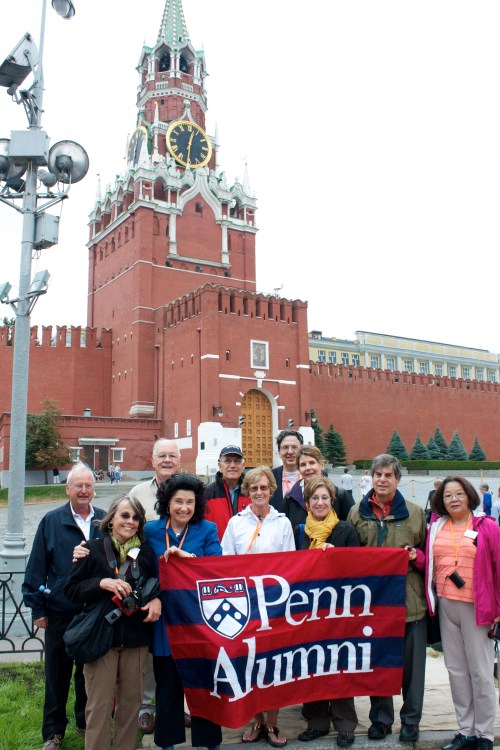
Proud Penn Alumni in Moscow.

Moscow- The Red Square
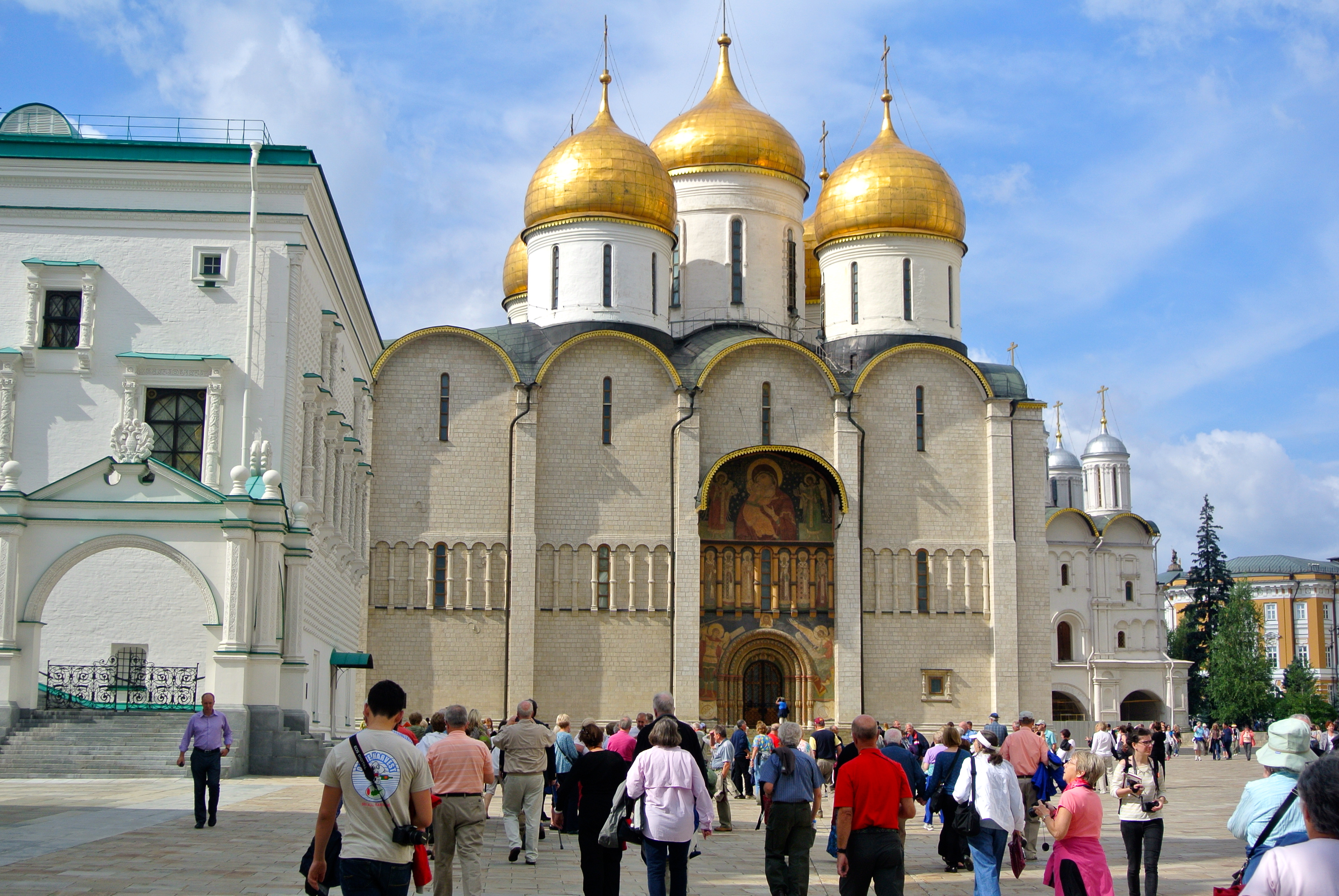
After lunch, we were off to the Kremlin where lines were long but whose treasures are well worth it. There we visited the Uspensky (Dormition) Cathedral, where all tsars were crowned as well as the armory museum. We made our way through a huge gallery containing the wasp-waisted wedding dresses of Tsarinas, and the formal attire of Nicholas II, the last Romanov Tsar. The high spot for me was found in the lower right corner of a case of precious crowns, including that of Ivan the Dread. This crown consisted of a circle of rich fur, surmounted by a small precious metal cap and cross obviously of great antiquity. “The shapka (cap) of Monomakh ?” I wondered to myself. I had heard of it in sophomore year at Harvard and lectured on it. It is a Central Asian crown, dating perhaps to the eleventh century, that demonstrates the continuity in ruling style, court etiquette, etc. from the Mongols and their nomadic forebears to the early years of the Muscovite Russian dynasty that emerged several centuries later. Other group members took real interest. This made my day more than worth it. I even sent an email to my old professor saying that I had finally seen the cap and that in my memory I could still hear him lecturing passionately about its significance.
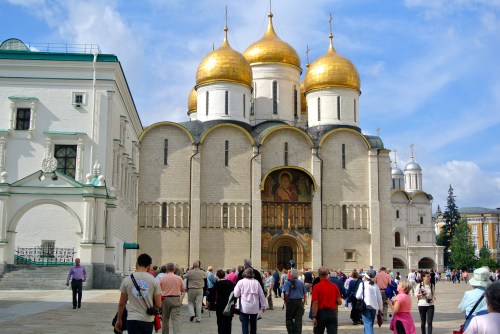
The Uspensky (Dormition) Cathedral.
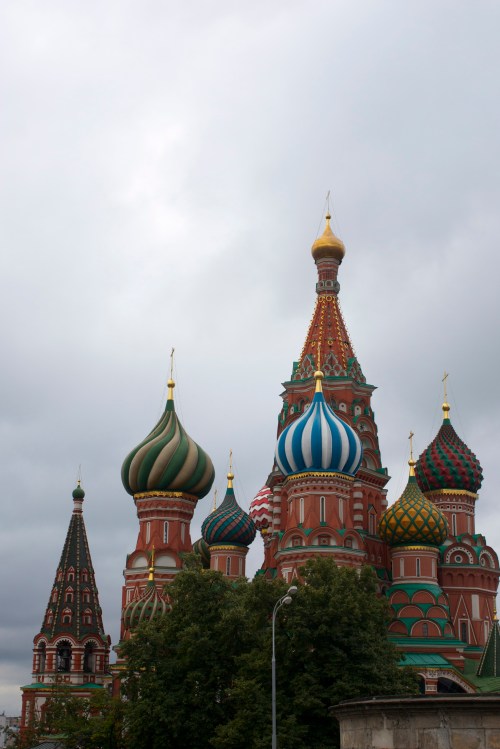
Moscow- The Kremlin.
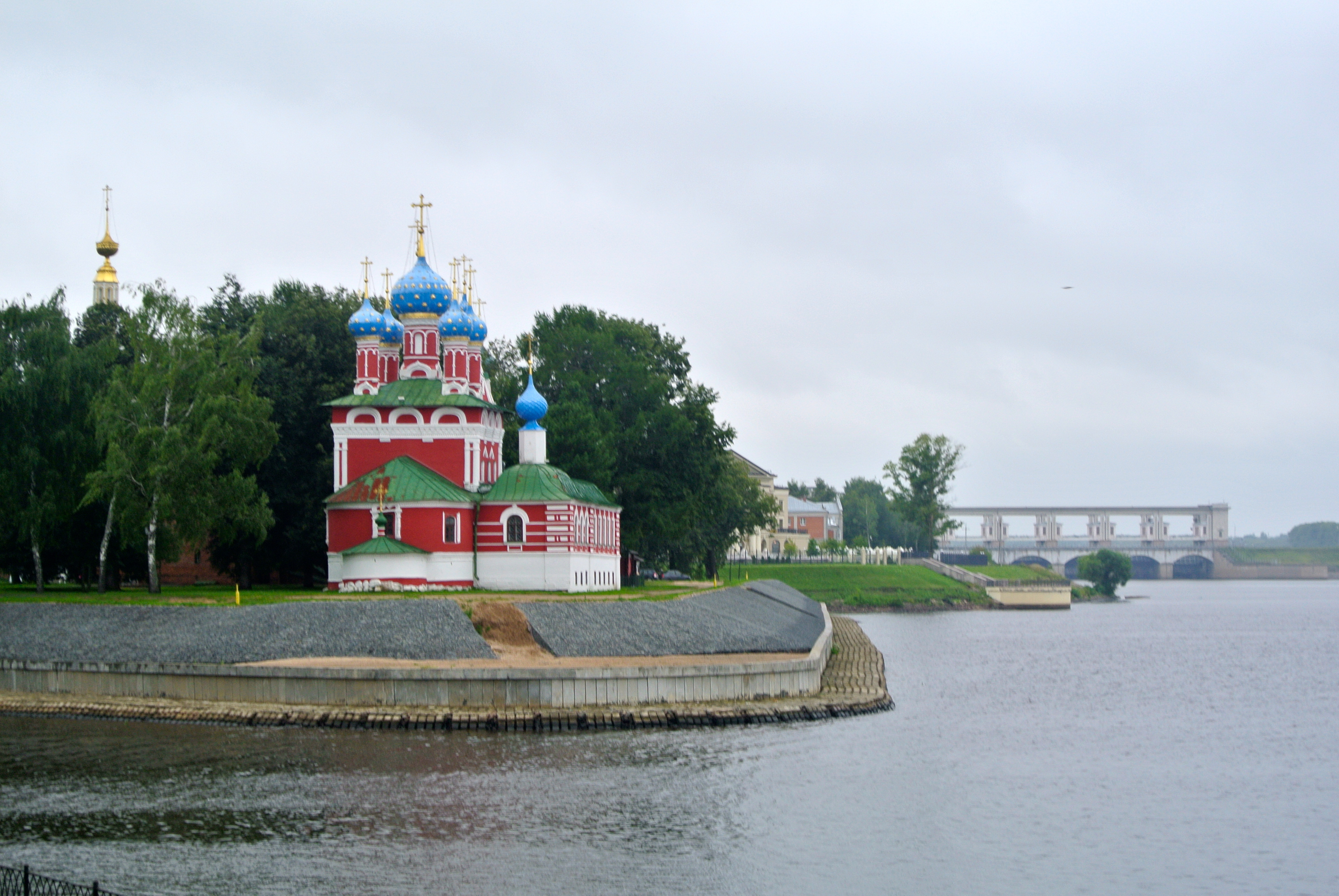
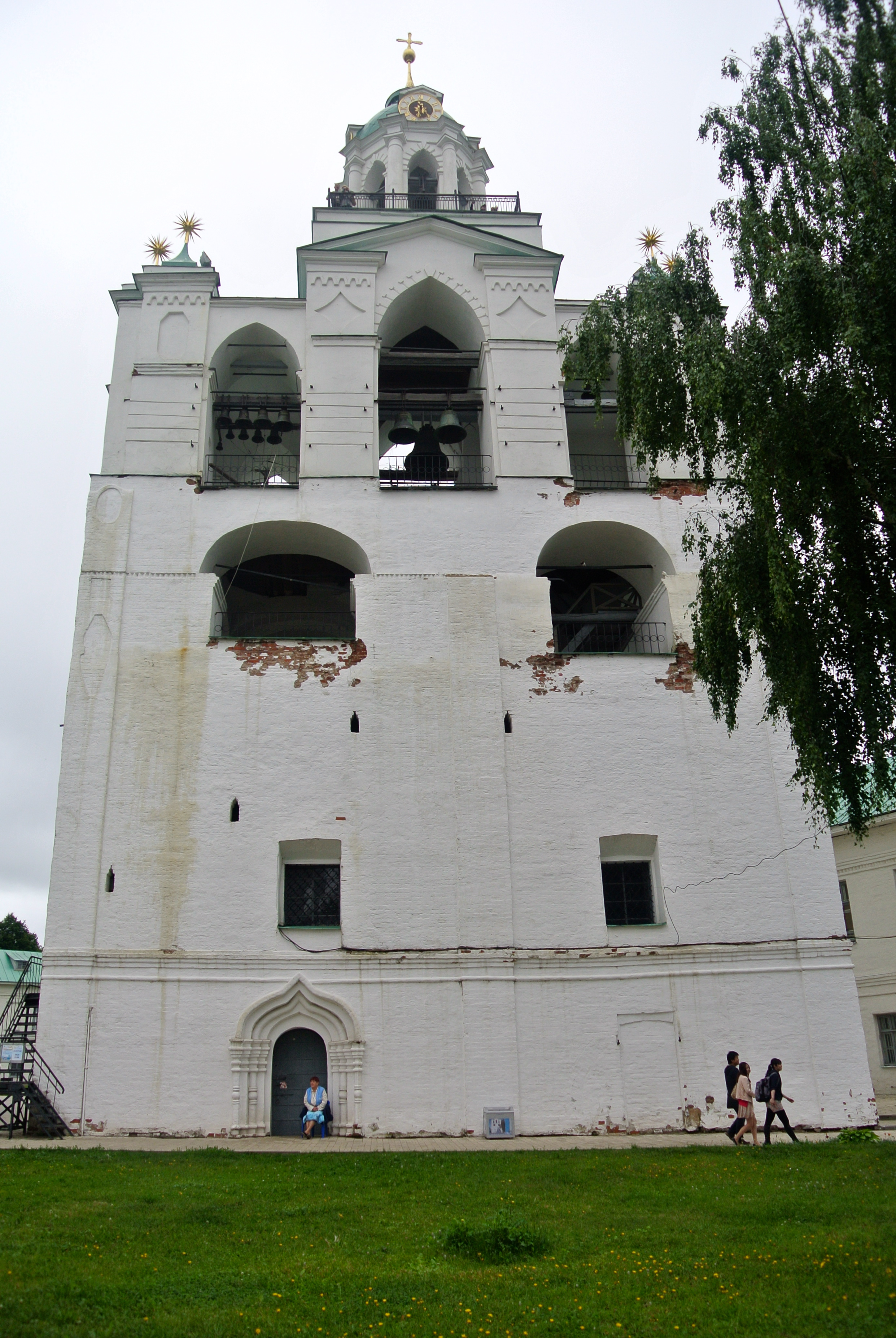
After cruising nearly all of the following day, which filled with a lecture (this one given by me on rivers, trade and the origins of the Russian state), group gatherings, briefing from the cruise director and the all-important lifeboat drill, we arrived at the ancient city of Uglich, famous as the place where the last son of Ivan the Terrible (or more accurately, “Dread”), Dmitry, had his throat cut–to this day no one can agree exactly how. This left Russia without a legitimate ruler, precipitating a general crisis known as “the time of troubles” which ended only in 1613, when Michael Romanov was elected by an assembly of nobles. He founded a dynasty that fell only with the disaster of World War I, three hundred years later. A church (one of at least two with this name) “on the spilled blood” was built where Dmitry was killed (it is said that the ambitious Boris Godunov, who sought to be Tsar, was the black hand, but this is not proven). It probably has not looked better since 1917. Then we stumbled on an actual liturgy in another church, with an amateur choir of five or so women, one with a toddler clinging to her knees. This small ensemble, singing like angels, confirmed my opinion that of all the liturgical music in the world, that of Russia is the most sublime.

Uglich from the river.
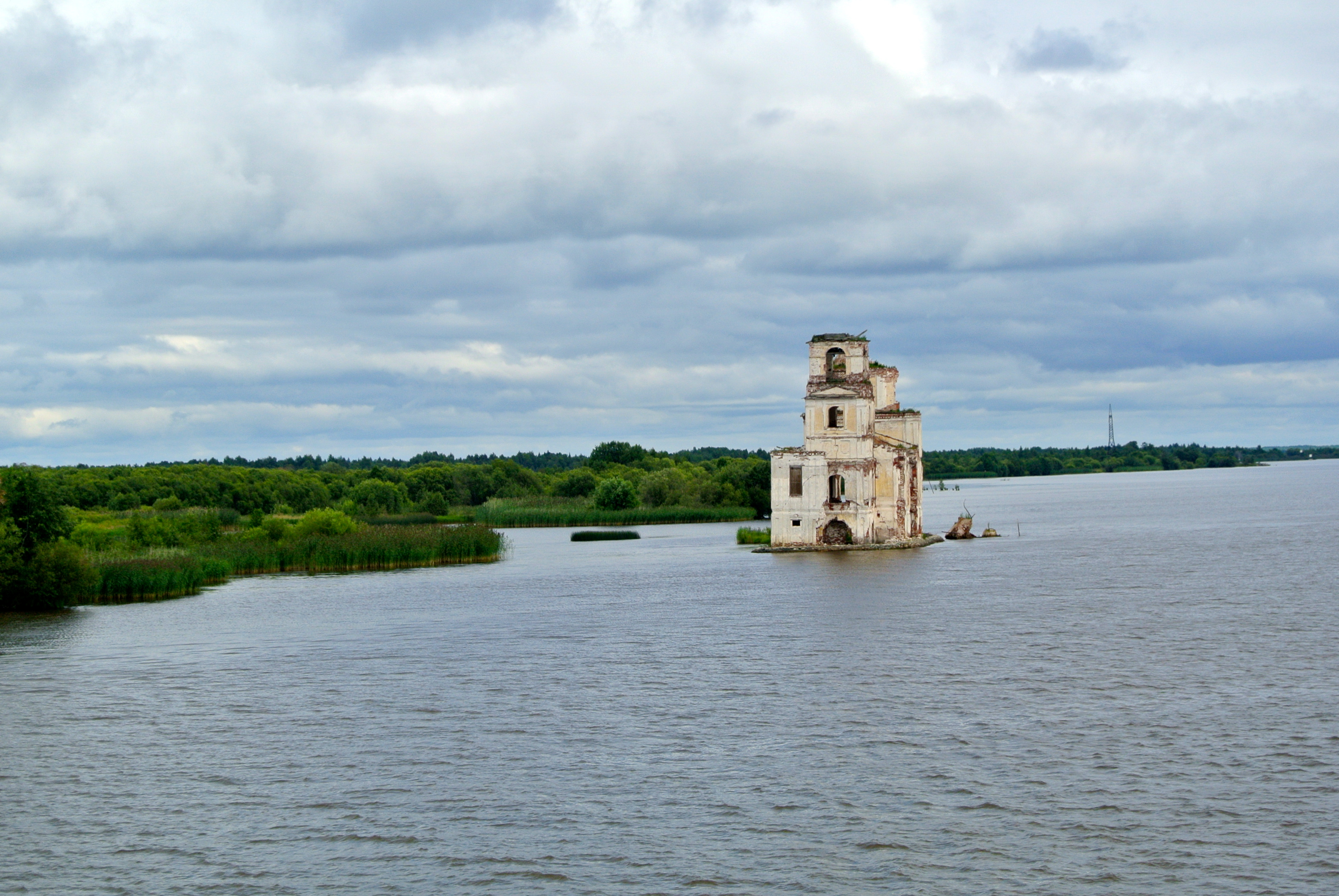
The scenery, as well as our guides, reminded us that the continuous waterway over which we were cruising was the product of a vast and destructive project to create the “Moscow-Baltic” canal, undertaken by Stalin in 1932-1937, and costing the lives of perhaps tens of thousands of forced laborers—as well as destroying much of great cultural importance. Thus, at Uglich, the oldest settlement on our route, the Intercession monastery and other buildings were dynamited to make way for what even the official map calls the “huge and ugly structure” of a hydroelectric station today. Nearby, in the midst of the navigation channel at Kalyazin, a neoclassical campanile from the destroyed Monastery of St. Nicholas rises some 244 feet over the Uglich reservoir. Other medieval buildings were submerged. Times have changed, however, and today Divine Liturgy is celebrated several times a year in this isolated and melancholy-seeming belfry.
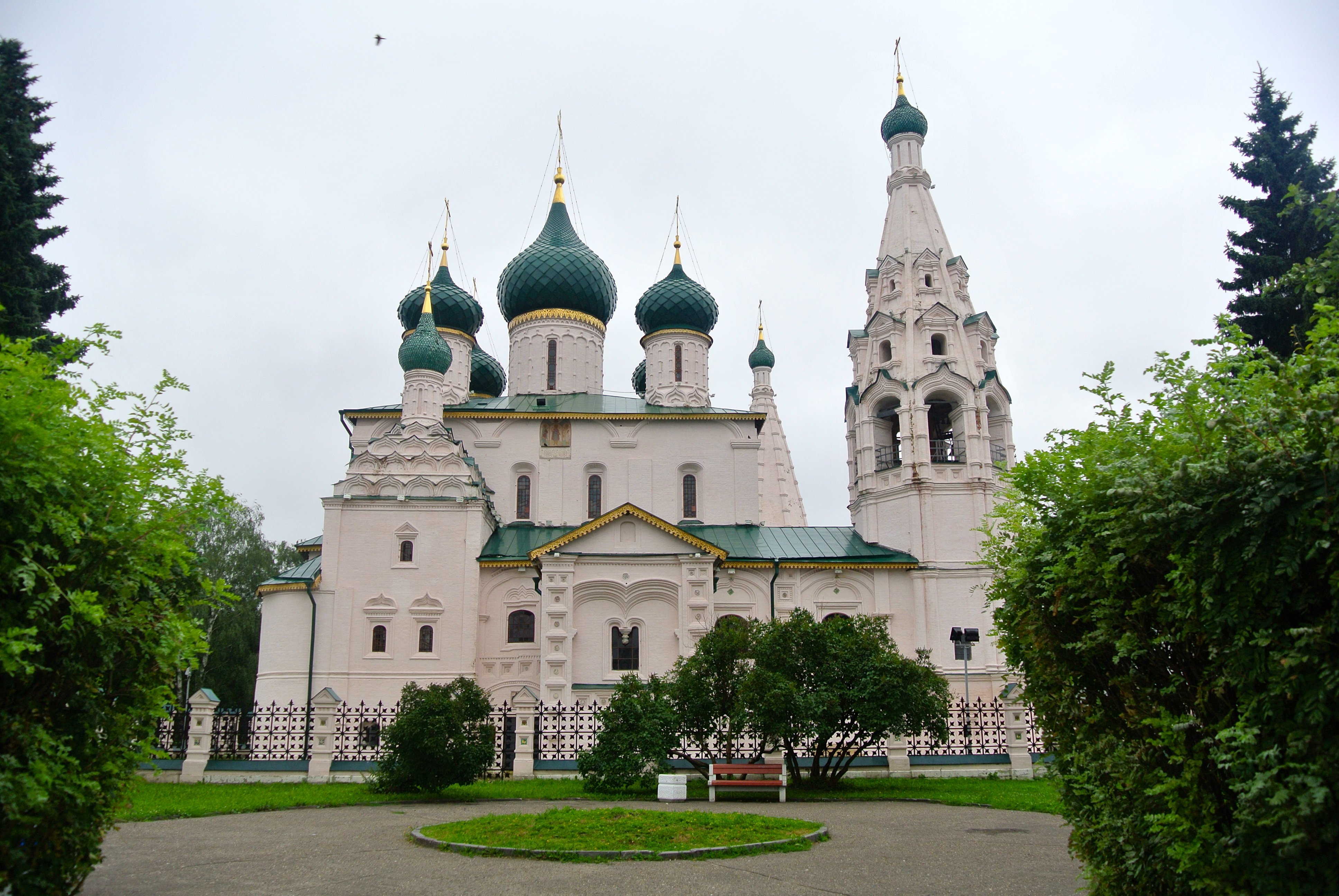
We were under way again by 7:30 PM and arrived at Yaroslavl in the middle of the following morning. This is a medium-sized city, having a population of nearly 600,000 and a provincial capital—of the province, our outspoken and amusing guide (she is a professor of ancient history) told us, it gave President Putin the fewest votes in the last election, and is thus very much out of favor (they elected a mayor and he was put in jail). Yaroslavl is home to many churches, including the impressive Cathedral of the Transfiguration, but perhaps most notably of that of Elijah the Prophet, in the city square, which many consider to be the most perfect example of Russian ecclesiastical architecture. In a nearby hall a group of five young men sang to us, unaccompanied, their sound beginning softly but then swelling to the full power, complete with the deep bass, that is so characteristic of Russian music, an expression we felt of the proverbial “Russian soul.”
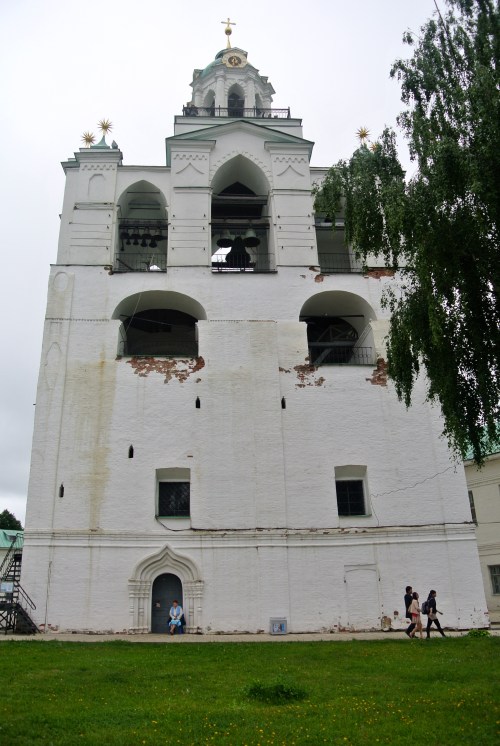
Cathedral of the Transfiguration in Yaroslavl.
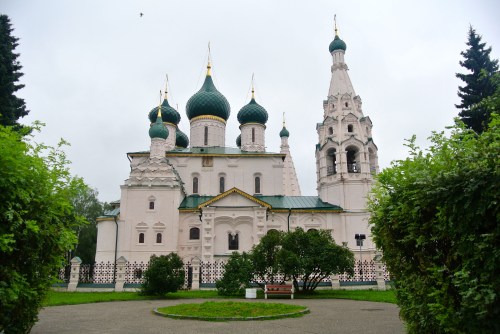
St. Elijah’s Church on the Central Square of Yaroslavl.
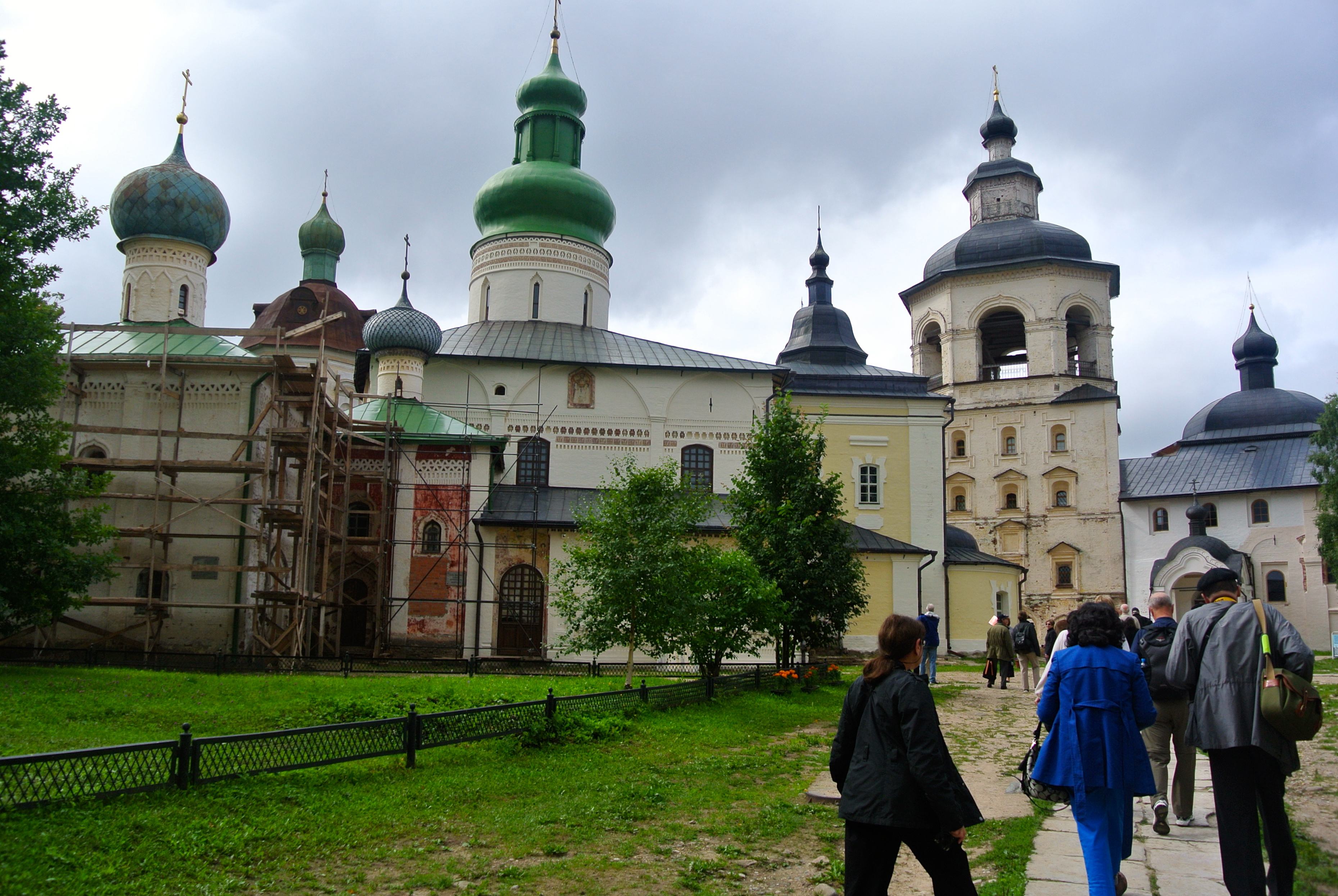
An afternoon and night of cruising brought us to Goritsy, the highest elevation, after Moscow, on our water route. The area is famous for its cluster of monasteries. The most impressive of these is the extensive and beautiful Kirillo-Belozersky, which the group visited.
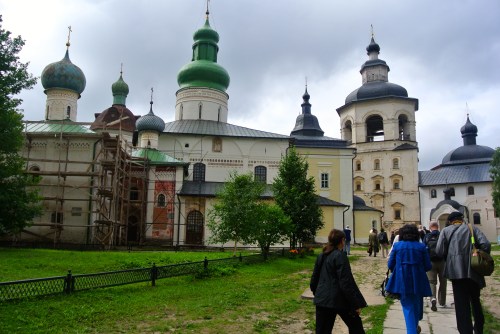
Kirillo-Belozerski Convent in Goritsy.
After Goritsy, the character of the cruise changes. Yaroslavl was on solid land, with some elevation though no real hills, beautiful, and even cozy–a great favorite of the group. Beyond, however, the landscape to my eye turned bleak, the same word another passenger chose to describe it. From Uglich to Goritsy, the towns stood above the rivers, on solid ground. Reeds, shrubs, and evergreen trees lined the shore.
A few miles beyond Goritsy, however, a series of six locks took the ship steeply downward toward sea level. Thereafter, we entered an uncongenial and barren landscape, flooded with water, dotted with numerous clusters of reeds, then hummocks on which shrubbery eked out an existence, followed by scrawny evergreens as far as the eye can see. One passed few traces of human habitation. Ecologically, the evergreen-birch-reed-mud-water system is very poor. Even if you can find soil, it is not fertile. It was a jolt to recall that it was in such a forbidding landscape that St. Petersburg itself was built, on mud and pilings, by diktat of Peter the Great in 1703, at a cost of serf laborers estimated at 100,000 or more dead.
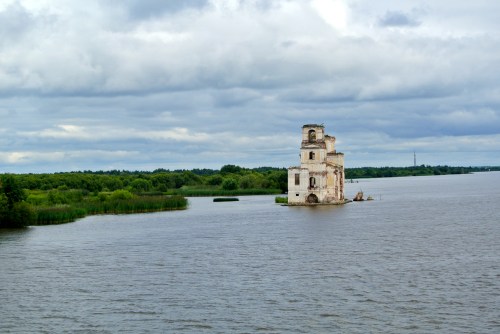
Traveling past Goritsy and down towards sea-level.
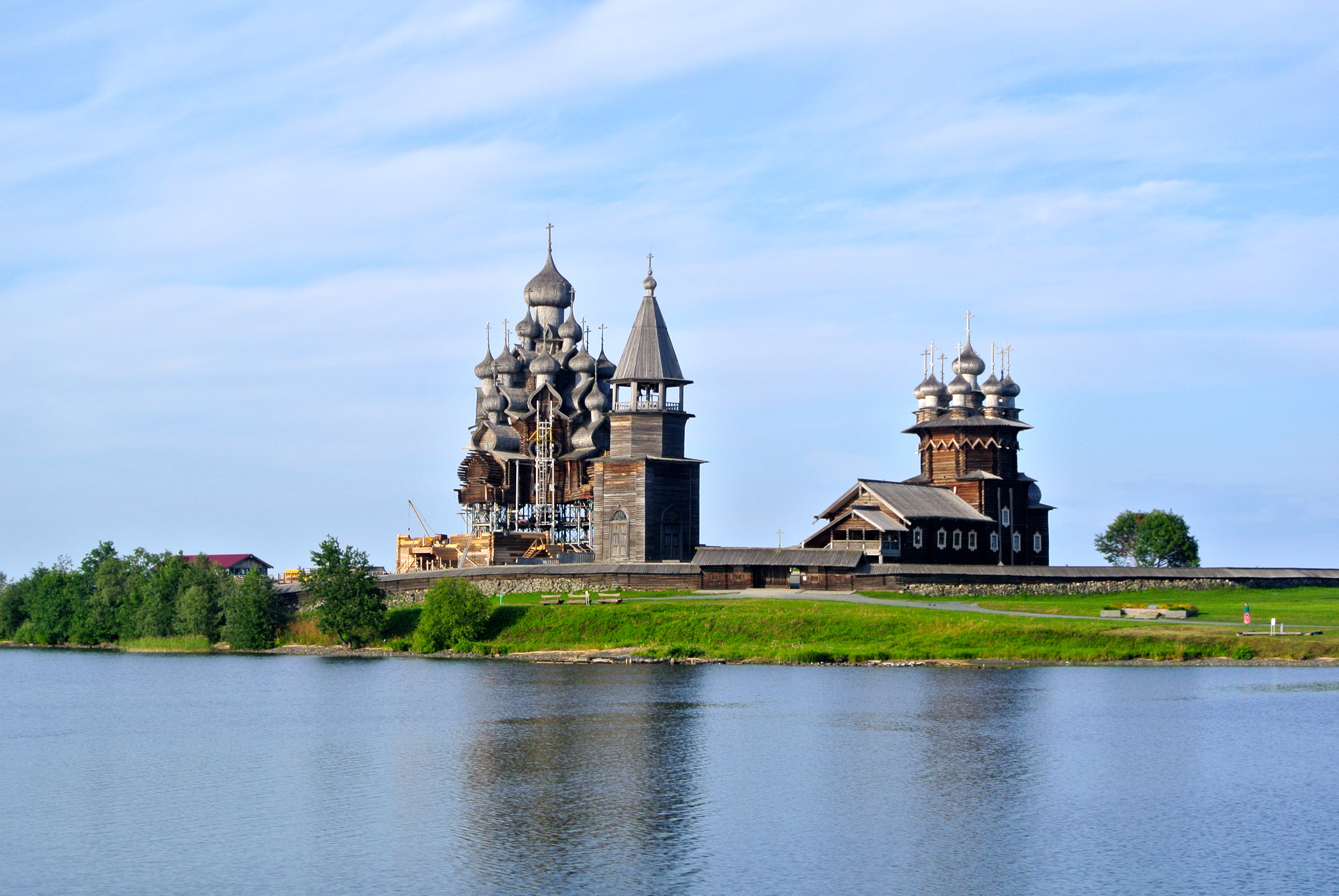
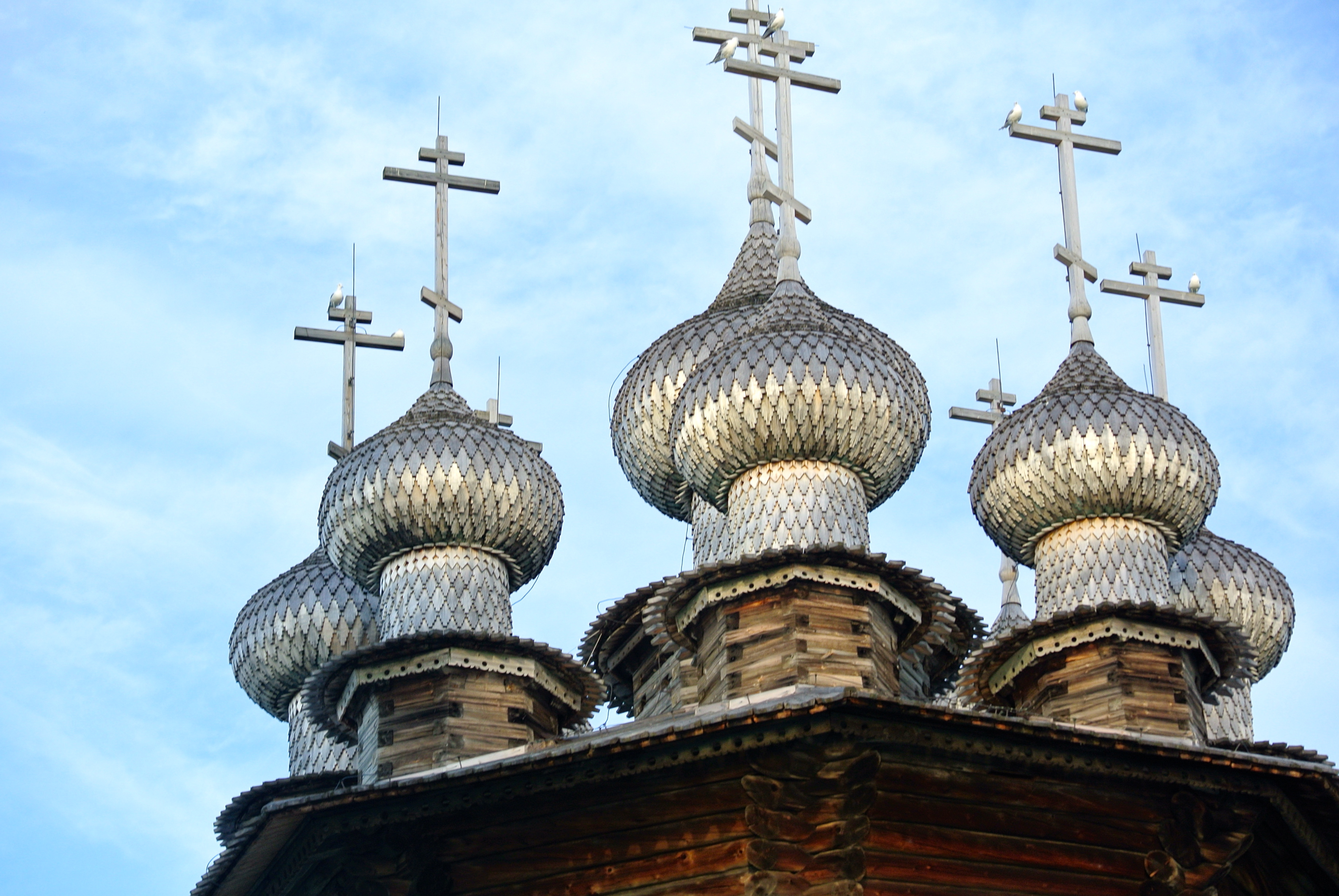
Following the canal we came to Lake Onega, the third largest body of fresh water in the world. In the lake is Kizhi island, a museum of Russian wooden architecture, all built without nails, including the Transfiguration Cathedral and the Church of the Intercession, both capped with rank upon rank of partial domes. There is also a small wooden chapel so perfect it could be in a picture book, a windmill, and a peasant house. The latter is rather ample in size. The “izba” which we were told meant sleeping, sitting, and living room, seemed very cozy and comfortable, with a big block-like heater about half the height of the room. On the top were furs, so that the oldest and youngest can sleep with its warmth. It is also used for cooking and heating the room.
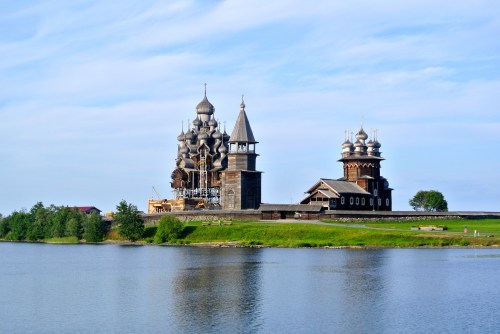
The Transfiguration Cathedral and the Church of the Intercession on Kizhi Island.

Close-up of the domes.
For all the seeming coziness of this dwelling, however, one must remember that the serfs, who comprised more than ninety percent of the Russian population until they were liberated in 1861, were tied to the land, and deeply impoverished. It is thought that famines struck about once every seven or eight years. From the agricultural labor of the serfs derived all the opulence and wealth of the nobility and royal house. But massive starvation–tens of millions dead in the countryside–came only with the Soviets and the confiscation of food from the rural people to feed the new and growing populations of industrial towns.
We walked through Kizhi at about eight in the evening. In the summer, the sun at that latitude does not really set. So at that hour the island was enchanting– fragrant pasture, the wooden buildings loosely grouped at one end, water all around. A fireboat sits just at the shore of the island at all times–I hope and expect they have elaborate detection and extinguishing systems. Word was that today Kizhi is on the international itinerary, and that huge ships, for example from the Norwegian line, dock there, with thousands of passengers at a time. By arriving late (fog had kept us immobile on the river for many hours over the night) we avoided such a nightmare.
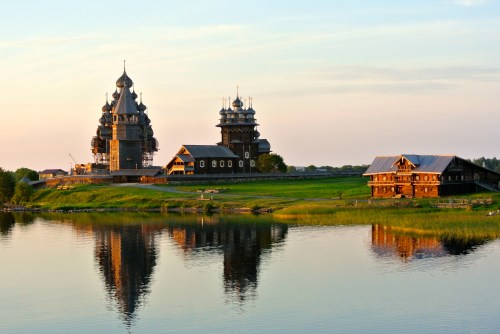
Kizhi glowing in the eight o’clock light.
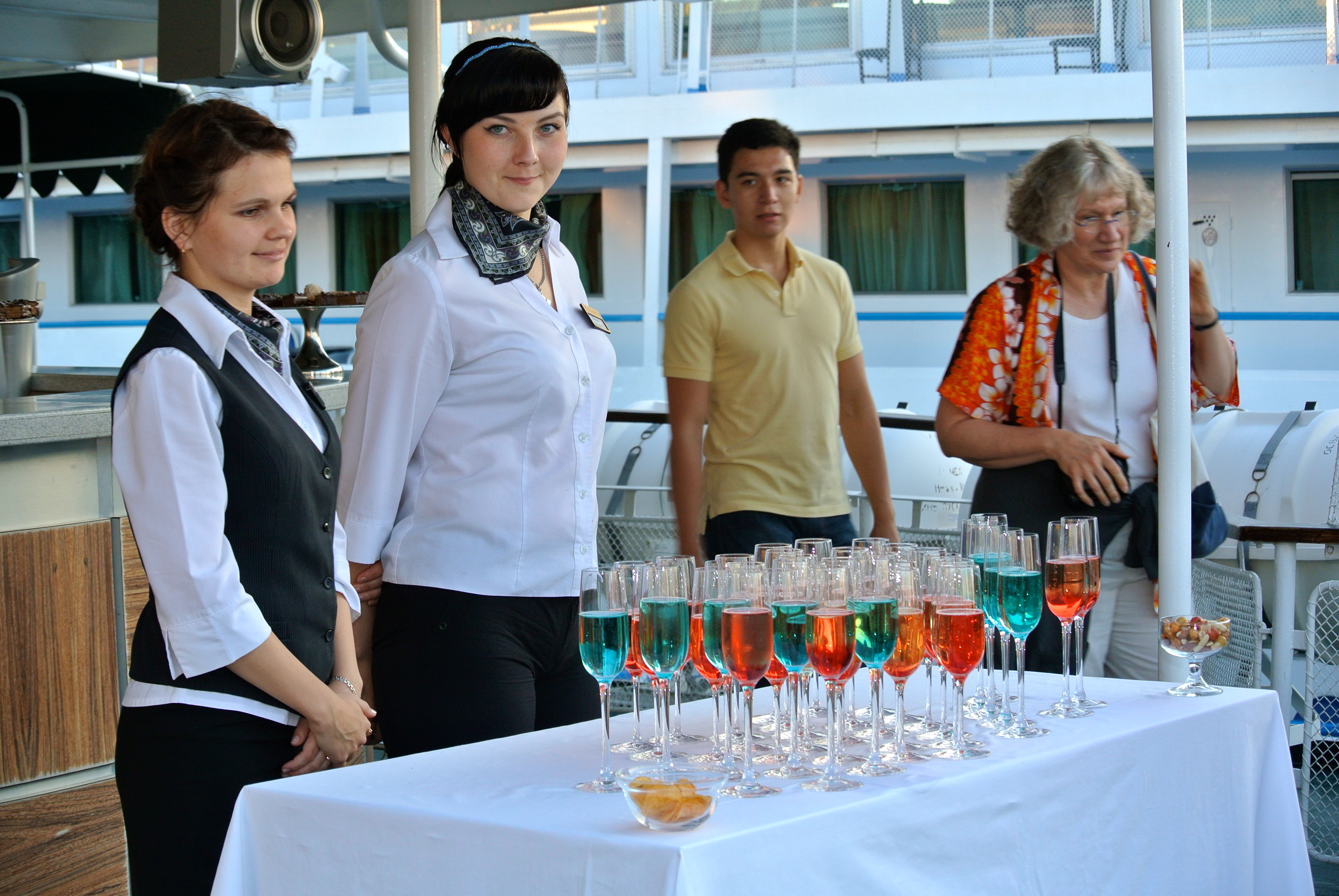
Not only that. Our late return drew many passengers to the top deck, where colored champagne was provided, and music. Soon passengers were dancing. The ship slowly and gently pulled away. The party continued, against the incomparable background of the ancient wooden buildings glowing in the rays of the slowly setting sun, as their images were reflected with great clarity on the still waters of the vast lake. It was a magical moment.
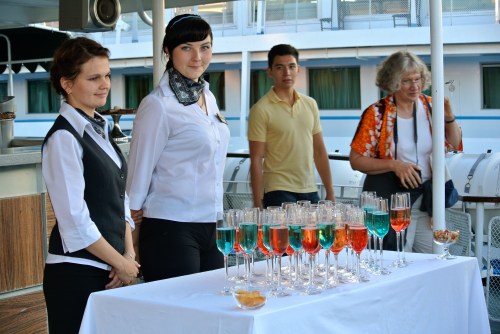
The crew offers passengers colored champagne as they depart Kizhi.
On the Svir river, which connects Lake Onega to the even larger Lake Ladoga is a low-quality “old Russian” theme park called Mandrogi, constructed by a friend of Mr. Putin. It promises blacksmiths and weavers demonstrating their ancient crafts (they were not at their posts when we visited), but in fact consists mostly of food stalls and souvenir shops, as well as an array of luxury villas, one of which is reportedly the favorite of the Russian president. No one was fooled by this “man made tourist trap” as one reviewer describes it. The passengers were back on the ship in a flash. They had paid good money for a first class tour, and this did not belong. But we learned that Mandrogi was, by government fiat, a legally obligatory stop for all Volga cruises, so nothing could be done.
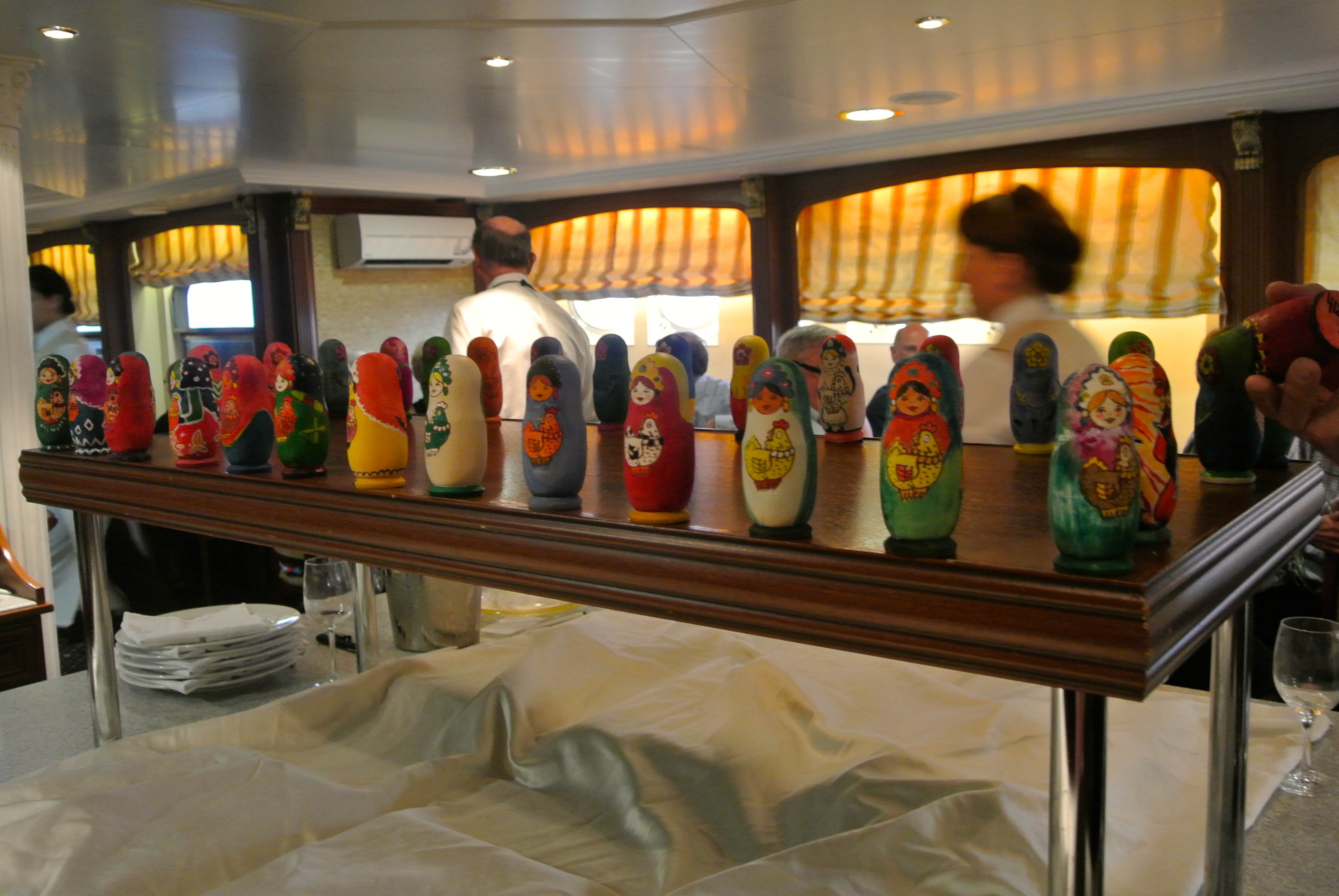
Mandrogi was followed by a vodka tasting and a farewell dinner at which the peerless Kira, the ship’s cruise director, introduced many of the ship’s key personnel, from captain and chief chef to housekeepers and the kitchen staff, all to thunderous applause from the passengers. I am proud to say also that in the Matryoshka doll painting competition our Penn experts took first and third of the three prizes. Indeed, as I observed the groups, I found ours perhaps the most active (they attended all the lectures) and certainly most deeply engrossed in serious conversation at mealtime. We reached St. Petersburg the following morning.

Penn alumni win first and third prizes in the Matryoshka doll painting competition.
The city is of an indefinable and elusive beauty: a network of rivers and canals that catch and transform in their seemingly fathomless waters every fugitive shift of color and mood of the northern sky. Its largely nineteenth-century buildings have mostly been repainted in characteristic bright, sometimes pastel, colors. But to see it all would take weeks.
We spent our first morning visiting the Catherine Palace at Tsarskoye Selo (“The tsar’s village” also called “Pushkin”), a clear attempt to overshadow even Versailles, with gold and gilding laid on thickly everywhere, parquet floors, and great high windows that fill the interior with the pure northern light. The palace was long celebrated for its room lined entirely with semi-precious Baltic amber. Hitler’s forces had packed up the whole room, which was then never seen again, before setting the palace ablaze as they retreated in 1944. Over the following decades roughly fifty of the original one hundred fifty rooms of the palace were restored, As for the most famous of them, in 2003 a meticulous restoration was completed and the fabled Amber Room was reopened.
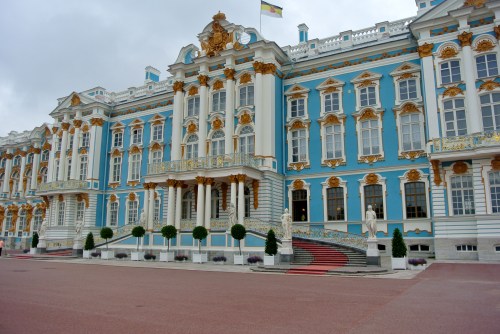
The Catherine Palace at Tsarskoye Selo, St. Petersburg.
The visit concluded with a lunch overlooking the garden, where we enjoyed an energetic display of Russian song and dance, with clackers, accordion, soaring female voices and one classic Russian bass—all from just four people.
In the afternoon we visited St. Isaac’s Cathedral, which one imagines was designed to rival St. Peter’s in Rome. Its huge dome, on a tall cylindrical base, dominates the city skyline. When we visited, the Cathedral was ringed with dozens and dozens of tourist buses—more than I have ever seen in one place except the Great Wall of China. But once inside one scarcely felt crowded: the building can accommodate 14,000 worshippers.
We also explored the Fortress of St. Peter and St. Paul, one of the earliest structures built in St. Petersburg, and, in a rather western looking cathedral having a golden spire, the burial place of all the tsars since Peter the Great. The entire imperial family was murdered in 1918 in Yekaterinburg, in the south, as they fled, and their bodies thrown down a dry well and covered with acid and then cement. In the last days of communism the house where the murders took place was demolished, lest it become a shrine of sorts (irony of ironies, an Orthodox memorial chapel now stands on the site). All the remains have now been recovered and their identities confirmed using DNA. Today the entire group—Tsar, Tsarina, five children (including Anastasia) and four attendants (one a doctor) who refused offers to be allowed to leave them–rests in special chapel in this cathedral, with fresh flowers. Both Nicholas and Alexandra are now martyrs and saints of the official Russian post-Soviet Orthodox Church.
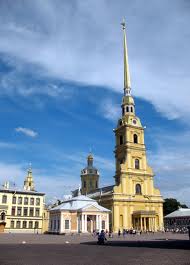
The Fortress of St. Peter and St. Paul with its tall spire.
Also in St. Petersburg, the shrine church of “The Savior on the Spilled Blood,” is beautifully restored and full of visitors. This marks the spot where Alexander II, the “tsar liberator” who freed the serfs and was well along in planning more constitutional reforms, including the more liberal Loris-Melikov constitution he had signed that very morning, was murdered in 1881 by the terrorist “People’s Will” organization—perhaps the single most important setback contributing to the throwing of Russia off the constitutional democratic track. (The Tsar’s son Alexander III was a narrow-minded disciplinarian who promptly rescinded the new constitution). Fresh flowers mark the place on the sidewalk, now enclosed by the church, where the Tsar collapsed after he had survived a first bomb in his armored coach, gotten out to see if he could help, was hit again, and then fallen to the ground. Returned to the palace, he died a few hours later.
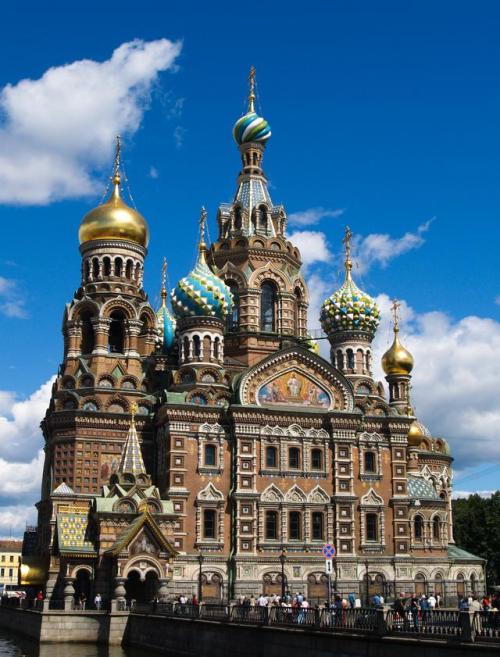
The shrine church of “The Savior on the Spilled Blood.”
That evening in St. Petersburg many passengers stayed in town for dinner and entertainment. A rollicking Russian folk show was available, along with the Swan Lake ballet. Our guides showed us some fine and inexpensive places to eat—a Belgian restaurant proved particularly good—but quite naturally some chose to splurge on caviar, champagne, and the works at the queen of St. Petersburg hotels, the legendary Evropeiskaya, or Grand Hotel Europe, built in 1875.
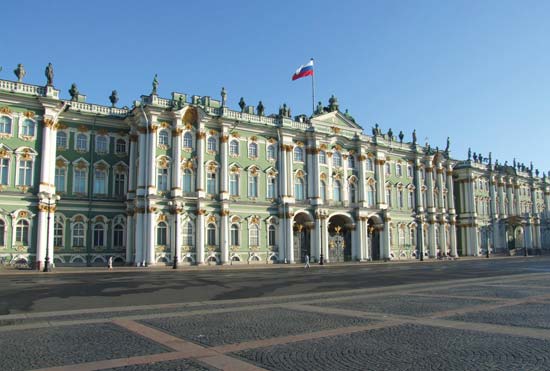
Even so, nearly all were on board early the next morning for special entrance into the Hermitage Museum before the public was admitted. This is of course one of the three or four most important museums in the world and the guides did a splendid job. My colleague from Columbia University Michael Stanislawski also found in the vast building several rooms of modern Jewish art—somewhat unexpected, but an indication, he said, of the status of Jews in Russia today, which is not perfect, but better than it has been in a very long time.
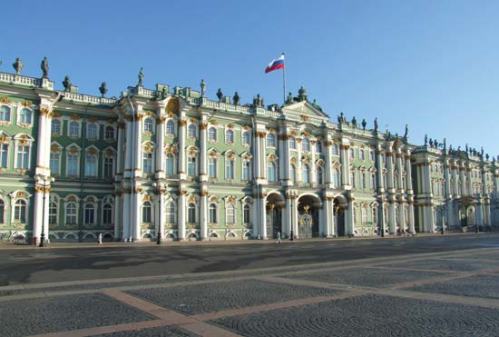
The Hermitage Museum in St. Petersburg.
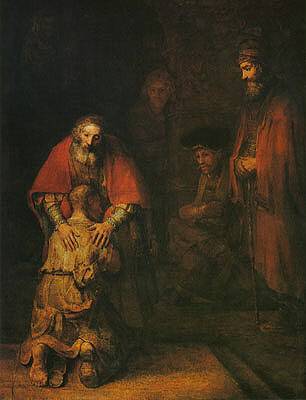
Return of the Prodigal Son by Rembrandt van Rijn (c. 1669). One of the many masterpieces held at the Hermitage Museum.
The finale was a hydrofoil trip across the Gulf of Finland to Peterhof, the palace started by Peter the Great. It has extensive grounds, with great water cascades and statues, as well as “tricks” put in place long ago—points where a footstep will earn the incautious visitor a squirt of water in the eye, or something similar.
All in all it is difficult to imagine a Russian trip in which better use was made of time. Or one with a more congenial, enthusiastic, and well-educated group of passengers. Although we saw far from everything, we were guided unerringly to the most important attractions. Our six lectures ranged from the doctrines of Orthodoxy to Chinese-Russian relations, and were presented by Michael Stanislawski, John Meffert of the National Trust for Historical Preservation, and myself. Our local guides were superb, as was the travel agency staff, who seemed omnipresent and all-competent. The ship is a gem and the itinerary endlessly interesting.
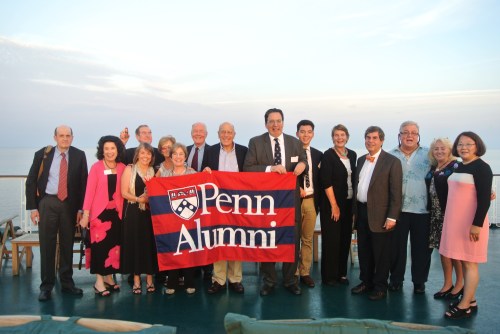
The superb Penn group aboard the M.S. Volga Dream.
Every member of our group will have his or her unique and valuable memories of the trip, and insights and reflections drawn from them. Permit me to conclude with some of my own.
For those who, like this writer, remember Soviet times vividly, the experience was an astonishing revelation of how much Russia has changed, mostly but not entirely for the better, since the end of Communism in 1991. It was a reminder as well that history is full of real surprises, in this case one on a scale such as to overturn almost all of the accepted wisdom (and copious writings) with respect to Russia of most of the twentieth century. If I had told my college professor of Soviet History back in 1970 that in the year 2000 Tsar Nicholas and his wife Alexandra would have been proclaimed martyrs and saints of the Moscow Patriarchate of the Russian Orthodox Church, he would have thought me simply mad. The thought was beyond inconceivable. It is all a salutary lesson too for historians and others a little too sure of themselves and of what they believe, as well as a memento mori for aspiring social engineers.
On the other hand the changes are understandable and in retrospect (always retrospect!) seem to have been essential. The economy, though riddled with corruption, inefficiency, and personal dealing, particularly at the top, is now fundamentally free and dynamic, and like nearly all the others of the former Soviet bloc (Belarus is a clear exception) comparable to the leading economies in the world. The Soviet Union had been, in the words of its own leaders, “stagnant”—which is why Gorbachev was summoned in an attempt to re-instill vigor.
The changes in Russia remind us of something else important too. This is that progress need not be a headlong leap into an unknown future that seeks only the new and novel. Restoration of that which has been lost or destroyed is also progress. In communist days life was hard; food, housing, and consumer goods were scarce; all sorts of freedom, intellectual and religious not least, were lacking, while information was impossible to obtain. At the same time, though the standards at the great Russian universities, conservatories, orchestras, ballet companies, and research laboratories—the level of non-political culture in general—was maintained among the highest in the world.

Swan Lake advertised in St. Petersburg.
It is scarcely surprising that after seventy years of the attempted imposition of the originally German doctrines of Marxism without success (they have failed wherever they have been tried) coupled with decades of sustained attack on the culture Russians had always cherished (and for which it became clear nothing could be substituted, despite grandiose efforts and abundant coercion), the Russians should return to their past—which includes the Orthodoxy (with state patronage of course, but that is not the whole story, for the state seeks legitimacy and popularity through its largesse), whose revival I found perhaps the most striking revelation of the trip, but not that alone. The list of changes is very long. Several of us concluded that Russia was not yet out of the wood, but was steadily moving closer to its edge.
In forty years, as a professor and before, I have traveled a great deal, including five visits to Russia, one for a semester as a student in the vanished Leningrad. I knew from the start that “Waterways of Russia” would be something new and memorable. I had expected the fellowship and intellectual sharpness of the Penn group would be an endless source of pleasure, which it was. What I did not suspect, however, was how deeply what we saw would stir and move me. Russia is an ancient country and one I had known, in its Soviet form, and through émigré teachers and friends, since high school. Yet here it presented itself, clearly the same place it had been forty years ago, yet changed completely—bright with the splendor and beauty of its ancient culture restored, the streets alive with people and commerce, guides and colleagues speaking freely as never before. Russia had shed the incubus of nearly seventy years and was herself again. For a historian this provided much to ponder, and for a confessed Russophile, a sort of joy of which I had never dreamed.
I suspect that other passengers may have had similarly deep, or for that matter quite different, reactions. Whatever the case, I know that for me, and I hope for our group, “Waterways of Russia” was a high point of my life.

Food aboard the M.S. Volga Dream.
[Interested in traveling with Penn Alumni Travel? Visit our 2014 schedule here. Professor Arthur Waldron will be joining our 2014 Black Sea Cruise.]













![One of my favorite pieces in the show was this, "Jami Swimming II," by Adrian Frankel Giuliani. Check out her work at [www.adrianpastelportraits.com].](https://franklypenn.com/wp-content/uploads/2013/10/jamiswimming.jpg)









 Frankly Penn