November 5, 1895

Author: Janell Wiseley


This may look like an ordinary trowel, but it is no such thing. This trowel was used to lay the cornerstone of the Dormitory Quadrangles on November 5, 1895.


trowels

Courtesy of the University of Pennsyvlania Archives and the Penn Facebook page.

Leave a comment

Filed under Campus Life, Historical, Memories of Penn

Two Weeks

Author: Carolyn Grace, C’16

It’s a shame that my job has me blogging only twice a month.  A lot can happen in two weeks, especially when you’re a Penn student.  These past several days were particularly buzzing with activity, so I’ve decided to make this post a re-cap of what I’ve done since my last post.  Enjoy!

October 22nd – 25th: Going GrΣΣk

This year's Greek Week logo

This year’s Greek Week t-shirt logo

As a Junior Delegate on the Panhellenic Council, I helped organize this fall’s Greek Week.  Panhel, IFC (Interfraternity Council), and MGC (Multicultural Greek Council) sponsor a week of academic, social, and philanthropic events for the Penn Greek community each semester.  This year, we hosted a Penn Faculty Speaker Series, an Academic Bowl trivia game, a dodgeball tournament, and a Meet the Greeks BBQ.  The events were really fun, and they did a great job of bringing together the various frats and sororities on campus!

October 27th: Running for the Cure

After 13 years of playing purely water sports, I decided to run my first ever 5k: the Rena Rowan Ribbon Run.  The final Greek Week event, the Ribbon run benefits the Rena Rowan Breast Center at Penn’s very own Abramson Cancer Center. The Rowan Center provides all clinical services a woman facing breast cancer may need; including integrated cancer treatments, psychosocial counseling, cancer risk evaluation, and nutritional counseling.

SK at Rena Rowan!

SK at Rena Rowan!

I ran in honor of my Mom, whose strength and knowledge of her diagnosis brought her to theAbramson Cancer and Rena Rowan Breast centers.  Some fellow Sigma Kappa sisters joined me, and our team ended up doing extremely well!  We placed 1st, 2nd, and 4th overall in the Women’s division, and we won Best Sorority Participation!

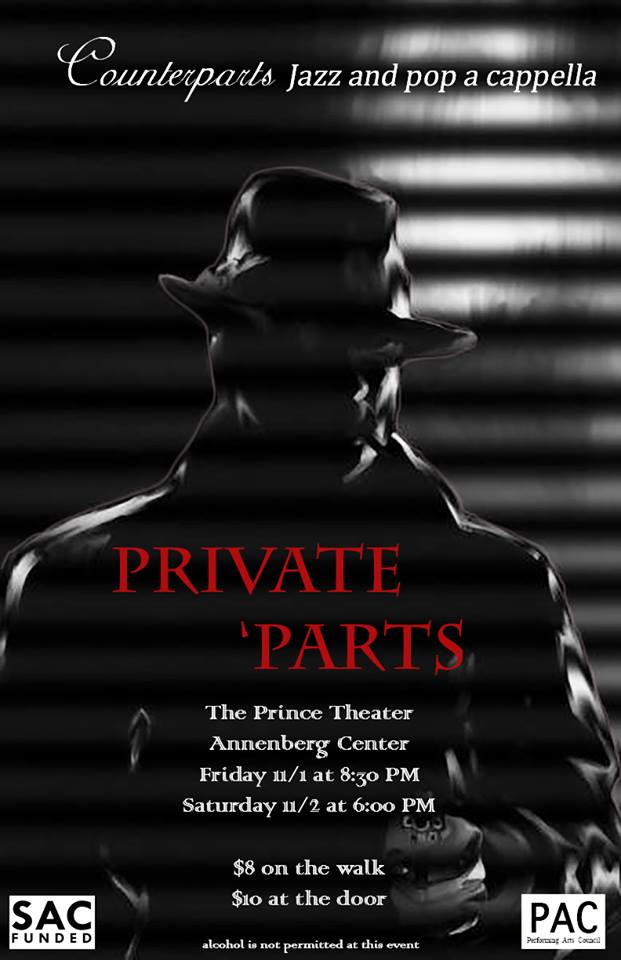
November 1st – 2nd: Private ‘Parts

Our fall show poster

Our fall show poster

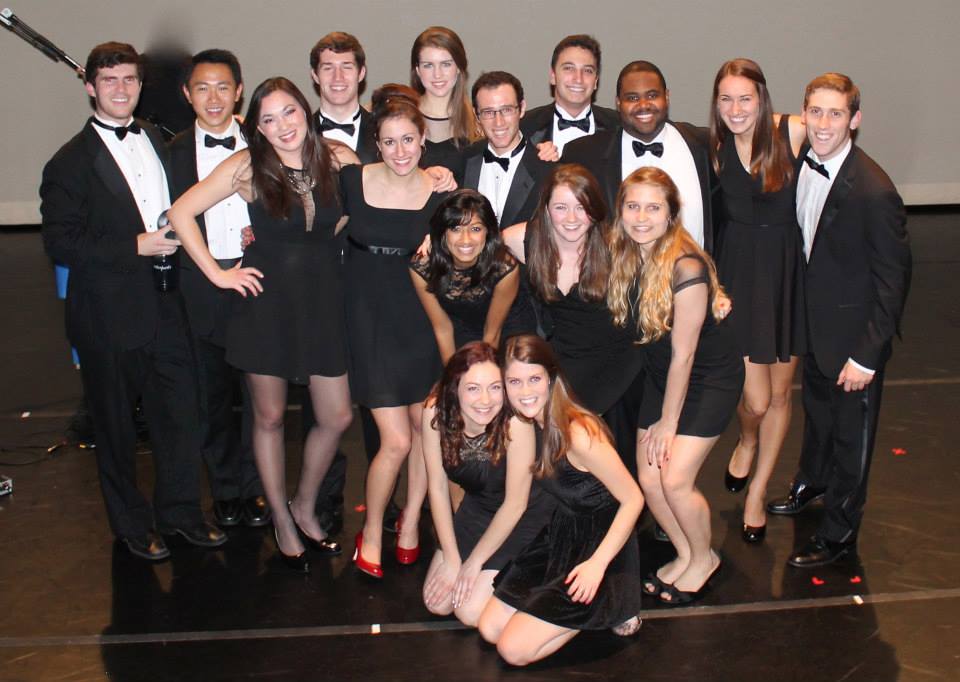
After almost 6 weeks of rehearsing, Counterparts finally performed our fall semester show “Private ‘Parts”! Now, I know what you’re thinking, and yes, the show title was dectective themed.  Just look at the poster!   In all seriousness, though, the show was fantastic.  I sang a jazz number called “Baby I’m a Fool” by Melody Gardot.  It’s been my favorite CP solo so far!  My family came to see us perform, as did a lot of my friends and alumni of the group.  After the show, past and present CP members went to City Tap House for dinner to celebrate another successful show.  Videos of our performances will be up on our YouTube channel within the next couple weeks, so stay tuned!

Counterparts, before the start of our fall show!

Counterparts, before the start of our fall show!

November 3rd: Handle With Care

The album cover for Handle With Care

The album cover for Handle With Care

Counterparts’s newest CD, “Handle With Care,” is officially available!  We recored the CD last spring, and since then our Music Director and President were working with the studio to mix and master each track.  And the results are incredible!  One of my solos from last year, “Your Heart Is As Black As Night,” is featured on the album.  I’m so excited to listen to it, and I’m so proud of CP.  Our hard work really paid off!  We sold a lot of copies this past weekend at our show, but we have also made it available for download online.  Take a listen, and buy it today 🙂

November 5th:  QUIZZO

This year's logo for SK Quizzo

This year’s logo for SK Quizzo

SK is kicking it into gear with preparing for Quizzo.  There are now 10 days left until the event, and we still have so much to do!  We’ve been actively recruiting teams across campus (Right now, I’m working on registering both a Counterparts and a Mask & Wig team) as well as collecting donations, creating flyers, and ordering shirts for the event.  The prizes look awesome: free spring break trips, free overnight stays at hotels in Atlantic City, pro athletic gear, Tory Burch bags, club box tickets to 76ers games, and gift cards upon gift cards.  I wish I could play!

Leave a comment

Filed under Campus Life, Carolyn G., Events, Photos, Student Perspective, The Arts, The Arts at Penn, Video, Videos

A Palestra Preview with the Philadelphia 76ers and the Penn Quakers

Author: Stephanie Yee, C08 

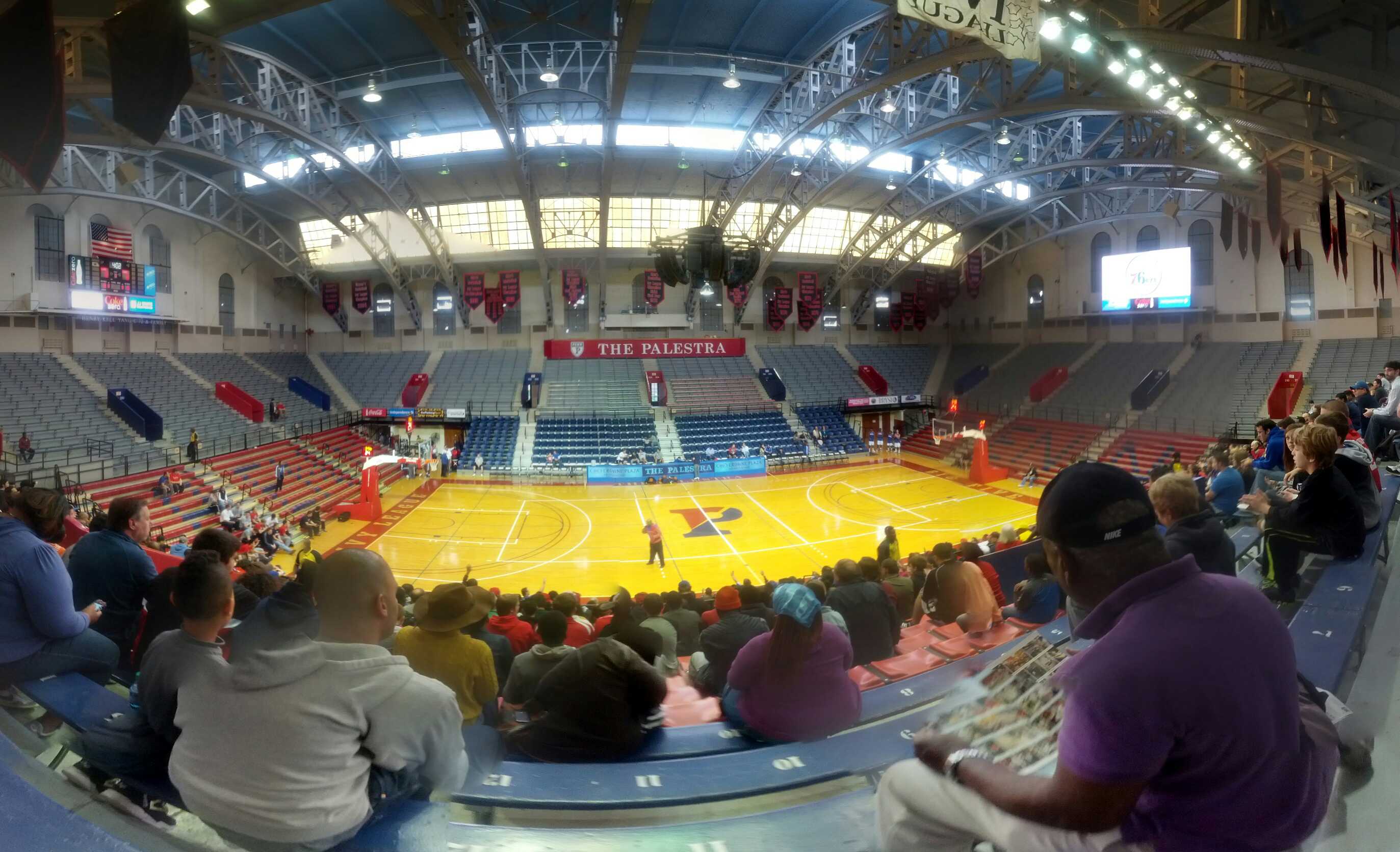
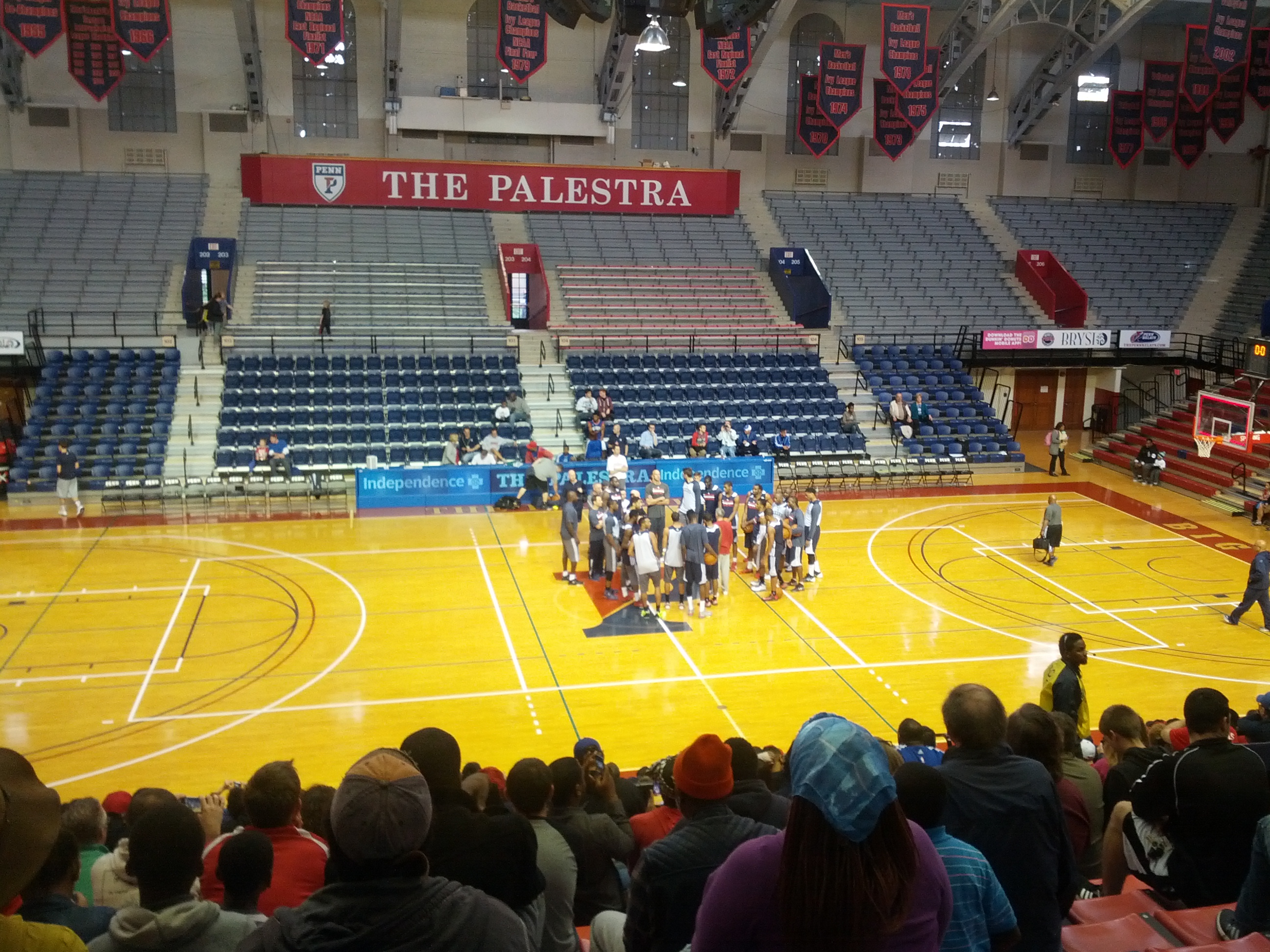
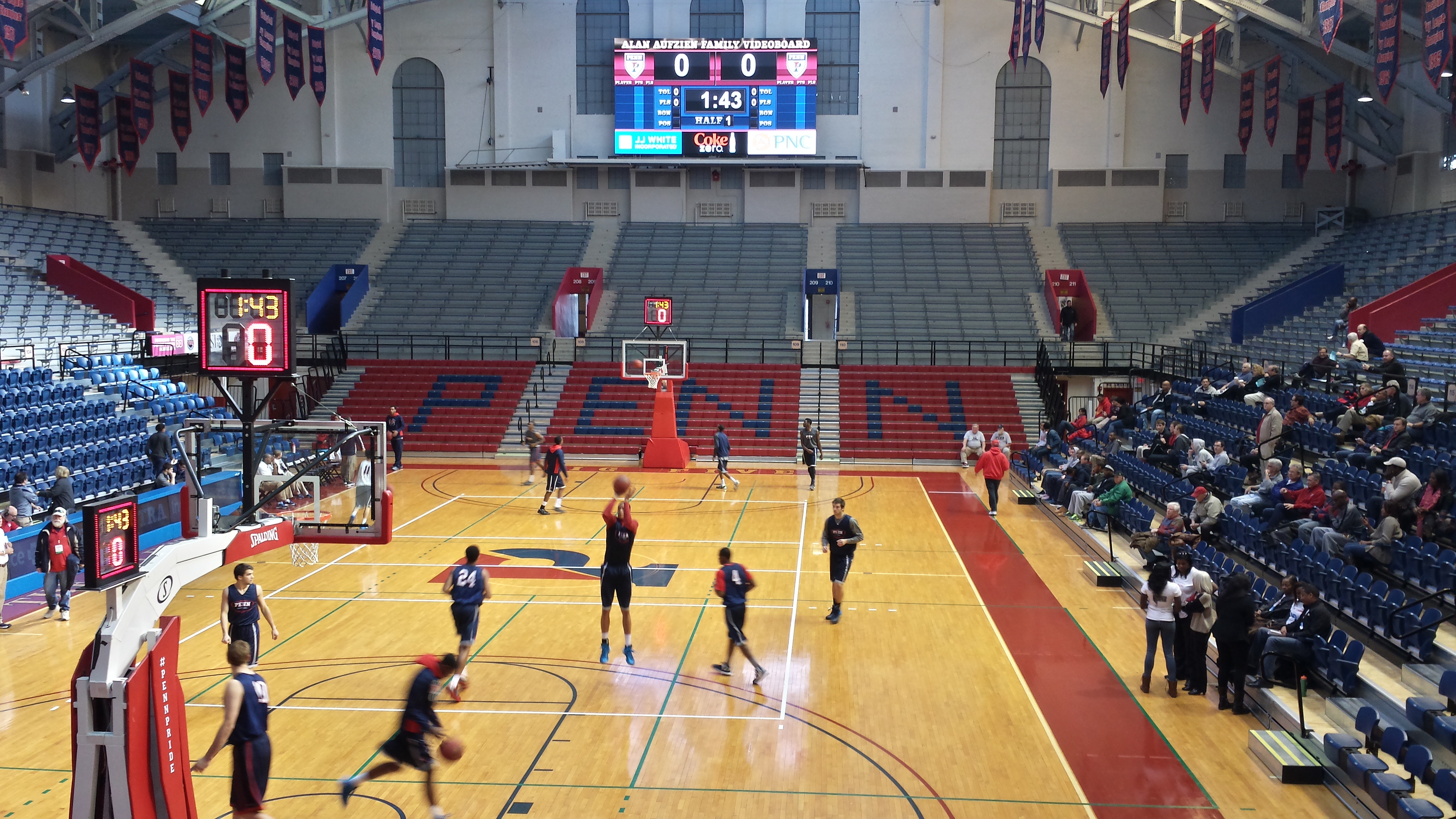
I have been anxiously waiting for the 2013-2014 Penn Men’s Basketball season to begin. T minus 4 days, but who’s counting? I had the opportunity to get a sneak peak of the Palestra renovations when the Philadelphia 76ers had a free open practice in the Palestra on Saturday, October 19. The new red and blue bleachers look awesome! They spell out PENN.

Caption: 76ers fans gathered to watch the team practice

Caption: 76ers fans gathered to watch the team practice

The Philadelphia 76ers on the Palestra floor

The Philadelphia 76ers on the Palestra floor

One week later, the Penn Men’s and Women’s Basketball teams had an open scrimmage at the Palestra. The Men’s team looks great! I can’t wait for the season to begin!


Great view of the new red and blue bleachers

Great view of the new red and blue bleachers

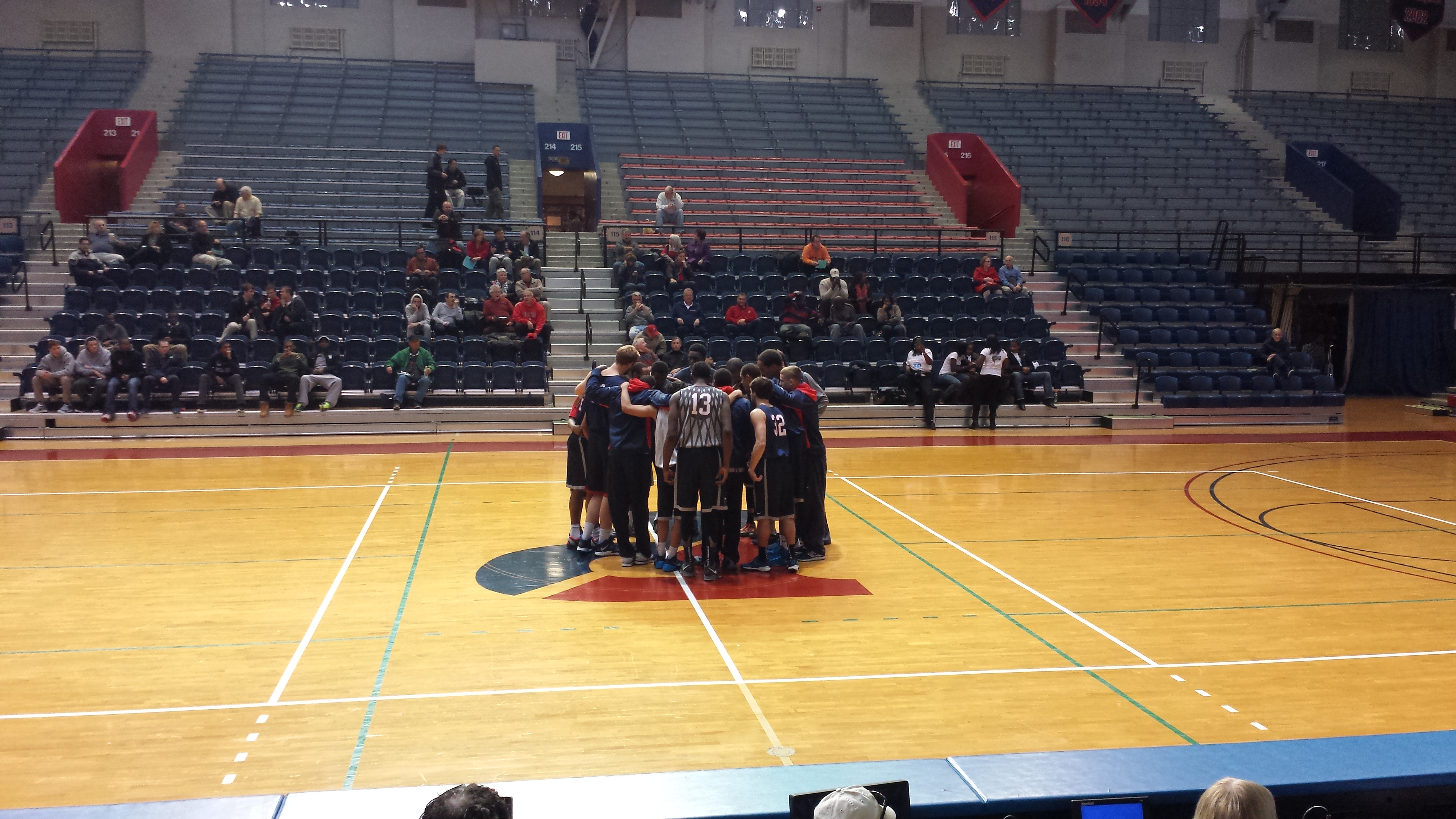
The team before the scrimmage began

The team before the scrimmage began

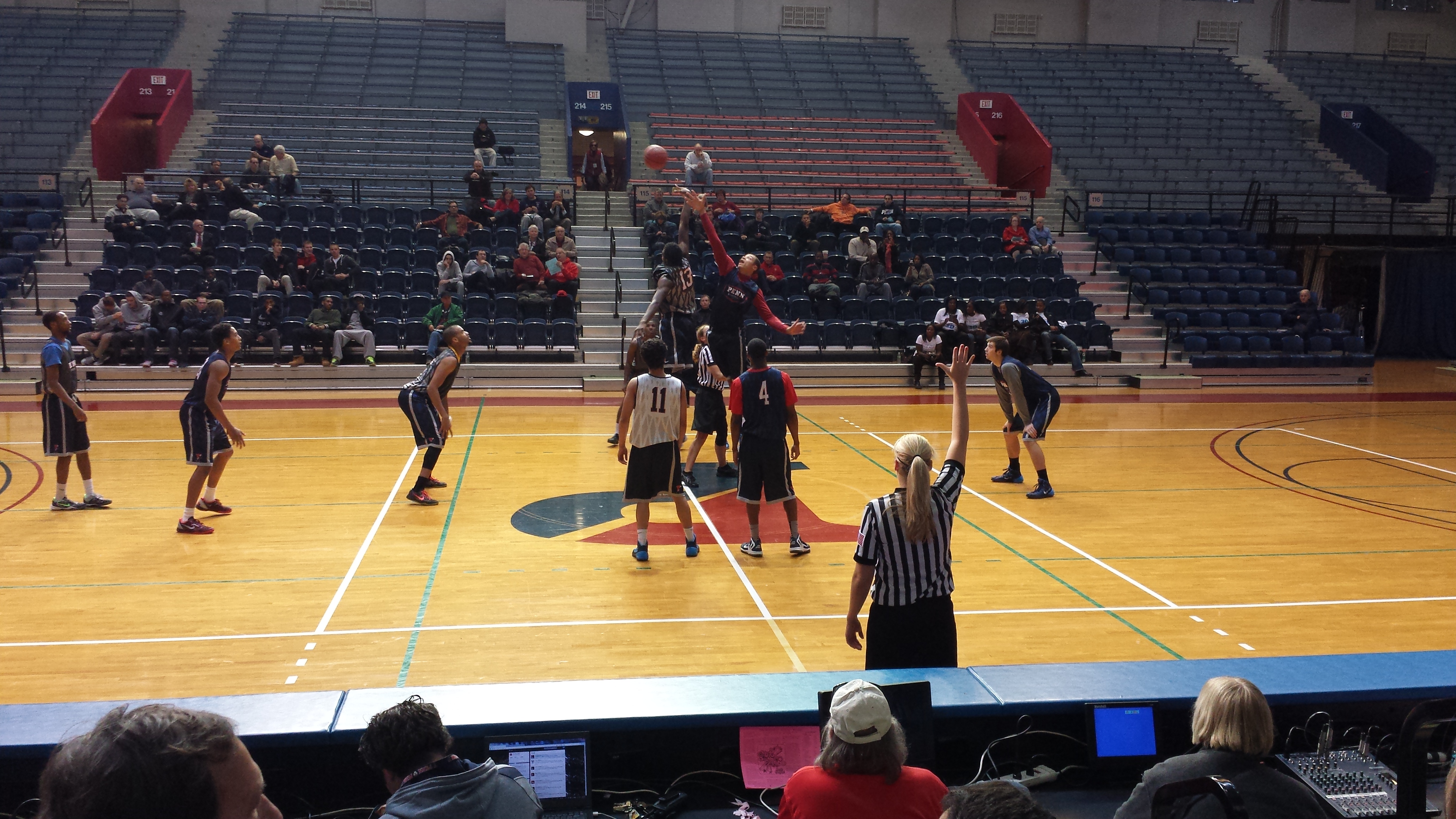
The tip

The tip

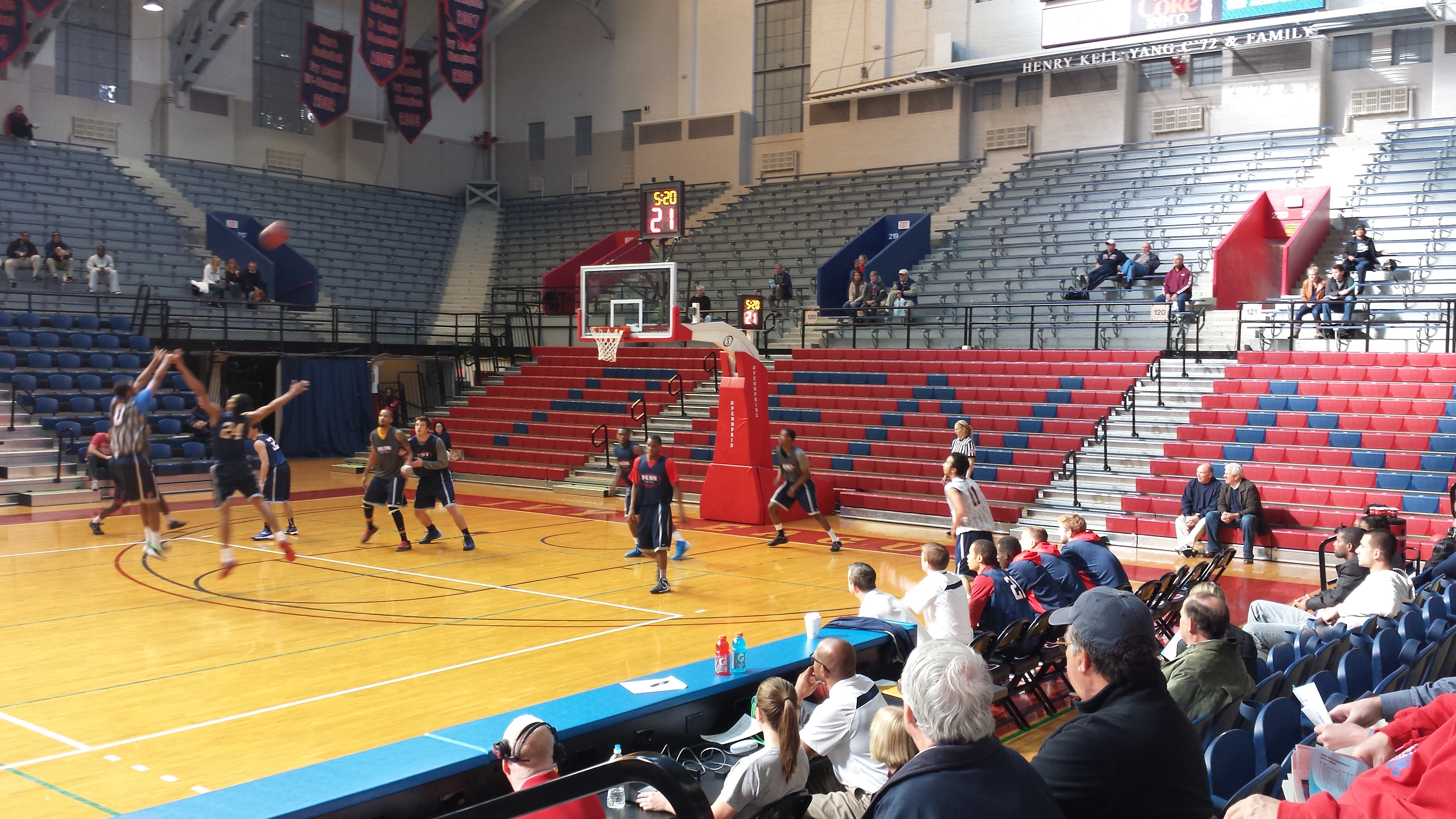
Scrimmage time!

Scrimmage time!

  The season begins on Saturday, November 9 at 5pm when the Quakers take on the Temple Owls. Click here to buy tickets. See you there!

Leave a comment

Filed under Uncategorized

Jambo!

Author: Molly Rand, GED’13


I recently had the amazing opportunity to serve as an Alumni Relations staff-host for the Penn Travel trip: Treasures of East Africa. During the trip, I was joined by an adventurous group of 10 alumni travelers. Together, we experienced what makes Africa, and East Africa in particular, such a unique and marvelous place.

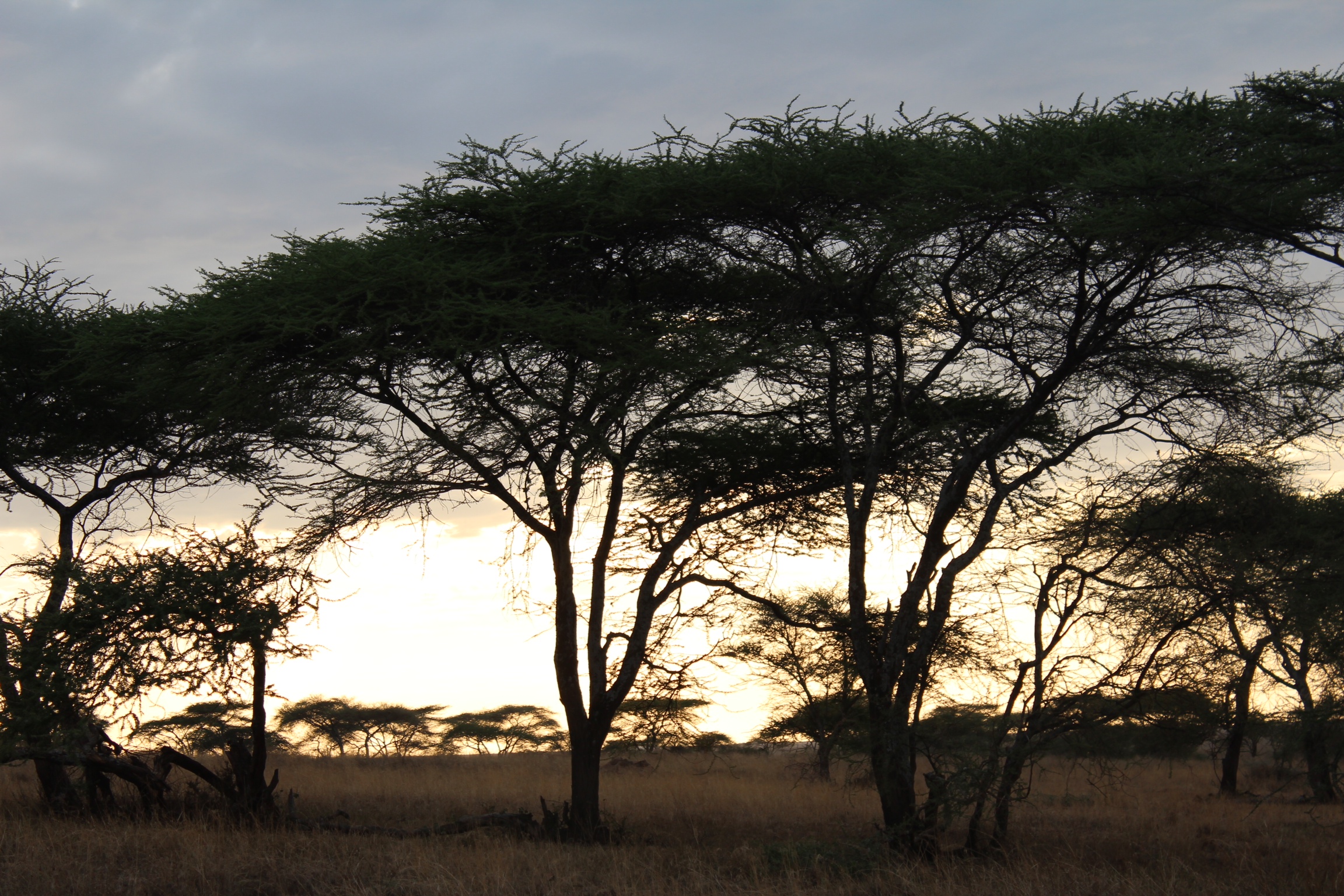
Each day of the two-week trip was spent exploring the vast land of savannahs and diverse local cultures of Tanzania and Kenya. We captured sights and snapped photos of the incredible wildlife and surrounding landscape. We enjoyed a breathtaking sunset each evening and then awoke the next morning to catch it rise again.

Masai Mara Sunset, Kenya

Masai Mara Sunset, Kenya

Serengeti Sunrise – Serengeti National Park, Tanzania

Serengeti Sunrise – Serengeti National Park, Tanzania


In some way, our group became a small family over the course of the trip, traveling together to take on the next adventure: to see or taste something new, to learn the next phrase for our Swahili vocabulary, and to experience another unknown treasure of East Africa.

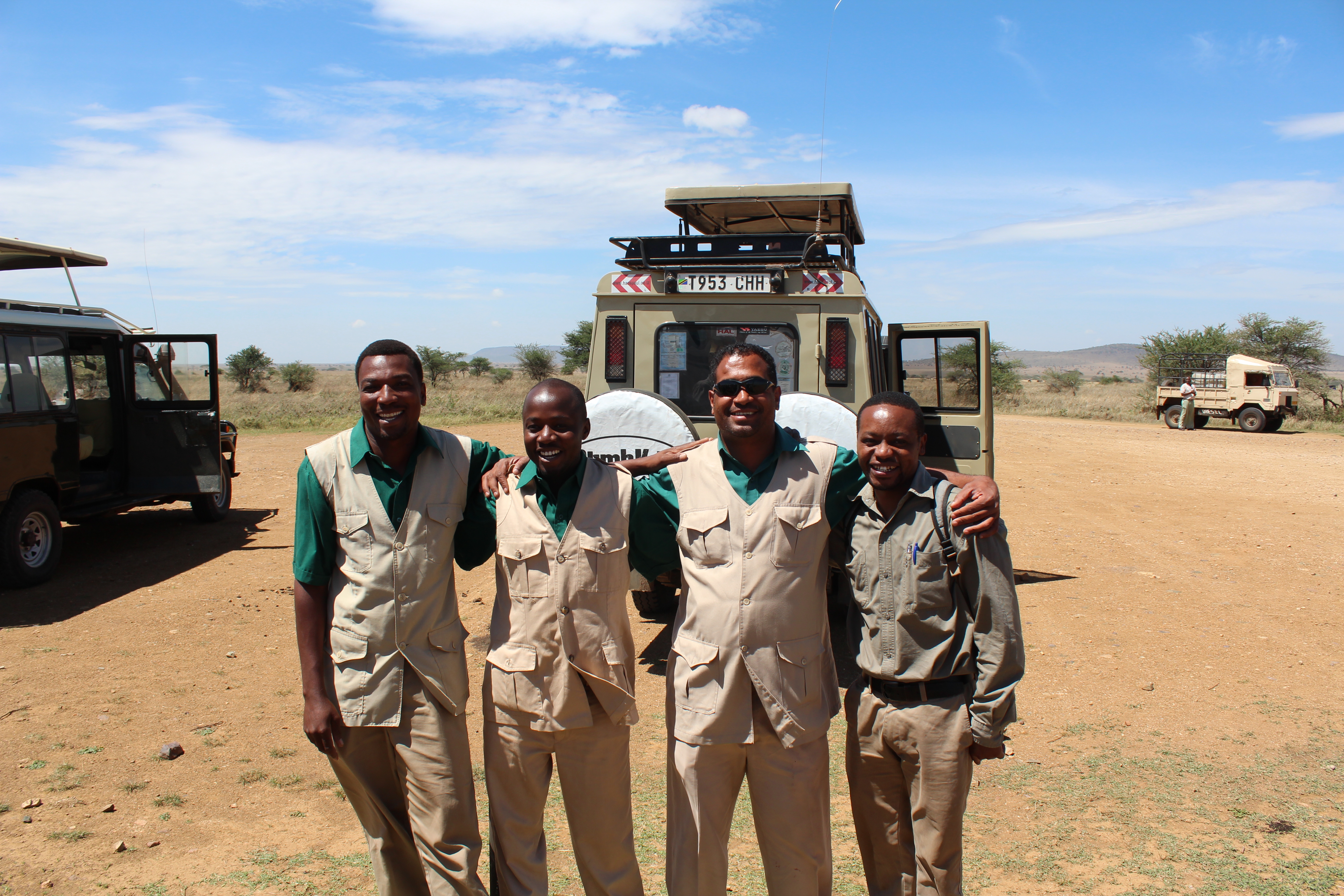
We endured long hours and road trips in our safari vans where the bumpy and unsteady rides, or African massage as they call it, only helped bring us closer together. Our local drivers and guides quickly became our new best friends, sharing with us their vast knowledge and passion for the beautiful place they call home.


Our safari drivers (Left to Right: Wolfgang, Wilfred, Shafino) and Safari Director, Adam, in Tanzania

Our safari drivers (Left to Right: Wolfgang, Wilfred, Shafino) and Safari Director, Adam, in Tanzania.


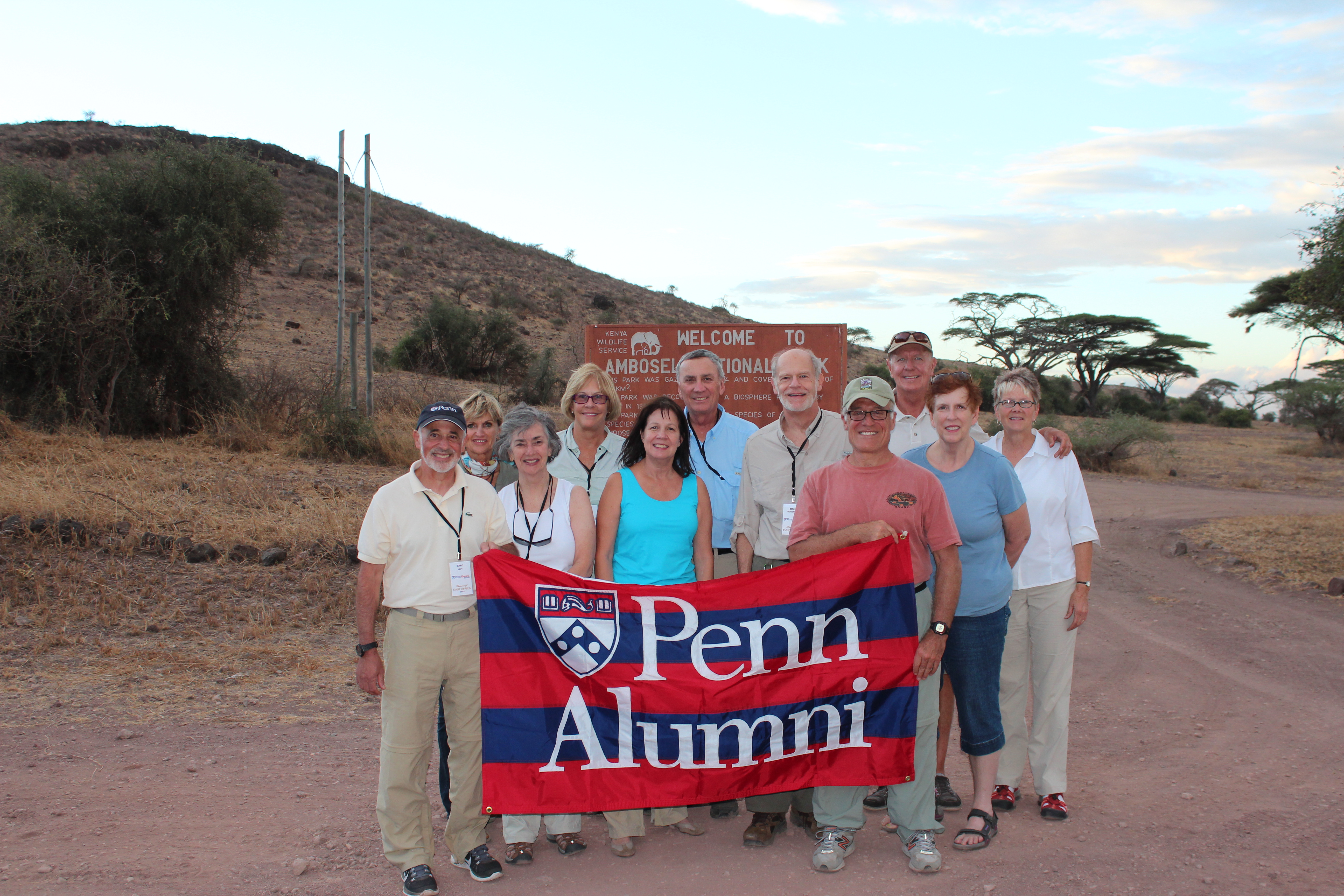
Our group’s first stop after crossing the border from Tanzania into Kenya: Amboseli National Park

Our group’s first stop after crossing the border from Tanzania into Kenya: Amboseli National Park.


Spotting a herd of elephants in front of Mt. Kiliminjaro

Spotting a herd of elephants in front of Mt. Kiliminjaro.


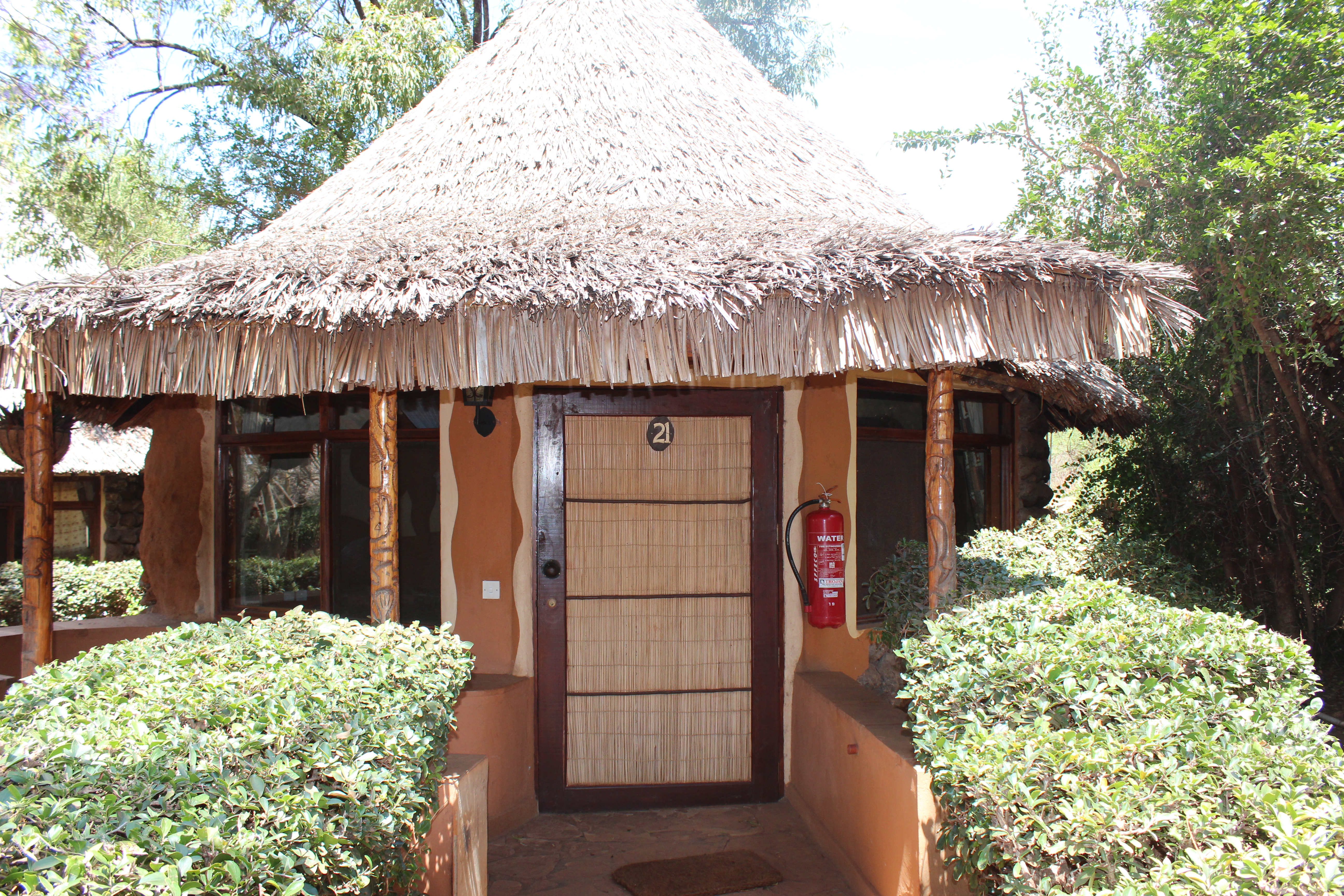
Room at the Amboseli Sopa Lodge, Kenya

Room at the Amboseli Sopa Lodge, Kenya


Before too long, I think we all became humbly aware of how different our daily lives were from the people we encountered. Yet despite those differences, the warm smiles and kind hearts of those who we met made us all feel right at home.

Photo from our visit to the Masai village kindergarten in Tanzania

Photo from our visit to the Masai village kindergarten in Tanzania.


The trip offered us a unique opportunity to immerse ourselves in a culture we only knew from a distance before this journey began. It challenged us to abandon our own perspectives and approach each interaction with a pure sense of curiosity and appreciation for the unfamiliar. As each day passed, we gained a more distinct awareness for the little things in life that really matter.

As for the other stuff, “hakuna matata” as the locals would say.


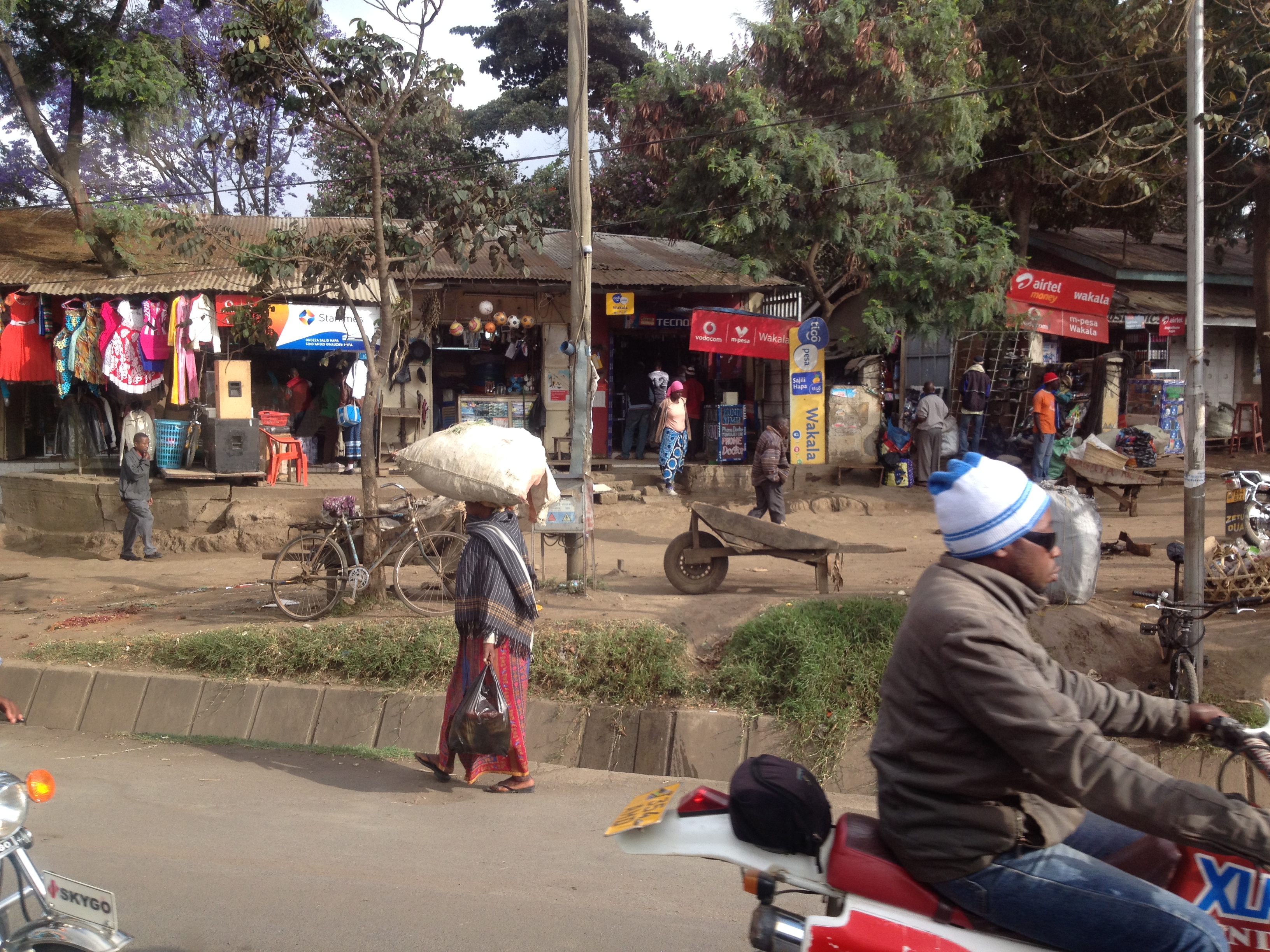
View as we drove through Arusha and surrounding villages in Tanzania

View as we drove through Arusha and surrounding villages in Tanzania.

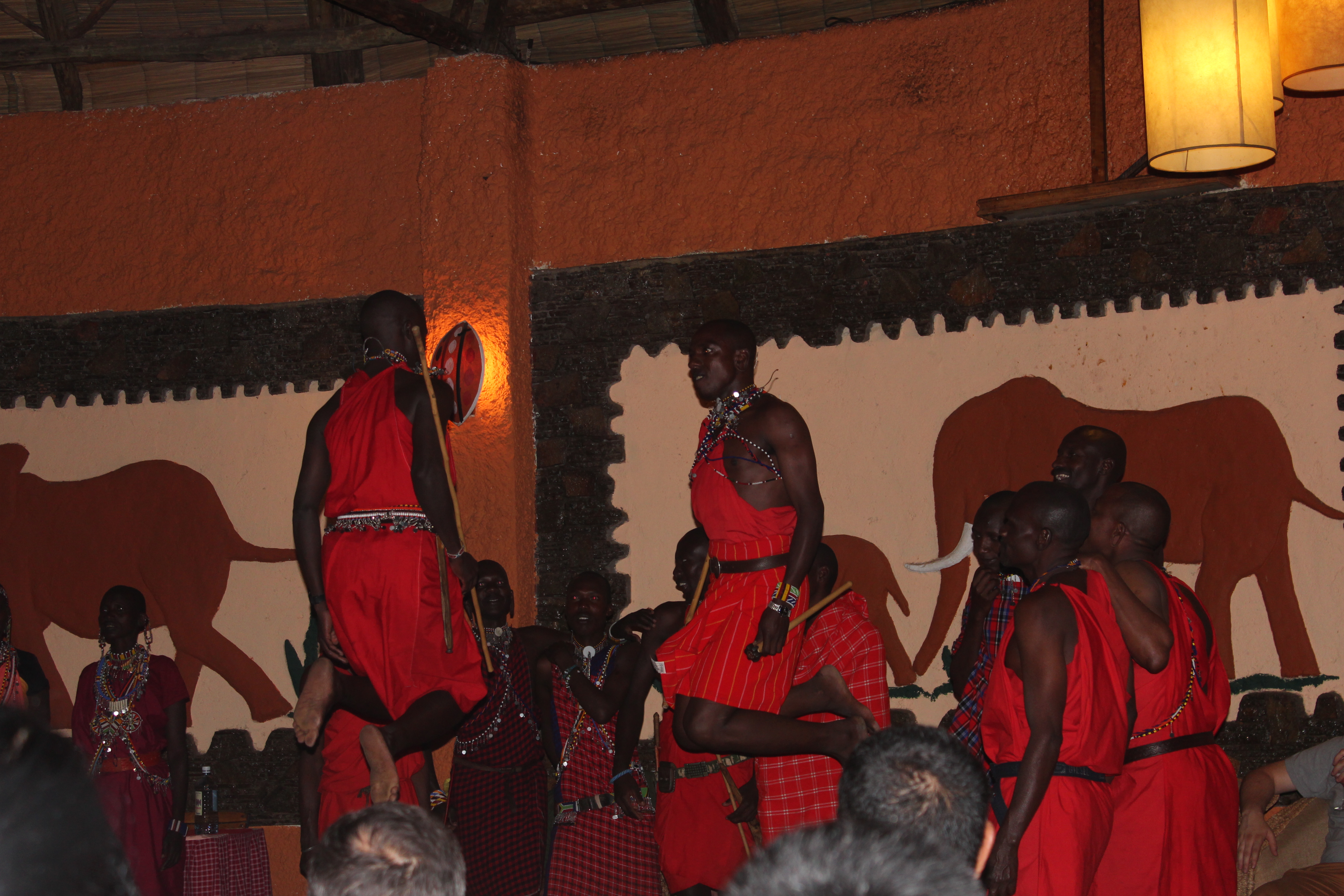
Traditional Masai jumping dance – a competitive jumping ritual men do to showcase their strength and agility to women in the tribe

Traditional Masai jumping dance – a competitive jumping ritual men do to showcase their strength and agility to women in the tribe.


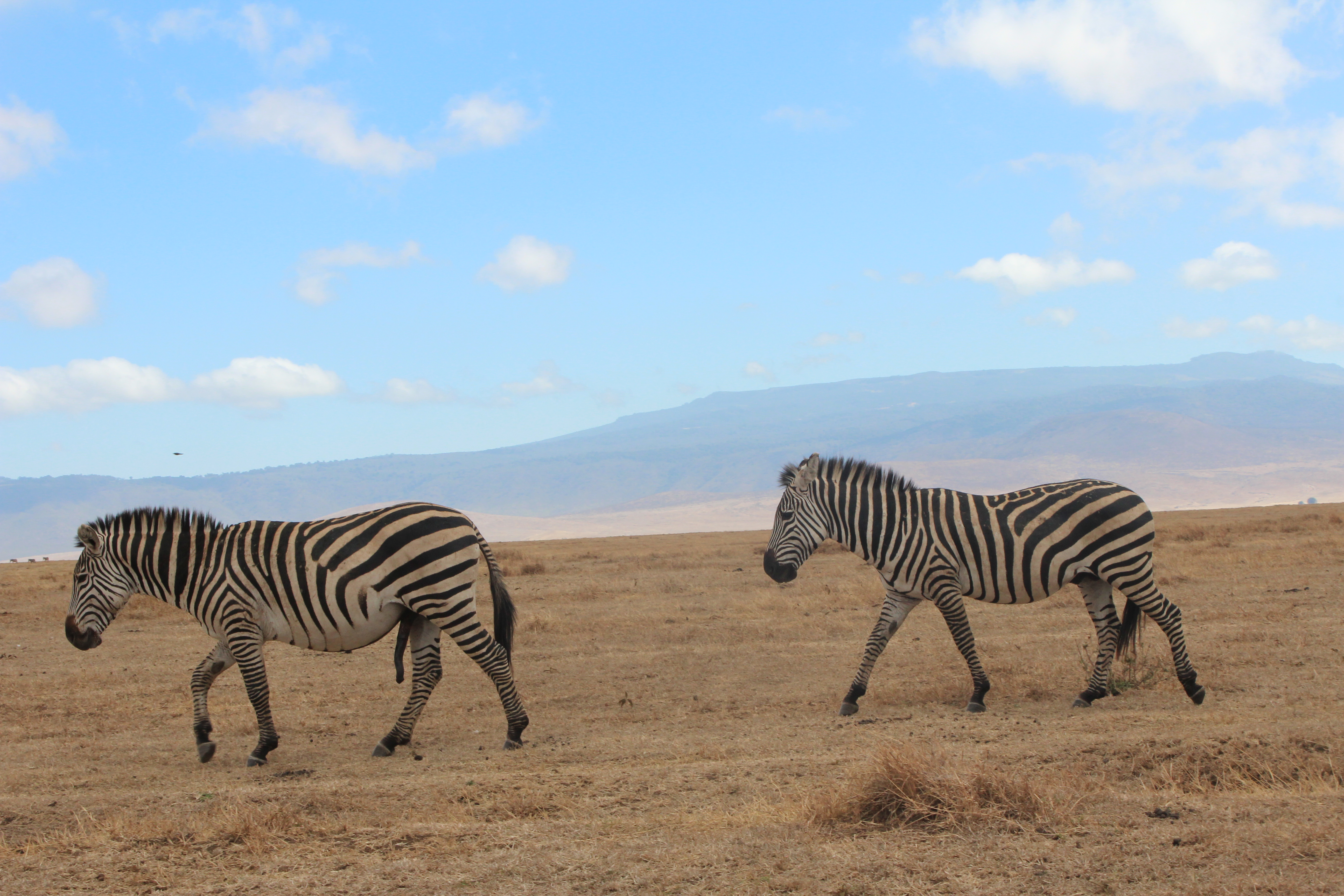
At last, this would not be an accurate trip re-cap if I did not do my best to describe the unbelievable wildlife and conservation areas of Tanzania and Kenya. It is hard to truly comprehend how incredible it is to observe all of the animals until you are there, watching them run, eat, or sometimes even hunt, often only a mere 5 feet away. Our group was lucky to spot every single animal on the list – literally. We viewed all of the “Big 5” as well as the remaining four of the lineup to see what our guides noted as the “Big 9.” (Buffalo, Elephant, Leopard, Lion, Rhino, Cheetah, Giraffe, Zebra, and last but definitely not least, the Hippo).

At night, the lodge had security walk guests to their rooms after dinner, not because of any danger in the area caused by crime, but because of the animals nearby. At the Lake Naivasha Sopa Lodge in Tanzania, the hippos were notorious for coming onto the property at night. One evening, I asked a guard as he escorted me down the path, with his flashlight in hand, if the animals come up to the lodge because of all the people.

He responded very confidently, “No, no…they come close because this is their natural habitat. We are in their house.

His reaction made me realize even more the unique beauty of East Africa.


Hippo spotting in Serengeti National Park of Tanzania

Hippo spotting in Serengeti National Park of Tanzania.


Elephant crossing in front of Mt. Kilimanjaro, Kenya

Elephant crossing in front of Mt. Kilimanjaro, Kenya.

First lions of the trip in the Ngorongoro Crater in Tanzania

First lions of the trip in the Ngorongoro Crater in Tanzania.


A group of giraffes is called a journey – we spotted these in the Masai Mara of Kenya

A group of giraffes is called a journey – we spotted these in the Masai Mara of Kenya.


Our guides taught us that a group traveling together is called a dazzle.

Our guides taught us that a group traveling together is called a dazzle.

When someone asks me the classic post-travel question, I struggle to find an answer as to what was my favorite part of our East Africa experience. Every moment we spent in Tanzania and Kenya was memorable – whether we were observing a mother elephant protect her baby, visiting a Masai village, watching a lion hunt its prey, or having a conversation with one of our local guides.

The people of Tanzania and Kenya ask no favors of travelers except for one: “tell your friends and family about this place, let them know they should come too. And most of all, make sure to come back.

If I should ever get another opportunity to visit these countries again, I will be sure to let my new local friends know. In the meantime, make sure you add East Africa to your travel bucket list. I promise every single moment will be well worth it.

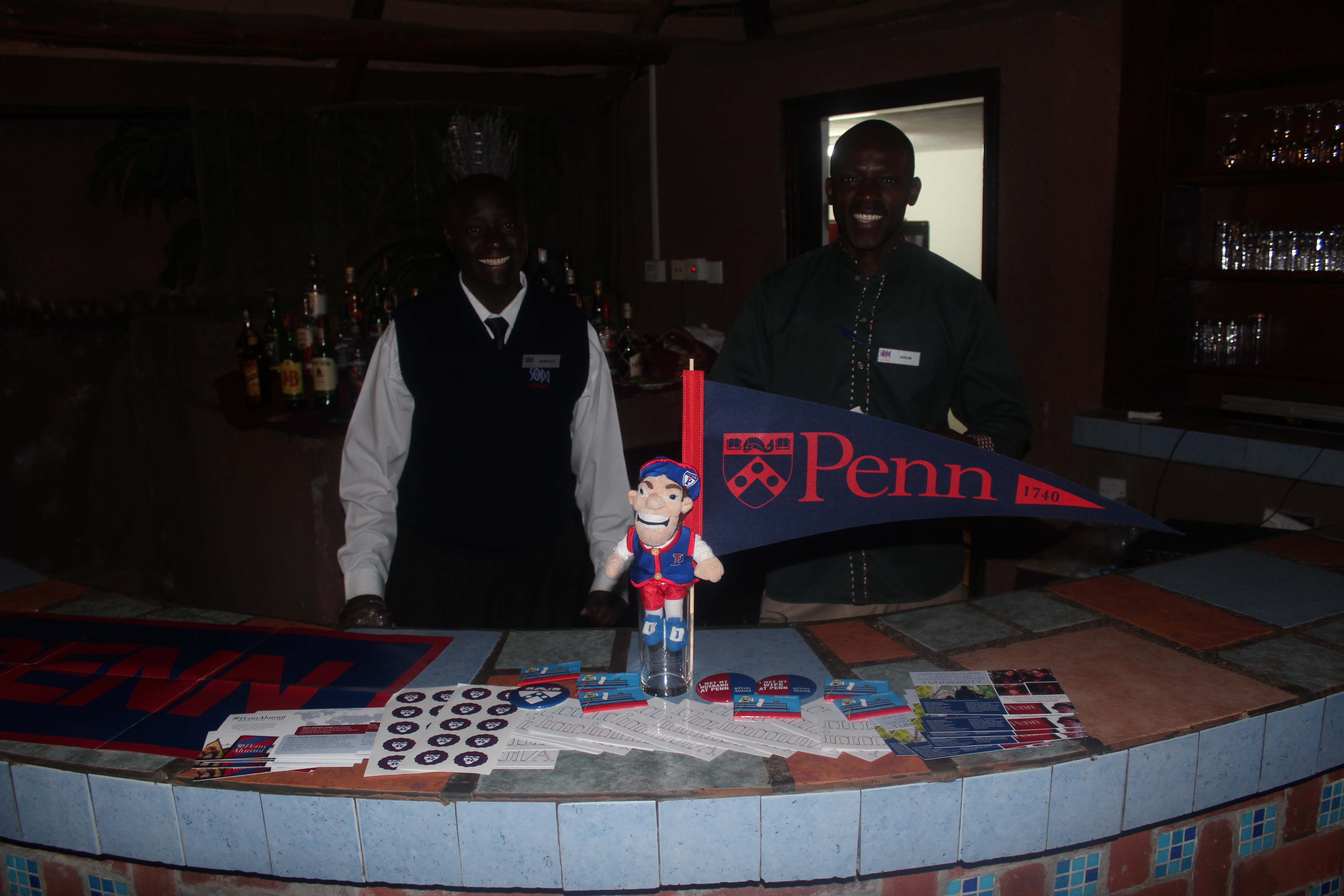
Preparing for our Penn reception at the beautiful Lake Naivasha Sopa Lodge

Preparing for our Penn reception at the beautiful Lake Naivasha Sopa Lodge.


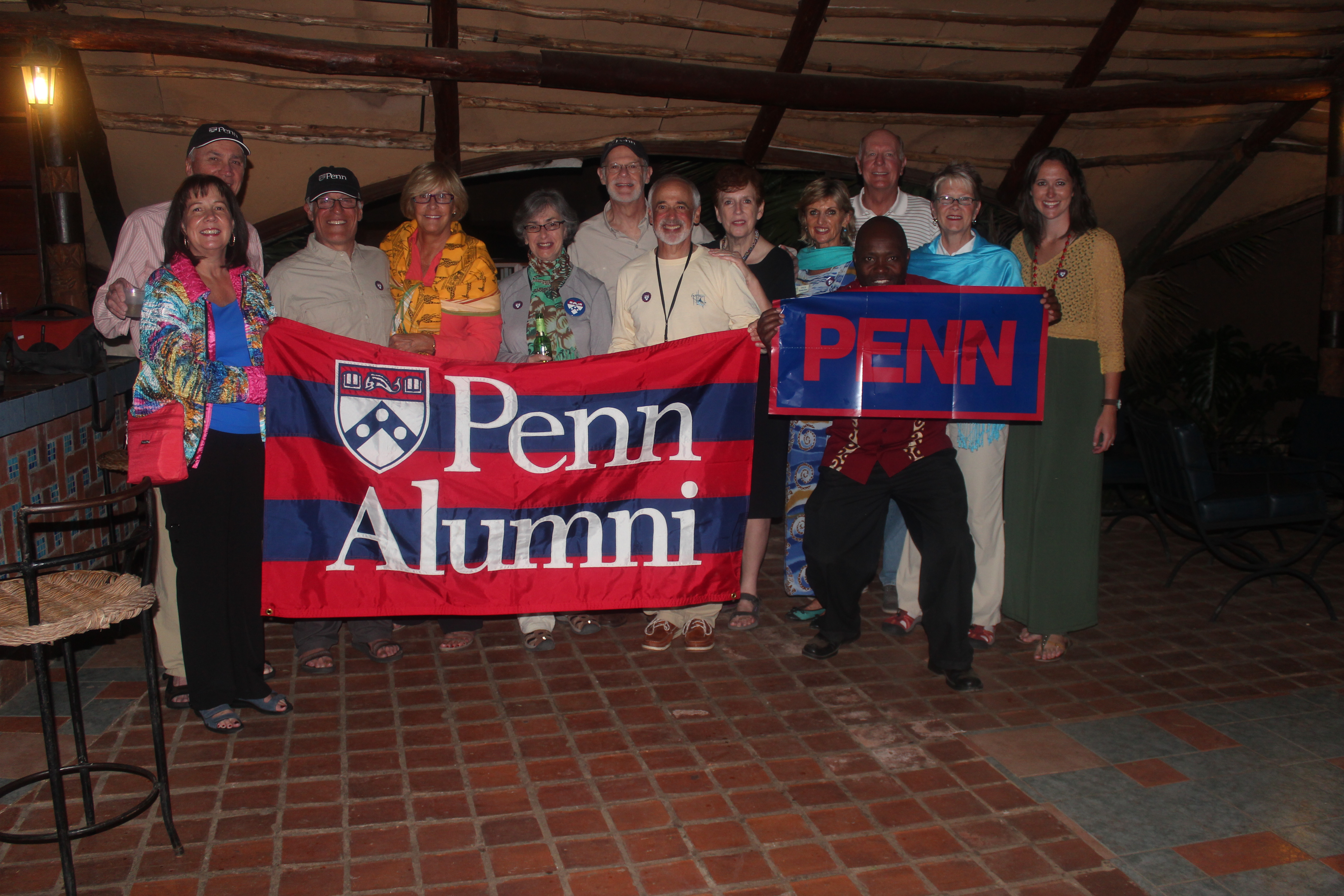
Our amazing group of Penn Alumni & Friends!

Our amazing group of Penn Alumni & Friends!


2 Comments

Filed under Alumni Perspective, Alumni Programming, Molly Rand, Penn Alumni Travel, Travel

Halloween Costumes: Not Just for Kids

By Nicole C. Maloy, W’95

Sadly, grown-ups have fewer options than kids do to participate in the “dress up as a _______” part of Halloween. What a shame! It is so much fun, and I am reminded of this every year when the Halloween-themed salsa dance parties roll around. It is a special – ahem – treat for me and hundreds of others to have a socially-acceptable excuse to get in costume. I took advantage of one of these last weekend at Philadelphia Salsafest, an annual weekend-long event with classes all day, performances in the evening, and dancing all night. (Side note – if you want a crash course in salsa dance, come to this in 2014, or do a search for your city and “salsa congress” to see what similar weekend-long options are available near you. Most have class sessions for dancers of all levels. You can also search for a city plus “salsa lesson” to find a club or a studio that can get you started in the mean time. Worth it!)

Storm

Storm’s cape, attached at the wrists. A good idea on paper. 😉 Not so much for social dancing.

At the intersection of salsa dancing and Halloween, there is a catch: you have to be able to dance in your costume. Among other things, according to my own personal rules, such a costume must leave me with good range of motion in the arms and legs, must not endanger me or a dance partner when forced into rapid rotation, and must not inhibit my ability to cool off between songs in a hot room. The year I dressed up as Storm from the X-Men, I decided against strangulation and chose to forego the cape. It was a good decision. When the film Avatar came out, I was very excited about the possibility of dressing as the tall, blue character of Neytiri until I realized that my options were 1) blue body make up all over my arms, or 2) a high necked, long-sleeved, non-breathing blue body suit and blue makeup on my face. Option A could sweat off and/or leave my dance partners, and their thoughtfully-constructed costumes, covered in blue paint. Too inconsiderate. Option B would get makeup on people AND send me to the hospital with heatstroke. Too emergency roomy. I was a bit bummed, but ended up very happy to dance as The Bride from Kill Bill. It turned out that there were a few Neytiris at the party, so at least I was the only one in the costume I selected! That my yellow tracksuit left no remnants on anyone else, and didn’t make me pass out, were nice bonuses.

Image

Did you get your body makeup on my costume? Why I oughtta…

While I brainstormed for this year’s costume, I considered the whole “era/decade” concept. I had done several variations of the ‘80s, and I once dressed as a ‘60s-era hippie, but – eureka! – never the ‘50s. And what is more dance-ready than the ensemble of an American teenage bobbysoxer? Decision made. My dream would have been to dance to a salsa remake of “Johnny B. Goode” as a tribute to Back to the Future, but I and my poodle skirt still had a great time spinning the night away with other fully-grown humans masquerading as superheroes, puns, celebrities, animated characters, and more.

Halloween 2013! I haven’t worn saddle shoes since I was in kindergarten, so I’m just glad they come in my size.

Halloween 2013! I haven’t worn saddle shoes since I was in kindergarten, so I’m just glad they come in my size.

Do you have an outlet for your burning desire to get into costume as an adult? Next year you can dress up to answer the door to your trick-or-treaters. Or you can take up an activity that draws eccentric types who share your dream of walking around as the Stay Puft Marshmallow Man. You can also host – or encourage a friend to host – a Halloween party where costumes are expressly encouraged for the adults. Someone out there will thank you for the opportunity.

2 Comments

Filed under Nicole M., Philadelphia, Uncategorized

Go Green at QuakerFest

 Author: Kelly O’Connor

Homecoming Weekend

Thanks to Penn’s Green Campus Partnership, QuakerFest is becoming more environmentally sustainable. This year, QuakerFest, the alumni tailgate held before the Homecoming football game, will be a zero-waste event, in line with the University’s ReThink Your Footprint waste minimization awareness campaign. A zero-waste event is an event where at least 90% of event waste is diverted from landfills. All waste that is produced at the event will be recyclable, compostable, or reusable.

Penn-Alumni-Zero-Waste-graphic1-copyThe goal of the ReThink Your Footprint campaign is to raise the level of conversation about waste management beyond solely recycling and into a broader discussion of source reduction and reuse – resulting in greater diversion of campus waste from the landfill. ReThink Your Footprint culminates during three weeks, November 4 – 22, with an awareness campaign designed to engage the entire Penn Community. In support of our Climate Action Plan’s goals in the area of waste minimization, an assortment of initiatives, events, presentations, and other forms of outreach will take place during this period to share information about environmentally sustainable practices in source reduction, reuse, and recycling.

With up to 1,000 people attending QuakerFest, this event is a perfect opportunity to demonstrate ReThink Your Footprint in action. At QuakerFest, all plates and utensils will be compostable. Student volunteers will help attendees with zero-waste decision-making when they finish eating at the QuakerFest picnic. Other volunteers will help explain what zero-waste events are and how this event ties in to Penn’s Climate Action Plan goals to attendees.

Click here to view all Homecoming Weekend events.

Register Today!


Leave a comment

Filed under Alumni Programming, Campus Life, Homecoming Weekend featuring arts and culture, Kelly P., Sustainability at Penn

Penn Student On Track To Being Principal of Charter School

Author: Max Gaines

Jessica King, C’15, calls herself “a child of public school.” King was admitted to the University of Pennsylvania as an early-decision applicant. She received a “healthy” federal grant package including a work-study program award. Now a junior communications major with a specialization in civic communication, King has held jobs in the Community School Student Partnerships program of Penn’s Netter Center for Community Partnerships since her freshman year.

“I was a mentor in the classroom at Lea Elementary School. I worked in an autism special needs class,” King says. “During the day, I worked one-on-one with individual students and as an after-school counselor.”

She found the mentoring work so fulfilling that she stayed with the program. In her sophomore year she rose to a senior staff position as director of CSSP at Lea site in West Philadelphia where 30 mentors serve 10-15 classes.

“Today, I oversee a board of 16. The CSSP organization as a whole has 300 mentors through the work-study program at five elementary and high school sites,” she says. Despite enjoying her work in the traditional public school arena and years of attending conventional public schools in Boca Raton, Fla., where she grew up, her dream job is to work as a principal of a charter school.

Leave a comment

Filed under Max G., The Penn Fund

Penn Alumni Travel: Music Diary along the Danube

Author: Stephen Lehmann, Humanities Bibliographer, Penn Libraries (retired)

The title of our Penn Alumni Travel cruise was “Symphony on the Blue Danube,” and although we heard no symphonies (at least no complete symphonies) and spent more days off than on the Danube (which is famously green), the trip was nothing if not true to its musical theme. Even the boat (“Amadeus Elegant”) was musical, with its three inside decks named after Haydn, Strauss, and Mozart.

The trip’s musical offerings began on our first evening on the boat, docked on the Danube at Budapest, with a delightful on-board performance by the Lugosi Band – clarinet, violin, cimbalom and dancers – playing a variety of Hungarian and Hungarian-Gypsy dances (including the ubiquitous “Csardas” composed by the Italian Vittorio Monti in 1906), as well as some Brahms Hungarian Dances. Four dancers accompanied the band. It was an altogether spirited evening, and the virtuosity of the instrumentalists – not only in their musicianship, but in the rhythmic clapping and slapping of legs and heels – was striking and impressive.  Audience participation was encouraged.

Karen Goldstein being a good sport.

Karen Goldstein being a good sport.

The first on-shore concert – an optional add-on – was given on Wednesday, October 2, in the Brahms-Saal of Vienna’s historic Musikverein building, just off the Ringstrasse.   The Brahms-Saal, which was inaugurated in 1870 by Clara Schumann, is the smaller of the two second-story halls under the Musikverein’s roof. It seats about 600, and is used mainly for recitals and chamber music. It was restored in 1992-93 to its original splendor: green walls, red pilasters, a lot of gold.  (Across a small landing is the Grosser Musikvereinsaal, home to the Vienna Philharmonic, and seating over 2,000.)

The Brahms-Saal of the Musikverein.

The Brahms-Saal of the Musikverein.

The program, performed by a small orchestra dressed in 18th-century costume, consisted largely of bits and pieces of works by Mozart – one movement each from the 40th and 41st Symphonies, two movements from the G-major Violin Concerto, arias from five of the operas, and the two chestnuts, Ronda alla turca and Eine kleine Nachtmusik. The concert concluded with Johann Strauss’s Blue Danube Waltz and Radetzky March.  (A few of our group managed to get tickets to the Vienna State Opera House, where they heard Rossini’s Barber of Seville, generating a certain amount of envy among the rest of us.)

The next day (Thursday, October 3), we were treated to a morning concert: the Mozart Ensemble, a string quartet, played a full program of Mozart, Dvorak and Haydn – all, with the exception of the Dvorak (a slow movement from his “American Quartet”), performed in their entirety (Mozart Quartet K. 157 and Divertimento K. 138 and Haydn Quartet op. 9, no. 6).  Again the venue, the “Sala Terrena” (“ground-level room”), was remarkable, both historically – it is the oldest concert hall in Vienna, and Mozart played there – and aesthetically, with its 18th-century, fresco-covered vaulted space in the Renaissance Venetian style. As it seats only seventy people, the performances were given in shifts, and we attended in two groups.

Sala Terrena

Sala Terrena

In the evening, still docked in Vienna, we were treated to another on-board concert, this time a small ensemble (two violins, cello, piano, soprano) performing light Viennese music from the 19th and early 20th centuries – Strauss waltzes and polkas, arias from Strauss and Lehar operettas, pieces by composers like Johann Schrammel and Karl Michael Zierer.  Introducing the music was a very tall Viennese, who spoke easily, informatively and in excellent English.

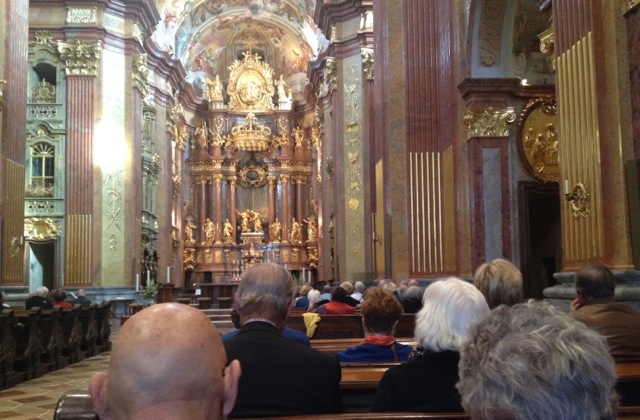
In the dead of night on October 3 the Amadeus Elegant slipped away from Vienna, and we awoke the next morning to find ourselves in the splendid Wachau Valley. After an early stop in medieval Dürnstein (no music), we proceeded to the magnificent early eighteenth century Benedictine abbey at Melk on the Danube’s south bank. There we heard a brief organ concert – the music was not identified, but the consensus was that it was Bach – performed by an 85-year old monk, who had been our guide’s music teacher.

The Biddles and the Blairs enjoying Melk’s organ.

The Biddles and the Blairs enjoying Melk’s organ.

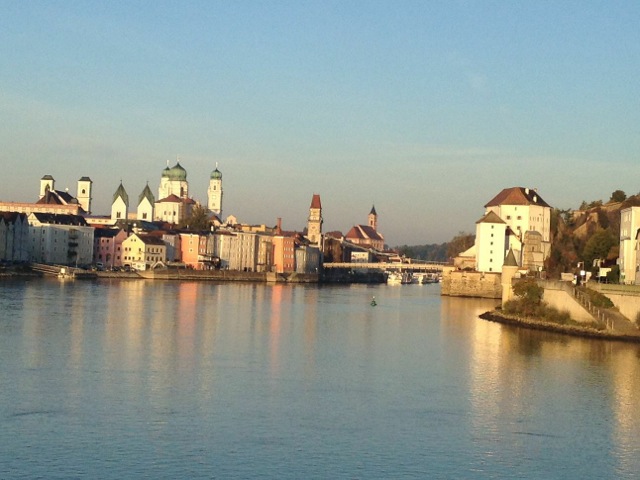
Early the following morning, October 5 (Saturday), we left Austria, sailing past Bavarian villages

Photo 5

and on into Passau.

Photo 6

The walking tour through Passau culminated in the baroque Cathedral of St. Stephen, a late 17th century structure whose organ is the fourth-largest organ and the largest cathedral organ in the world, with almost 18,000 pipes and over 200 registers. Before climbing up to her loft, the organist, Brigitte Furth, explained the workings of the Passau organ and the ways in which she would illustrate its various components and colors. The composers in her program were French (Louis James Alfred Lefébure-Wély, Jean Langlais) and German (Melchior Franck, Pachelbel, Bach). She ended with a piece by Langlais in which she sounded all five of the cathedral’s organs – each set of pipes coming from a different part of the building and ending together in a pew-shaking fortissississimo.

The only other music we heard that day came from the engines of the busses on the ride from Passau to Prague.

On our first day in Prague (Sunday, October 6), our guides took us to the beautiful, five-tier 18th-century Estate Theater, where Mozart’s Don Giovanni (1787) and La Clemenza di Tito (1891) were first performed.
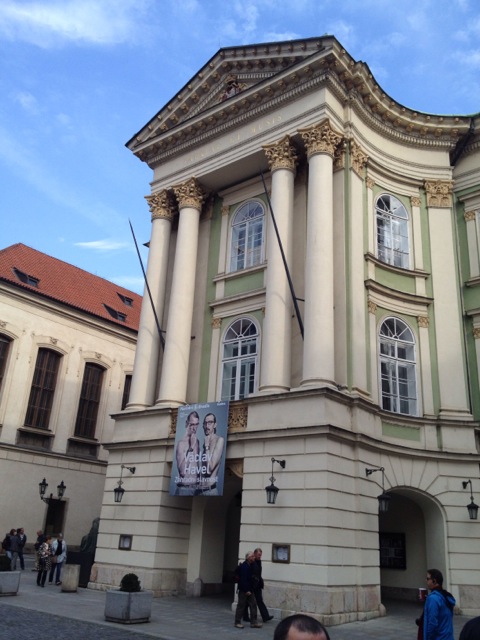
Photo 7

In its foyer we heard a brief concert for woodwind quintet playing arrangements from Mozart operas and a piece by the Czech composer Frantisek Saver Dusek. But the highpoint was an impromptu rendition of the Czech national anthem by Vaclav Bechyni, the theater’s charming guide.
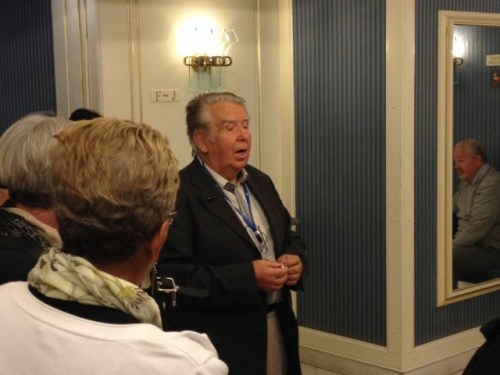
Dana Jolley, Linda Freeman, and, in reflection, Bill Koch listening to Vaclav Bechyni singing the Czech  national anthem.

Dana Jolley, Linda Freeman, and, in reflection, Bill Koch
listening to Vaclav Bechyni singing the Czech national anthem.

That evening a number of us went to a performance of Dvorak’s three act water-nymph opera Rusalka at the State Opera, built in 1888 as Prague’s German Theatre. The production was traditional, with English super-titles helpfully provided for those of us who can’t follow the Czech.

We heard our last concert in Prague on Monday morning, October 7, at the Lobkowicz Palace – part of the vast Prague Castle complex – under three enormous chandeliers in a small hall decorated with trompe l’œil columns and niches. The performance, by a string quartet, began with a rendition of Beethoven’s Ode to Joy but came to an abrupt halt when the first violinist suffered a snapped string. He returned quickly, but rather than picking up again with the Beethoven, the musicians proceeded to the Pachelbel Canon and then on through various transcriptions (movements from a Beethoven piano sonata, Dvorak’s New World Symphony, etc.), and concluded with Amazing Grace, Roy Orbison’s Pretty Woman, and some tango.

At the Lobkowicz Palace we were also able to see some of its amazingly rich collection of music manuscripts and first editions, including a score of the Messiah with Mozart’s alterations, the orginal orchestral parts of Beethoven’s Fourth Symphony (dedicated to the seventh Prince Lobkowicz), the first edition of Beethoven’s Eroica Symphony (re-dedicated to Prince Lobkowicz after the original dedicatee, Napoleon, declared himself Emperor) and a copy of Beethoven’s Op. 18 Quartets with corrections in his own hand.

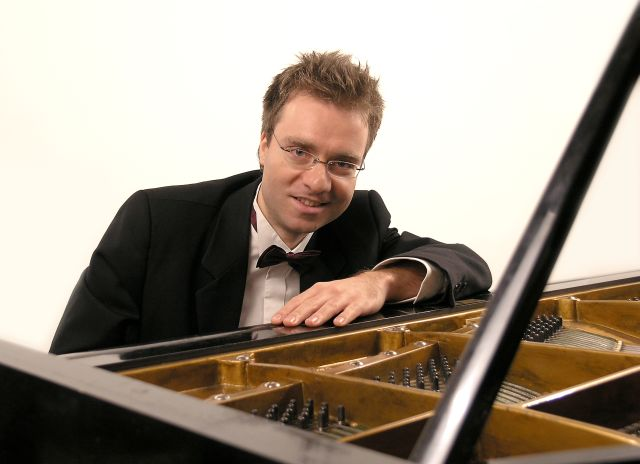
Finally, at our last stop – Cracow, Poland – we attended a private, all-Chopin recital at the city’s music conservatory on October 9 (Wednesday). Some from our group thought the pianist, Paweł Lubica, played harshly, but the acoustics didn’t help: the building had been constructed as an insurance company office, and the concert was held in a two-story former reception room with very hard surfaces.

Photo 9

Lubica played three waltzes and a sampling of other forms favored by Chopin (a Ballade, a Mazurka, a Prelude, a Nocturne, a Fantasie-Impromptu, and a Polonaise). My own favorite was the Nocturne (B major, op. 62, no. 1), and I was reminded of the pianist Rudolf Serkin’s observation that he wouldn’t play the Chopin nocturnes because they were too sad.

Sadness is a good segue to our journey’s end!  But sad only because it was such a great trip – the river, the sites, the people, the music. Thank you to everyone for helping to make it such a wonderful experience.
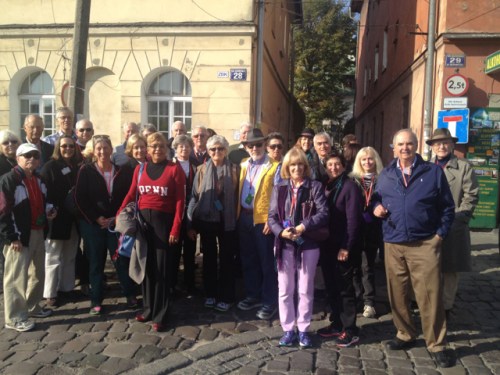
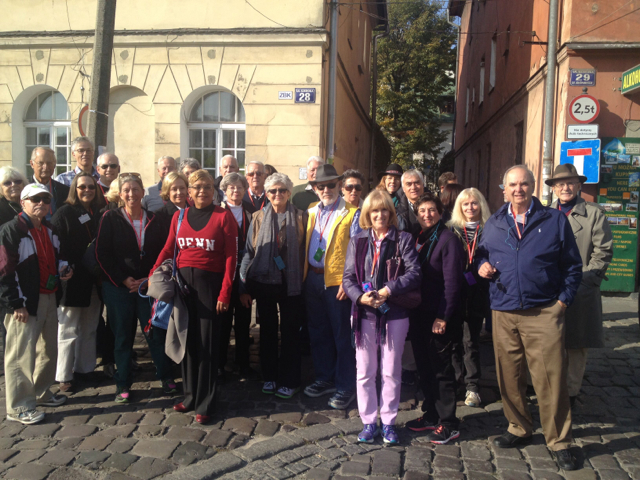
Proud Penn Alumni along on the Danube cruise.

Proud Penn Alumni along on the Danube cruise.

[Penn Alumni Travel is heading back to Vienna and Prague during the spring of 2014. History Professor (and seasoned traveler) Thomas Max Safley will be hosting this tour. If you’re interested in learning more about this trip or any of our 2014 tours, please click here.]

Leave a comment

Filed under Faculty perspective, Penn Alumni Travel, Travel

Penn Alumni Film Festival at Homecoming

Homecoming Weekend

Penn Alumni is proud to present the 2013 Penn Alumni Film Festival Lineup! Join fellow alumni, faculty, and students for a weekend of film screenings and panel discussions. Space is limited, advanced registration is encouraged.

Friday, 3:30 PM – 5 PM

Film Sound: The evolution of the subversive art of sound in movies

Claudia Cohen Hall, Terrace Room, 249 South 36th Street

Co-curators David Novack, ENG’86, PennDesign faculty and documentary filmmaker and   Nancy Levy Novack, C’87, PennDesign faculty and Emmy award winning film editor, will share turning points in film sound’s history. Clips will be shared and the floor will be open to robust discussion.


Friday, 5 PM – 5:30 PM

Penn Alumni Film Festival Reception

Claudia Cohen Hall, Terrace Room, 249 South 36th Street

Don’t miss the chance to meet the student filmmakers and network with alumni in the film industry.


Friday, 5:30 PM – 6:30 PM

Student Film Shorts 

Claudia Cohen Hall, Terrace Room, 249 South 36th Street

Join fellow alumni and students for a screening of five short films, each written, directed and produced by current Penn students, ranging in genre from drama and documentary to animation and experimental.


Saturday, 5:45 PM – 8 PM

Head Games, The Film 

 Claudia Cohen Hall, G17 Class of 1969 Lecture Room, 249 South 36th Street

Head Games exposes viewers to one of the leading public health issues of our time, concussion. The film features several of Penn’s leading scientists and clinicians interested in providing evidence-based treatments and improving the lives of those who have experienced lasting effects from a traumatic brain injury. Stick around after the documentary for a panel discussion with medical experts.


Saturday, 8:30 PM
Feature film: The premiere of Mandela: Long Walk to Freedom
Location to be determined
A chronicle of Nelson Mandela’s life journey from his childhood in a rural village through to his inauguration as the first democratically elected president of South Africa.
Rita Barnard, Professor of English and Comparative Literature at Penn, will introduce the film. To date, she has published two books: The Great Depression and the Culture of Abundance and Apartheid and Beyond: South African Writers and the Politics of Place. She is also the editor of The Cambridge Companion to Nelson Mandela (forthcoming in 2014, in time for the 20th anniversary of South Africa’s democracy) and is working sporadically on a series of essays on apartheid education.

Click here to view all Homecoming Weekend events.

Register Today!

Leave a comment

Filed under Uncategorized

New Kid on the Block

Author: Alyssa D’Alconzo, GED ’04, GRD ‘11

On October 1, I became the newest member of the Sweeten House family, moving into a third floor office and the role of Director of Alumni Education, Alumni Travel, & Career Networking.

photo%203

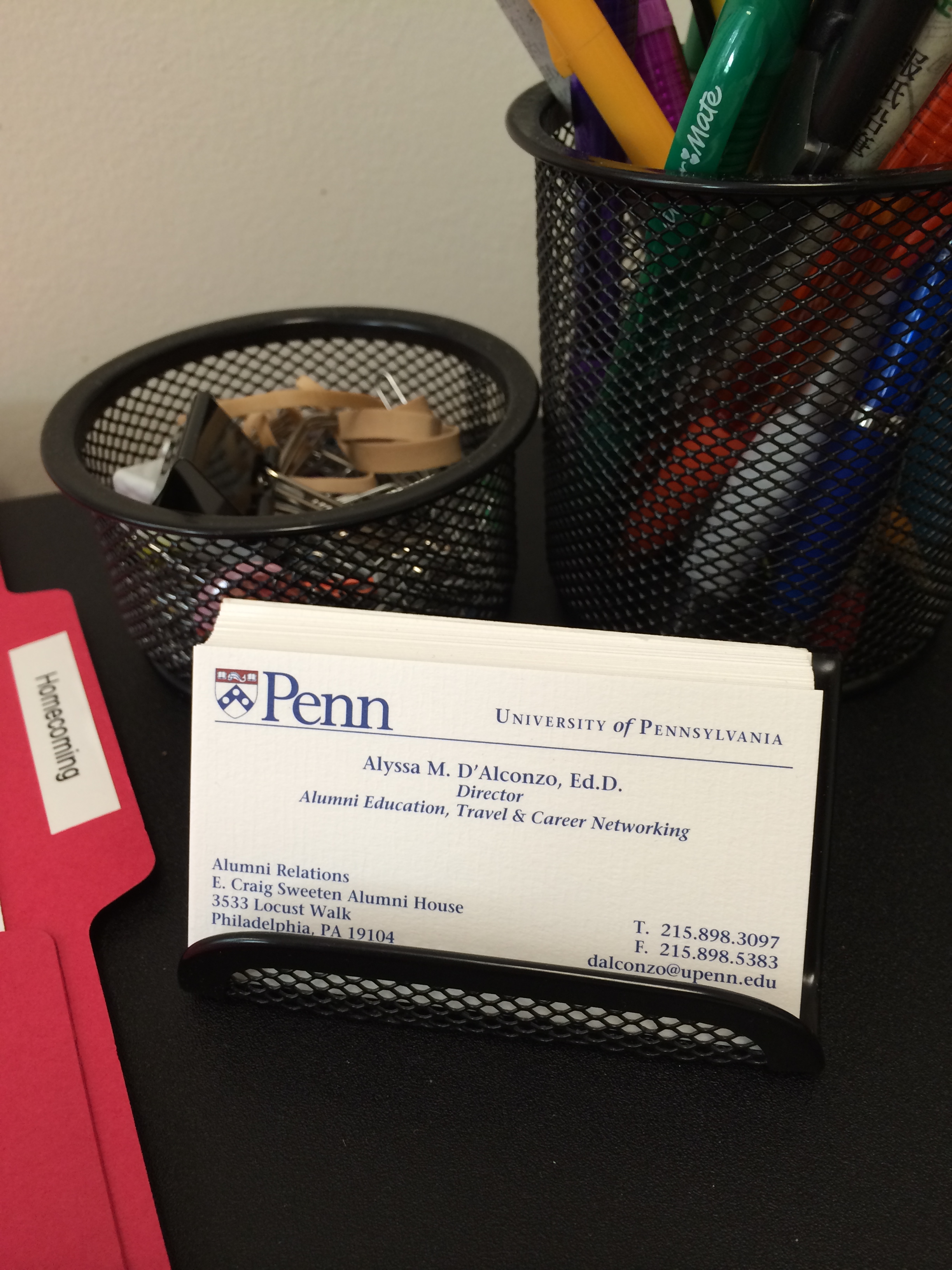
Proof my title fits on a standard-size business card.

I was so excited that I even took a “first day of work” picture!

photo%202

While I’m new to Alumni Relations, I’m not new to Penn.  I arrived on campus as a master’s student for the 2003-2004 academic year. After completing my M.S.Ed. in higher education and falling in love with Penn and Philadelphia, I took a job with the Penn Graduate School of Education. I continued my career at 3700 Walnut Street for last next 9 years, ultimately concluding my tenure there as the Director of Admissions & Financial Aid.

Along the way I earned a doctoral degree, also in higher education, during which my research focused on the information barrier to college access.

photo-92

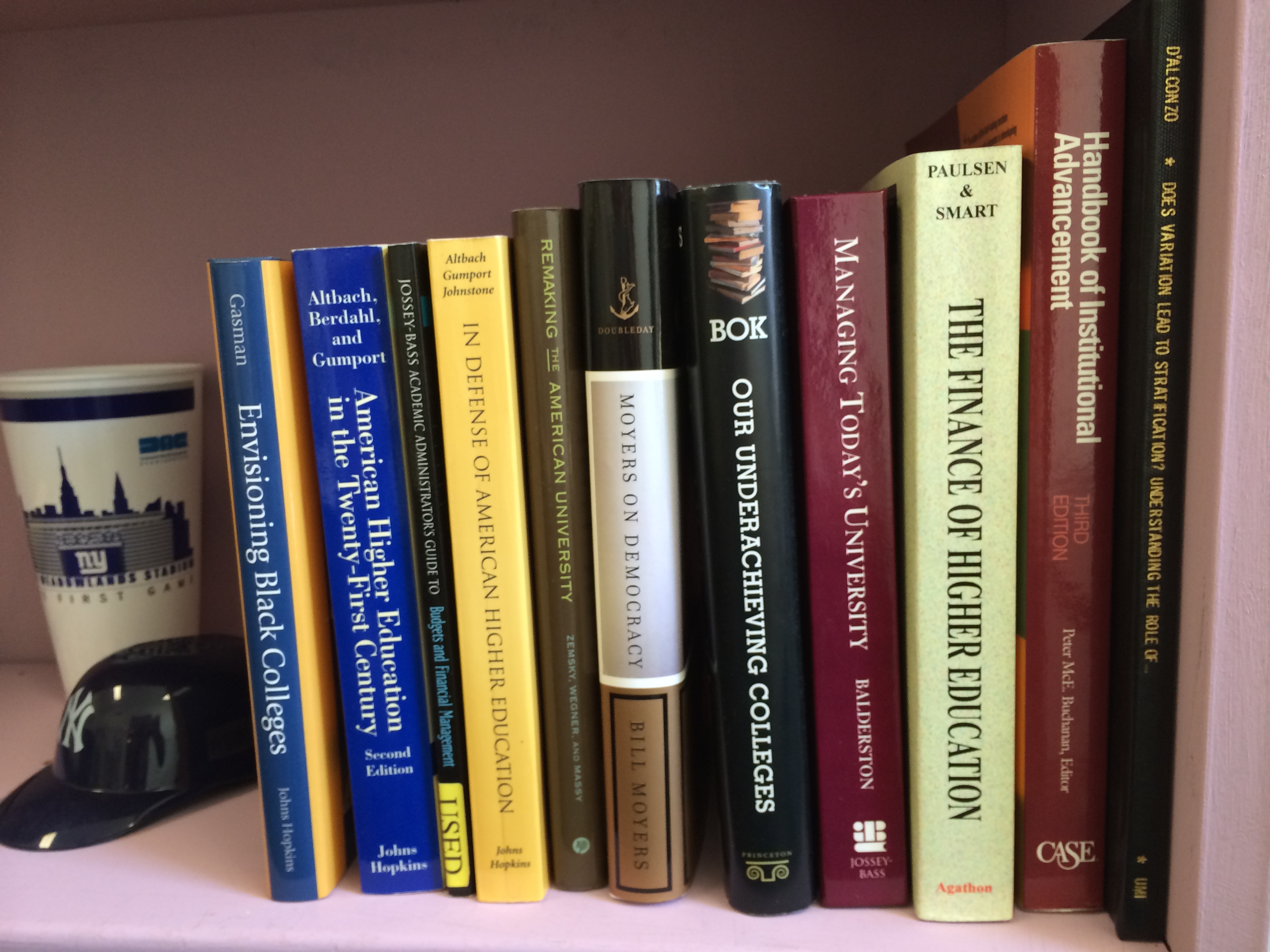
My dissertation joins other important works in my office bookcase.

When I’m not at work, you can find me exploring Philly and other cities around the world with family and friends, reading great books (To Kill a Mockingbird is my all-time favorite!), working out at CrossFit Center City,

photo%201

and baking, writing, and taking photos for my travel and baking blog Suitcases & Sweets.

Many Suitcases & Sweets treats will end up at Sweeten House for sharing, so be sure to stop by for one the next time you’re on Locust Walk! I’d love to meet you and hear about your Penn experience and education, travel, and career networking needs. I’ll also be around all weekend at Homecoming (are you registered?!), in Cuba with Penn Alumni Travel in January (there are still a few spots left to join me!), and online through our webinar series.

Everyone at Sweeten House has been incredibly welcoming and open to collaborating, and I’m looking forward to a future filled with developing and implementing dynamic programming that connects you — our alumni and friends — with the intellectual and professional life of this great university.

Leave a comment

Filed under Alyssa D.