Category Archives: Historical

Teach Me How To Dougie

Author: Liz Pinnie

Yesterday I scurried through my Sweeten closing tasks (close windows, turn lights off, give self a pat on the back) in an effort to leave a few minutes early.  Why the hustle?  Because I wanted tickets to see First Lady Michelle Obama and Dr. Jill Biden who are speaking at Penn today!  Now, there are a lot of fantastic things happening on Penn’s campus, and I recently haven’t been making the time to attend them because 1. I just moved into a new place and 2. I just moved into a new place.  However, for Michelle (am I allowed to call her that?  I feel like she’d be cool with a first name basis thing?), I am throwing caution (and laundry) to the wind and heading out to see her speak.  The reasons are two-fold.

One:

To me, Michelle Obama is a fantastic role model for the modern woman.  She is an intelligent, strong, and graceful woman, and I am delighted that she is representing our nation as First Lady.  Additionally, that lady can move!  Please see below video:

Two:

I am thrilled about the initiative that Michelle Obama and Jill Biden are at Penn to present.  Both women have made a commitment to support our troops and their families through “Joining Forces”.  Joining Forces works to provide much needed support to the men, women, and families who make sacrifices every day in service to our country.  Today Mrs. Obama and Dr. Biden come to Penn to speak about one of the initiatives of Joining Forces, which is a focus on education and treatment of Post Traumatic Stress Disorder and Traumatic Brain Injury.  According to White House data, PTSD and TBI affect approximately one in six of our veterans.  Though they are life altering disorders, they often go undiagnosed or untreated.  Today in a presentation in conjunction with Penn Nursing, First Lady Obama and Dr. Jill Biden will “announce a major initiative by more than 150 of America’s leading nursing organizations and more than 450 nursing schools in 50 states and territories to ensure our nation’s nurses are prepared to help meet the unique health needs of service members, veterans, and their families”.

I cannot wait to hear about this initiative, and to see a truly inspiring woman speak.

1 Comment

Filed under Campus Life, Events, Historical, Liz P., Uncategorized, Video, Videos

Penn and Wharton Club of Arizona Celebrate Ben’s Birthday

Author: Laura Solie, W’08

In January, forty Penn Alumni from the Wharton Club of Arizona gathered to celebrate the birth of Ben Franklin. The event, an annual tradition within Penn and the Wharton Club of Arizona, brought together alumni both young and old to cheer the birth of Penn’s founder.

After mingling around the catered food and sparkling conversation with friends, our Penn President reined us in for official introductions. As we went around the room introducing ourselves by name, school, graduation yard, and quick life updates, several things became apparent.

First, our experiences after graduation were incredibly diverse.  From creating a thirty-year career as a surgeon after studying art history to flitting around the country trying to make it in the hotel industry, our Penn education led us to success in many different directions.

Second, each and every one of us had an unique Penn story to share. Our older alumni recalled the days of Locust Walk when it was a road, while the younger folk dwelt on somewhat hazy memories of Spring Fling.

Third, and what stood out to me the most, was that someone named Candice Bergen had attended Penn and many people recalled knowing her as a student. Once her name was mentioned, the stories flowed. “She was, in fact, my roommate freshman year,” one alumna fondly remembered.

“Oh, of course! Candice Bergen! I have watched all of her movies,” shared another excitedly.

I found myself wondering who the heck this person was, and why I wasn’t more up-to-date on our Penn celebrities. After references to movies that were released way before my time (The Hunting Party??), I quickly searched for her name on my iPhone. “Oh!” I exclaimed after a moment. “The crazy mom in Sweet Home Alabama and on TV as Murphy Brown! She went to Penn? Awesome!”

And with that, I left another Penn event with pride for our accomplishments and the great feeling of being part of a special group–a group, as I now know, that includes a very famous celebrity.

Penn alumni enjoying conversation and recounting tales of a famous alumna.

For more information about other Penn & Wharton Club of AZ activities, visit the club website here.

1 Comment

Filed under Clubs, GAN, Guest blogger, Historical, Memories of Penn, Penn Clubs

Campus Landmarks: The Class of 1956 Trolley

Situated directly across from the Quad at 37th and Spruce Streets, the class of 1956 Trolley is one of the most remarkable nostalgic pieces on campus. Created in the style of trolley that used to rumble down Woodland Avenue in front of College Hall throughout much of Penn’s history, the trolley car serves not only as the entrance to the 37th Street Septa station, but as a reminder that in the not so distant past campus was even more urban than it is today. Donated as part of the class of 1956’s 50th reunion gift in 2006, a plaque inside the trolley tells its story as such:

“The Class of 1956 Trolley is a replica of the Peter Witt Trolleys that carried generations of commuting students to Penn from all parts of the region and also provided convenient access from campus to cultural and other attractions in Center City Philadelphia.

With noisy steel wheels and clanging bells, these trolleys created a constant interruption to campus life and were an unforgettable part of the Penn experience. Operated by the Philadelphia Transportation Company (a precursor to Septa), routes 11, 34, and 37 ran through the Penn campus on Woodland Avenue and Locust Street for nearly 65 years. In 1956 they were relocated underground, enabling the University to begin conversion of the university to a unified and attractive landscape environment. Woodland Avenue and Locust Walk became the first pedestrian walkways through the campus.

The Class of 1956 Trolley was fabricated by the Gomaco Trolley Company in October of 2006. The original Peter Witt trolleys were manufactured by J.G. Bell from 1923-1926.”

Trolley Tracks in front of College Hall. Date Unknown.

The Class of 1956 Trolley. The Quad is visible in the background.

Controls at the front of the trolley appear much as they did in the original Peter Witt cars.

Benches inside the trolley allow a weary passenger or passerby a place to have lunch or enjoy the view.

The actual entrance to the 37th Street station provides access to trolleys heading eastbound towards Center City.

Leave a comment

Filed under Campus Life, Historical, Jason S.

Happy President’s Day!

Author: Aimee LaBrie

I didn’t realize until today that the 9th United States President, Mr. William Henry Harrison, was a graduate of the University of Pennsylvania. Sadly, he only held office for 32 days, before falling victim to complications from pnemonia.

Here are five other surprising facts about this distinguished alumnus:

1. At age 68 during the time of his inauguration, he was the oldest president elected into office until Ronald Reagan’s election in 1980.

2. He was also the last president to be born before the United States Declaration of Independence was written.

3. His inaugural address was the longest and the coldest in history–lasting nearly two hours in the bitter March wind (could this have been why he died of pnemonia one month later)?

4.Last President born as a British subject, before American independence.

5. His grandson, Benjamin Harrison, was the 23th President of the United States.

For more interesting info about President W. Harrison’s campaign against Van Buren and ultimate election, courtesy of the History Channel:

http://www.history.com/flash/VideoPlayer.swf?vid=6031377701

Leave a comment

Filed under Academics, Aimee L., Historical, Uncategorized

The Mungermen

Author: Richard “Dick”Rosenbleeth, Class of ’54

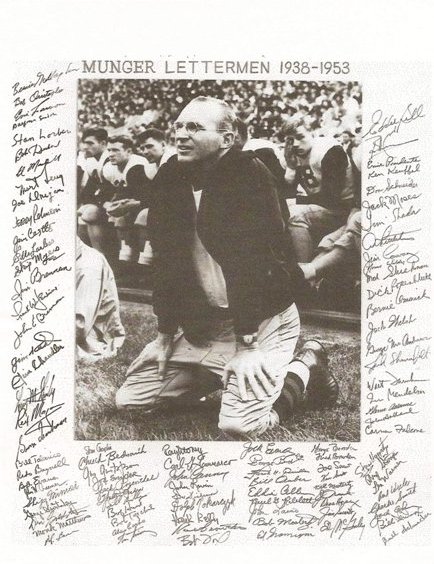
On October 24, 2009, the Mungermen held their annual reunion brunch before the Penn-Yale football game. More than 100 people were there; 40 Mungermen plus family and friends.  The Mungermen are those who played football under Coach George A. Munger (’33) from 1938 to 1953.  They also include those who were an integral part of the Munger teams – assistant coaches, doctors, trainers, and administrative personnel.  The reunions have taken place since 1956, always before a Penn football game.  In the beginning, there were approximately 241 Mungermen and about 100 survive today.

I went to my first Penn football game in 1940 when I was eight years old.  After that, I saw most games when I had a ticket and, later on, when I sold programs at Franklin Field.  In 1950, I came to Penn and played freshman and varsity football under George Munger, graduating in 1954.  So I have a clear picture of the Mungermen during the forties and fifties. I thought it would be timely to share the story of the Mungermen with others.  Much has been written about George Munger and rightfully so, but little about the Mungermen as such.

The Mungermen have bonded together all this time based on shared experiences and the memory of  George Munger who passed away 15 years ago.  Although the range in Classes is 1939 to 1956, the age differential is of no significance.   The idea for the reunions came from a meeting between George Munger, Jack Welch (’43), Bill Talarico (’49) and Bernie Lemonick (’51). Jack, Bill, and Bernie were Mungermen coaches and players.  Bernie is the current very dedicated leader.

George Munger is a College Football Hall of Fame coach and, as an undergraduate, was a star in football and track and field.  He was 28 years old when he became Head Coach and held that title for 16 years.  He had a record of 82 wins, 42 losses, 10 ties and a winning percentage of .649.  He left coaching in 1953 at age 44.  Penn football was in turmoil then because of the collapse of President Harold Stassen’s “Victory with Honor” Program.  He resigned because he and his long-time excellent assistant coaches Rae Crowther, Paul (PG) Riblett and Bill Talarico were blindsided by Penn’s decision to become part of the formal Ivy League. This not only impacted the coaches, but also the Mungermen Classes of 1954, 1955 and 1956.

The Ivy League Agreement banned spring practice and cut back on scholarships for football starting in 1953 and beyond.  In addition, the rules were changed in 1953 banning two-platoon football.  Games were already scheduled against the best teams in the country for the next three years.  Despite all this, Munger and his staff stayed on for the 1953 season, his first and only losing season, but that was the end of the Munger era.  After that, George Munger became Director of Physical Education and was never heard to complain about these events.  He was a loyal Penn man to the end.

A “last hurrah” dinner honoring George Munger on his 80th birthday was held on November 22, 1974.  The Dinner Program read:

“Here on the campus of the University of Pennsylvania, we, his players, are gathered tonight with George Munger to celebrate the occasion of his 80th birthday.”

Football coach, role model, advisor, and friend to us all, he keeps the memories of the days when we wore the Red and Blue under his leadership fresh in our thoughts.  Followers of Pennsylvania football will long remember his powerful single wing teams for their aggressive play and colorful performance.

During his 15 years as head coach, his teams were nationally recognized for their ability to play the best, and thousands came to Franklin Field autumn after autumn to spend an exciting afternoon of football.

We salute him in his 80th year for a job well done, for memories which are irreplaceable and for the unique pleasure of having been a “Mungerman” in a memorable era of Pennsylvania football.

This, in the main, explains why the Mungermen have stayed together all these years.  But there is more to the story.  George Munger had great affection for his players and that great affection was returned.  My own personal experience confirms this.  He was not the typical football coach.  He was quietly articulate and inspiring; and preferred to be called George, not Coach Munger.  He wanted his players to succeed as students, football players and after in their careers or professions.  More than ninety percent of them graduated.

Each year before the last game of the year against Cornell, George told the team:  “Fight like Hell, beat Cornell and no school [practice] Monday.”  He would be pleased to know that his players still have “school on Monday,” even though it is only once every year.

The Mungermen[1] during their playing days won 9 unofficial Ivy League titles (no formal Ivy League existed until after 1956); competed against the best teams and best players in the country; led the nation in attendance year after year; and achieved a winning record. The best teams were: 1940 (6-1-1), 1941 (7-1) and 1947 (7-0-1). The most memorable games were: Cornell 1940 (22-21), Duke 1944 (18-7), Navy 1946 (32-18), Princeton 1946 (14-17), Army 1947 (7-7) and 1948 (13-13), Dartmouth 1950 (42-26), Wisconsin 1950 (20-0) and California(7-14), Army 1951 (7-6), Princeton 1952 (13-7), ending Princeton’s 24 game winning streak, Navy 1953 (9-6), Notre Dame 1952 (7-7) and 1953 (20-28), and 1953 Ohio State (6-12) and Penn State (13-7).

Harlan Gustafson (’39), Ray Frick (’41), Frank Reagan (’41), Bernie Kuczyski (’42), Bob Odell (’43), George Savitsky (’48, four times), Skip Minisi (’48), Chuck Bednarik (’49, two times), Bull Schweder (’50), Reds Bagnell (’51), Bernie Lemonick (’51), Gerry Mcginley (’52), Eddie Bell (’53, two times), and Jack Shanafelt (’54)  were All-Americans.  Odell, Bednarik, and Bagnell won the Maxwell Award.  Some were All East, named to All -Opponent teams and played in post season All-Star games.  A few are in the College, Pro-Football, Pennsylvania State, and Penn Halls of Fame.  Others were good solid players, some were substitutes and some “meatballs” who came to practice every day and helped the varsity prepare, but all were important to the football program.  These were the glory years of Penn football when Franklin Field was filled to capacity every Saturday in the fall.   The Penn football games were the talk of the town and Penn was nationally recognized as a football power.

The Mungermen have served their country in World War II, Korea, and Vietnam, and also served their communities. They have become successful doctors, dentists, lawyers, educators, artists, coaches, businessmen, executives and entrepreneurs. Quite a few have been active in alumni affairs as trustees and otherwise.  Some have made significant financial contributions to the University.

In 1994, the Mungermen contributed 1.5 million dollars to establish the George A. Munger Endowment for Football at Penn.  Our fine coach, Al Bagnoli, is currently the George A. Munger Head Coach for Football.  Today a statue of George Munger stands at the West end of Franklin Field, erected with funds raised by the Mungermen.  There was also a weight training room in Franklin Field funded by the Mungermen.  All of these efforts were aided by contributions of Friends of the Mungermen.

This, then, is the story of the Mungermen, who have contributed so much to Penn football and to the University.  I hope this has been a worthwhile trip down memory lane, both for those who are and are not familiar with this era of Penn football. 


[1]Don Rottenberg’s excellent 1985 book, Fight on Pennsylvania, was a very helpful source.

1 Comment

Filed under Athletics, Campus Life, Guest blogger, Historical

Five Years at Penn

Author: Kelly Graf

This past Tuesday marked exactly five years since I began my career at Penn. Five years! Ok, so it’s not exactly a lifetime, but it has encompassed a lot of really amazing experiences. Because I try to keep things all about me, I decided to look through these five years and find one of the most exciting developments at Penn for every year that I have worked here. ***Please note that I do not take credit (at these not all) for these accomplishments, though the timing does seem coincidental.

  • 2007:     The Making History campaign was launched. A little over a year after I started at Penn, the University launched its biggest campaign in history with an ambitious goal of $3.5 billion. I celebrated the launch on College Green with thousands of Penn students, staff and faculty.
  • 2008:     The Perelman Center opens. The $302 million, 500,000-square-foot outpatient facility was truly magnificent to see built as I passed every day on my way home. Today, it serves as home to 12 clinical specialties whose staff will work together in multidisciplinary teams aided by state-of-the-art medical technology.

  • 2009:     Vincent Price named provost. After a bittersweet departure with former Provost Ron Daniels, the University community was thrilled when Vice Provost Price was formerly named as Daniels’ successor in serving as the University’s “chief academic officer.”
  • 2010: >George A. Weiss Pavilion completed.  With more than 8,000 square feet of workout space, the two-story fitness center offered an east campus alternative to the Pottruck Center.

  • 2011: Penn Park opens.  What was a huge parking lot full of postal vehicles is now an inviting, specious landscape full of sporting fields, green space and recreational activities. It is truly breathtaking to see the transformation that Penn has accomplished there.

I can’t wait to see what the next five years brings to Penn, thanks to gifts and support from our loyal friends and alumni.

Leave a comment

Filed under Campus Life, Historical, Kelly G.

Penn Traditions of the not-so-Distant Past

Before there were skimmers or Hey Day, Penn was home to a number of yearly contests and rituals pitting Freshman students against their Sophomore counterparts. The Push Ball Fight, an athletic event where the two opposing classes carried a six foot high ball around a field in an attempt to score goals, was quickly dismissed as “not very interesting to the spectators, nor to the participants.” With hundreds of participants shoving one another in a bid to move a giant sphere across a line and final scores ranging between upwards of 0 and 2 points (who among us can forget the excitement of the tie 0-0 Push Ball Fight of 1911), Push Ball came to an unceremonious end in 1913.

Proud Penn men preparing to push a ball, 1908.

Dating back to 1867, the rules to the Bowl Fight were relatively straightforward. The freshmen provided a student to serve as “bowl man” and the sophomores provided the bowl. If the elder class succeeded in placing the bowl man into their vessel, they were declared the winners. If the freshmen broke the bowl before this occurred, they were crowned the victors. As time went on the competition became more spirited and bloody, with the Provost himself attempting to intervene in 1873. Finally, in 1916, the fighting had become so fierce that a student was killed during the course of the battle. The Bowl Fight was quickly abolished, however the bowl (along with other awards such as the spade, cane, and spoon) is still awarded to a member of the senior class during Hey Day even today.

Scrambling for the Bowl, 1895.

Perhaps one of the stranger and longest enduring traditions was that of the Sophomore Cremation.  From 1877 to 1930, members of the Sophomore class would don black robes and process from the U.S. Mint in downtown Philadelphia westward to campus. The school band would play a funeral dirge, while the students clutched volumes of their most hated text books in their hands. Upon arriving at Penn, the books, along with effigies of less popular professors, were placed upon a burning funeral pyre and cremated. Afterwards attendees were given the chance to eulogize the incinerated tomes through poems and prose. Of course the freshmen, not wanting to be left out of the festivities, pelted the funeral goers with rotten eggs and other projectiles; an act that often led to escalating violence. Because of these transgressions and clashes with local law enforcement, the Sophomore Cremation was officially abolished in 1930.

Advertisement for the Sophomore Cremation, 1908

You can read more about these and other colorful student traditions from throughout the university’s history at the Penn Archives Website.

Leave a comment

Filed under Historical, Jason S.

Where Were You?

Author: Leigh Ann P.

Everyone remembers where he or she was on September 11, 2001.  People love to share their stories, no matter how boring or insignificant, and I am no different:  I was a sophomore at Dickinson College in Carlisle, PA, and I remember my roommate, Jenn, coming in to our room from her 8 AM class and telling me a plane had flown into the World Trade Center.  I remember still being in bed at 8:46 AM when the first plane hit, so this memory means two things to me:

1. First, this is my JFK-assassination memory moment, and I will never forget it, because like Kennedy’s assassination, it changed everything for a generation of people.  My entire life is now divided into pre-9/11 and post-9/11 memories, and I sometimes make these associations without even realizing it.  (Spice Girls?  Monica Lewinsky?  “Legally Blonde”?  Pre-9/11.  “The Forgotten”?  Justin Timberlake as a solo artist?  “Lost”?  Post-9/11).  The innocence of the last century and the nostalgia I have for it are not simply coincidental.   My entire adult life has been and will always be post-9/11, defined by that most terrifying day; naïveté must be replaced by paranoia out of sheer necessity – not just because I’m now an adult, but because I’m an adult in a post-9/11 world.

2. Second, there was a time in my life when I was able to sleep past 9 AM on a weekday. 

The Daily Pennsylvanian has a great interactive piece with “Where Were You?” stories from current Penn students.  I write as someone who was 19 on the day of the attacks, but many of these men and women were merely 7 or 8 years old on that day.  It is interesting to read about that day from a child’s perspective, and how the situation took on new meanings as they matured.

The DP also profiles five of Penn’s 16 fallen alumni in a touching piece found here.

Tell us in the comments where you were on 9/11/01.

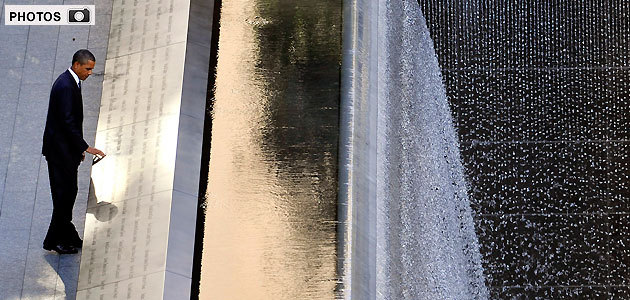
President Obama surveys the 9/11 memorial site at Ground Zero.


Leave a comment

Filed under Historical, Leigh Ann P., Student Perspective

I Remember…Freshman Orientation

Author: Elizabeth Kimmelman Schwartz, C’04

The summer before I left for college, I was a really mean person.  I wouldn’t admit it, but I was completely stressed out about starting school.  Also, being from the suburbs of Philadelphia, most of my friends were going to Penn State.  So, not only was I scared to go to college, but also I had to listen to all of my friends talking about how much fun school would be when they all got there together.  A part of me was so jealous that they would get to experience all of this with a built in friend group and that I had to do the college thing alone.  At the same time, I was so excited to go to Penn and was just itching to start my college life and gain more independence.  It was a very complicated time, which led to me snapping at everyone in close proximity, especially my mother.  I’m really sorry, Mom. Thanks for being patient.

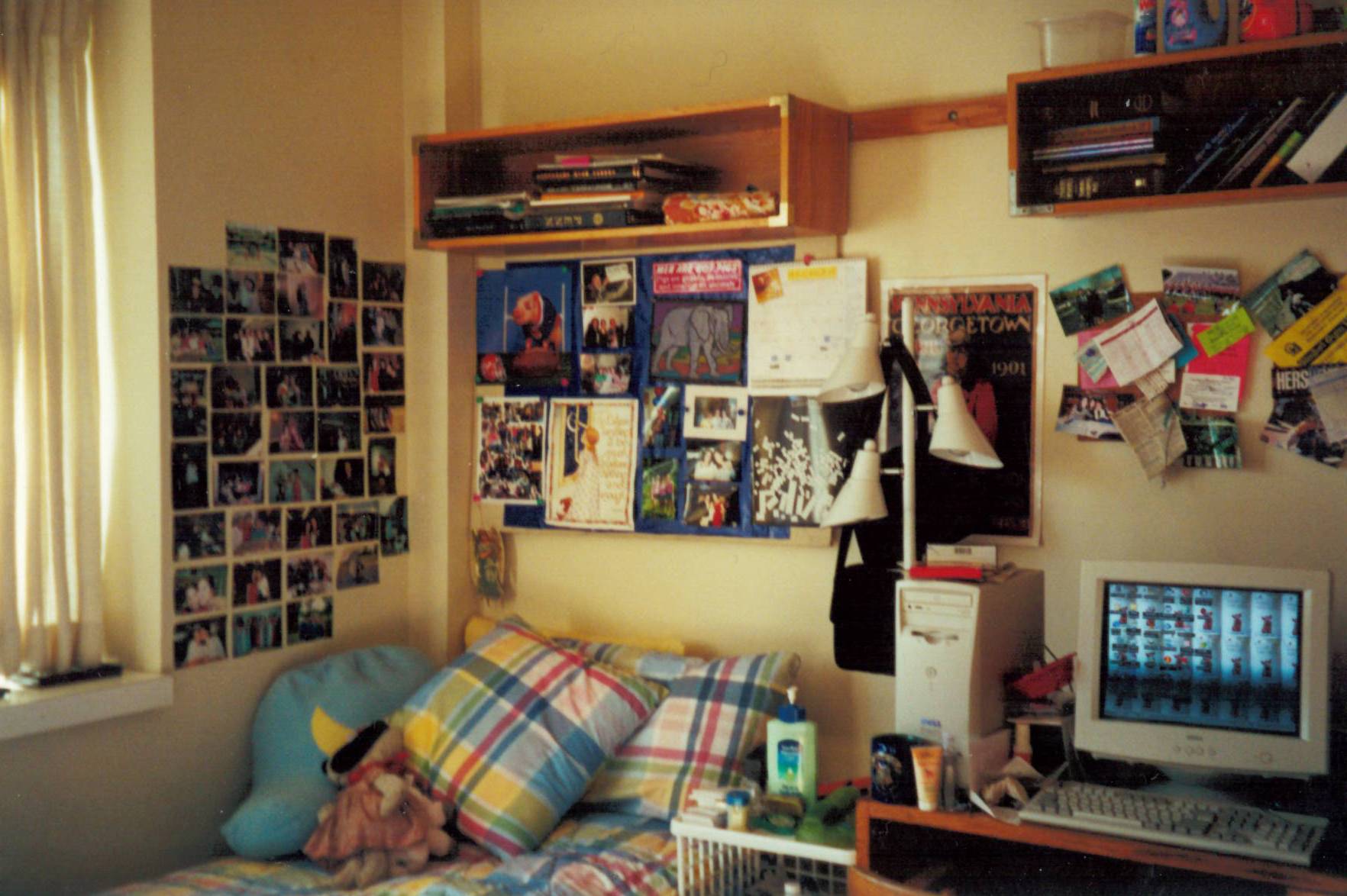
Even with the combination of stress, nerves and excitement, official move-in day went pretty well, besides my Dad almost breaking his back carrying my computer monitor in and out of the car. My family and I were completely enthralled by the concept of the giant rolling carts and were amazed at how efficient the move in staff was. I got to my room before my roommate, so I got to pick my side first and decorate my dorm room to make it the happiest, most colorful place EVER.  I had a collage of pictures on the wall next to my bed, giant corkboard already full of things above my computer, really bright fun bedspread that I had picked out at Bed Bath and Beyond, etc.

My Side of the Room

My roommate, however, was from South Korea and she came with two suitcases.  Her side of the room had a pale violet bedspread, the free Penn calendar on the wall and that was about it.  Grace was nice but very different from me – we quite literally spoke two different languages.  She had never met a Jewish person before and I had never met someone who actually lived in Korea.  A few hours in and already we were part of the Penn melting pot!

Roommate's Side

I don’t really remember a lot about official orientation besides those boring lectures on the Penn Reading Project (our book was Metamorphosis, which I hated, a guy turning into a bug seemed really implausible and I don’t enjoy books that are just one big metaphor), taking a walking tour of West Philadelphia, and attending a big fair for new students in Houston Hall that had a fake casino.  I remember telling myself constantly to not call my parents so I didn’t look pathetic, trying not to sit on AIM all of the time talking to my old friends, even though I wanted to, and every time I left the Quad, hoping that I would come back to my dorm room and see a message on the whiteboard on my door.

The beginning of college wasn’t as easy for me as it seemed to be for other people, and this was frustrating.  Everyone seemed to become insta-best friends with their hallmates.  My “hall” was 8 people – two doubles and four singles.  Grace, my roommate , immediately bonded with the Korean Christian Association so she had her clique.  The two girls who were next door were on the swim team, so they immediately were friends with other swimmers, and the people in the singles across the hall seemed to have no interest in leaving their rooms and making friends.  I didn’t have a built in group to eat meals with or go stand in the awful lines at fraternity parties with.  It was just me.  Luckily I’m an outgoing person, so I just forced myself to talk to people, but it really took awhile to find my footing.

As time went on, things got better.  I became really good friends with the one other person at Penn who I went to high school with. There was a guy in one of my classes who I thought was cute – nothing happened with him, but I did become best friends with the girl who lived next door to him after hanging out at their dorm all of the time (we are still best friends – she was in my wedding in October 2010 and I will be in her wedding in March).  I met the girls from a hall two floors above me and became really close with them, and, subsequently, an adopted member of the third floor of Baird.  A month or so after orientation, and I finally had a hall to hang out with!  Woo hoo!  Slowly but surely,  I was really starting to feel like I belonged at Penn.

So, Penn orientation for me didn’t mean insta-friendships, and now, when I work orientation events (yes, I get to staff that student fair with the fake casino!), I want to go up to the students who seem kind of lost and tell them, “Don’t worry.  It works out!.”  But really, everyone seems kind of lost, nervous and unsure of themselves, even the ones who travel around in the giant packs of insta-friends.  I wish I had realized back then that I wasn’t so alone and that the people who seemed to have a lot of friends were just as nervous as I was.  Also, be honest, how many of you are still really good friends with those insta-BFFs from orientation week?

4 Comments

Filed under Alumni Perspective, Elizabeth K., Historical, Memories of Penn

My Top Penn List: National Register of Historic Places on Campus

Author: Casey Ryan, C’95

As a member of the GAN alumni network staff, I contribute periodically to the Did You Know?, the weekly Penn update to our Regional Alumni Club Leadership.  We review Penn news, read local newspapers, scan recent and upcoming news magazine shows and more for the leads for our stories that we start off with our stylized phrase: “Did You Know…”, like in the following:

Did you know… that Philadelphia is the site of one of only 21 UNESCO World Heritage Sites in the US? Independence Hall was bestowed this honor since it was “directly or tangibly associated with events or living traditions, with ideas, or with beliefs, with artistic and literary works of outstanding universal significance.” Obviously the “works of outstanding universal significance” are the Declaration of Independence and the Constitution, including the Bill of Rights, all of which have influenced lawmakers, politicians and governmental charters around the world.

Independence Hall

I bring this up because I was recently watching Anderson Cooper 360° and someone made a passing reference to UNESCO World Heritage Sites. I figured that I should read up more on World Heritage Sites, having been to a few like the above mentioned Independence Hall, Great Barrier Reef and Delos.  Since I was using Wikipedia for my research, I searched on so many links, and, as was mentioned in a prior entry, I ended up on an interesting reading journey. I eventually landed on the entry on the National Register of Historic Places in Pennsylvania from my starting point of the Independence Hall Wikipedia article.

Independence Hall is the centerpiece of the Independence National Historical Park, a United States National Historical Park.  This NHP, in turn, is on the National Register of Historic Places. Did you know what else is on this register? The University of Pennsylvania Campus Historic District.  This is a significant part of campus is bounded by portions of Woodland and Hamilton Walks, Convention Boulevard,  32nd, Walnut, 36th, Spruce, and 39th Streets. This area comprised of 28 contributing properties.

The Fisher Fine Arts Library, Interior (number 9)

Here are my favorite ten historic contributing properties:

10.          The Quadrangle (a.k.a. University Dormitories) – 1895-1910. The popular dormitory building just had to be on my list.

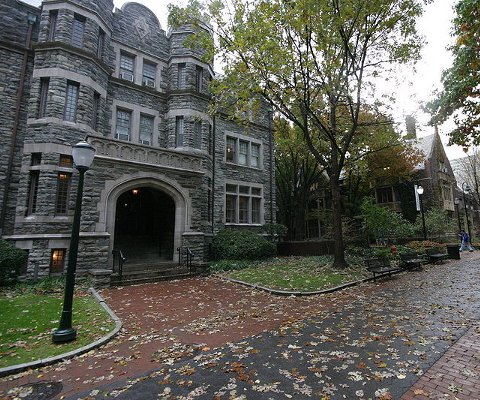
9.            The Fisher Fine Arts Library (a.k.a. Furness Library) – 1888-1891, and Duhring Wing, 1914-1915. This library is one of the pure architectural gems on campus designed by Frank Furness.

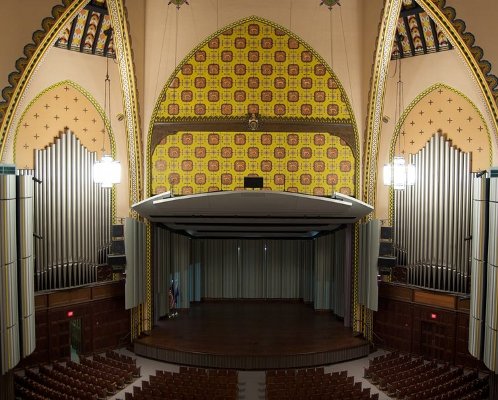
8.            Irvine Auditorium – 1926-1928.  Though there is a false story about the blueprints being an alumnus’s failed thesis, this building holds a grandiose charm.

Towne Building (number 3)

7.            Veterinary School and Hospital – 1906, 1912. Another quadrangular historic building of note on Penn’s campus that hosts Pennsylvania’s only veterinary school (also mentioned in yesterday‘s post).

6.            Richards Medical Research Laboratories – 1964. Like Furness, the Richard Labs are notable for having a famous designer, Louis Kahn.

5.            University of Pennsylvania Museum of Archaeology and Anthropology (a.k.a. University Museum) – 1895-1899; additions, 1912, 1929, 1979, 2002. The original proposal for the museum had planned for the building to be 3 times its size, but it was

250 S. 36th Street, "The Castle" (number 2)

4.            Franklin Field – 1904, 1925. The first double tiered collegiate stadium needs to be on this list.

3.            Towne Building – 1903. The astronomy class that I had in this building always had a feel of being the stereotypical Ivy League setting, so I needed to include the building.

2.            250 S. 36th Street (a.k.a. “The Castle” -Tau chapter of Psi Upsilon Fraternity) – 1897–1899. The lead house on Locust Walk dominates many traditional shots to demonstrate college life.

Irvine Auditorium, Interior (number 8)

1.            College Hall – 1871-1872. The oldest building on the register which house the Office of the President and of the Secretary is the administrative and symbol heart of campus.

An honorable mention goes to the building that houses Alumni Relations, E. Craig Sweeten Alumni House (aka Delta Tau Delta), 1914.

College Hall (number 1)

For a complete list of all 28 buildings, visit Wikipedia’s University of Pennsylvania Campus Historic District entry.

4 Comments

Filed under Alumni Perspective, Casey R., Historical, Philadelphia, Top Ten