Category Archives: Fine Art

The Image as Archive; Towards a Third Cinema

Author: Lisa Marie Patzer

As I walked up the ramp to the second floor gallery at the ICA, I immediately recognized the whirring sound of the slide tray advancing and the click of the next slide falling into place.  Growing up in the 1970’s, I am nostalgic for all things celluloid, including 35mm slides.  Imagine my delight when I saw not one, but four slide projectors, sitting side by side in the gallery, dutifully rotating, loading and projecting images at regular intervals.  This is what I would call a little slice of cinephile heaven.

Still from "Sample Frames", 2011, by Alexandra Navratil

The four slide projectors are part of an installation titled Sample Frames, 2011 by Alexandra Navratil (born 1978) and is featured as part of the current exhibit Living Document / Naked Reality:  Towards and Archival Cinema on display at the Institute of Contemporary Art Project Space.

The show is curated by Jennifer Burris, the Whitney-Lauder Curatorial Fellow.  She states about the show, “Living Document / Naked Reality: Towards an Archival Cinema presents works by contemporary artists who explore cinema’s complex political, formal, and ideological history from the 1910s to the 1960s.  Each project engages with the often contradictory responses to the question ‘What is cinema?’  Together, these works—which include video, found object, and slide installation as well as a series of ‘black box’ screenings and events—provoke both critique and nostalgia for the outmoded film technologies and abandoned utopias of a previous era.”

Alexandra Navratil addresses the question “What is cinema?” through synchronized projections of 81 images that were produced by Eastman Kodak Company from 1916 to 1927 as a series of “color guidebooks”.  Kodak produced these slides in an attempt to demonstrate the correct way of tinting black and white slides.  What is fascinating is the way in which the film material has decomposed over the years, negating their original purpose as “pure sample frames”.  Instead, with the viewer sees are four variations of the same exact image, without reference to what the “true” or “correct” image would look like.

Accompanying the Sample Frames installation is an artist book designed by Navratil, Permanence Vocabulary.  On each page, a single term from the “Imagining Materials-Permanence-Vocabulary” manual is printed and defined. For instance, the first word “Abrasion” is printed in dark gray and following the word is the definition.
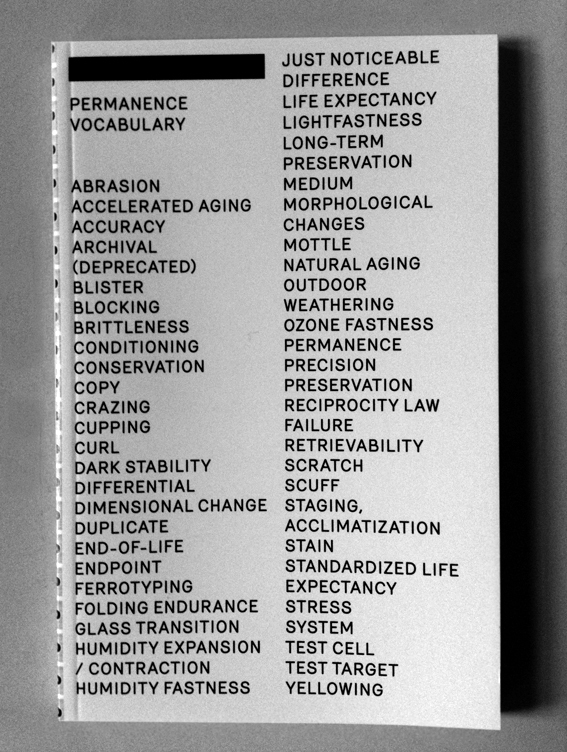
Permanence Vocabulary, Artist's Book, by Alexandra Navratil

The ICA has several events planned in partnership with the International House, Temple University and Penn, to run concurrent with this show.  See here for more information.

Leave a comment

Filed under Events, Film, Fine Art, Lisa Marie Patzer, The Arts, The Arts at Penn, Uncategorized

Pretty Things Junkie

Author: Leigh Ann P.

On Facebook recently, I stumbled upon a friend’s post with a link to a slideshow of the 25 most beautiful college libraries in the world.  I was instantly intrigued because I am a closeted architecture lover.

Many people don’t know this about me, but I have many other interests outside of food, trying to be skinny, photoshopping funny images of my coworkers and drawing pictures with paintbrush during the workday.  Indeed, I love, love, love beautiful buildings.

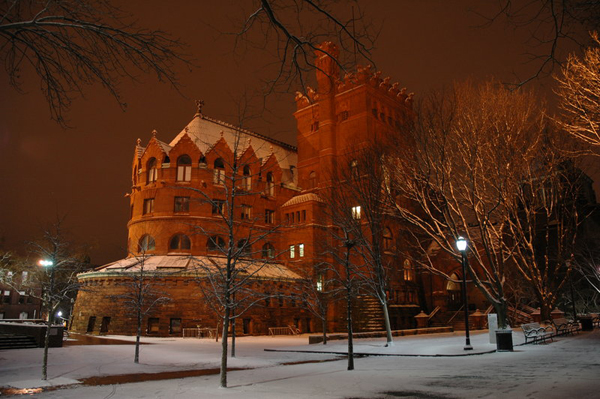
Luckily for me, Penn is full of them.  Not to my surprise, Penn’s own Fisher Fine Arts Library is included in the slideshow linked above.  I find it so interesting that so many colleges and universities put so much emphasis on making their libraries into aesthetic wonderlands, either in the most strikingly modern or in the most ornate, old-world sense, perhaps in an effort to make students want to go there.  This of course is not a new concept; in the Middle Ages people spent decades perfecting their beautiful town churches to make people want to go there as well.

Leave a comment

Filed under Fine Art, Leigh Ann P., Library

The Art of the Office Wall

Author: Lisa Marie Patzer

A recent blog post in MIRANDA, titled “A Space to Inspire Them: Art at Work”, made me think about the art that I am surrounded by here at Penn.  From the Arthur Ross Gallery, to the Kelly Writers House, and the Institute of Contemporary Art, arts and culture play an important role in life at Penn.  During Homecoming Weekend I took the Gallery Hop tour and visited The Arthur Ross Gallery for the first time.  Their current exhibit, Double Take: Series, Multiples, and Prints features prints, photographs, pastels and sculptures from the University of Pennsylvania’s diverse art collection.  One of my favorite photographs in the exhibit is Queen, by Audrey Flack:

Audrey Flack (b. 1931) Queen, 1975 Dye transfer photograph Gift of Seymour Passman

The gallery hop also included a tour of the Institute of Contemporary Art.  Here I was introduced to the work of Charline von Heyl.  I am now a devoted fan.

Charline von Heyl

Painting by Charline von Heyl at the Institute of Contemporary Art

The point of Rachel Pastan’s story, however, is that art belongs not only in galleries and museums, but also in factories, offices, cubicles and other work spaces where we spend most of our time. Pastan emphasizes the importance of being surrounded by art on a daily basis, not only for a sense of décor, but also because art improves employee morale, productivity and helps stimulate the imagination.

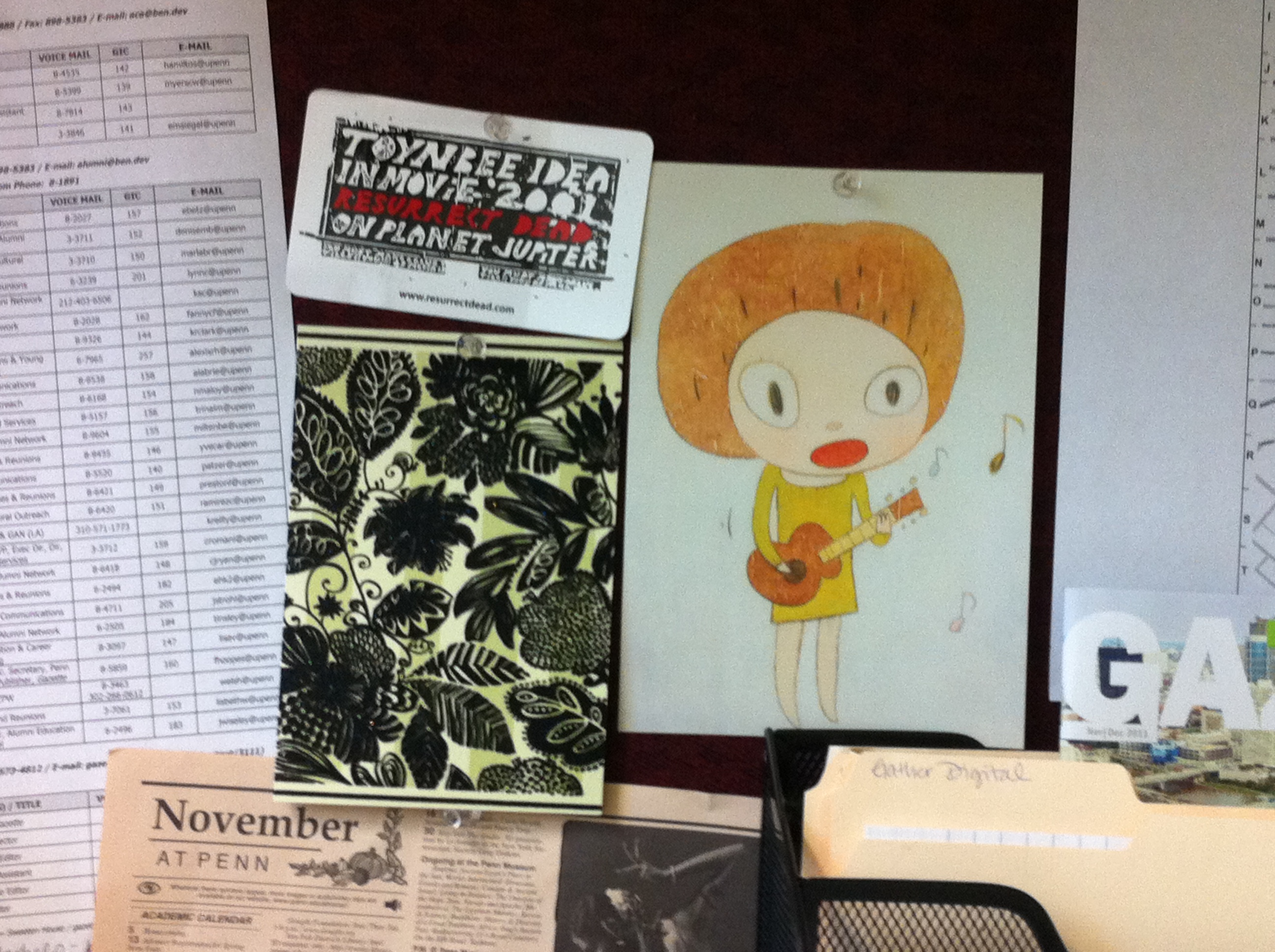
I still plan to frequent the museums, performance spaces and galleries at Penn, but Pastan’s article brought my attention to the wall I face while at work.  I have a few artistic images hanging amidst my work related materials, but there is a lot of opportunity to improve the artistic aesthetic of this space.

Office Wall number 1

Bits of art hanging on my office wall

Office wall photo 2

More bits of art hanging on my office wall

How about you?  What does your workspace look like?  Do you see art on a daily basis?

2 Comments

Filed under Fine Art, Lisa Marie Patzer, The Arts, The Arts at Penn

I Remember…Music Class

Author: Elizabeth Kimmelman-Schwartz, C’04

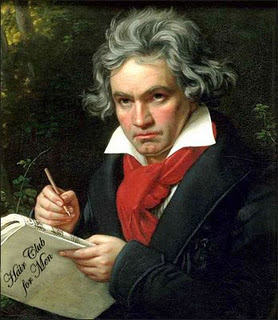
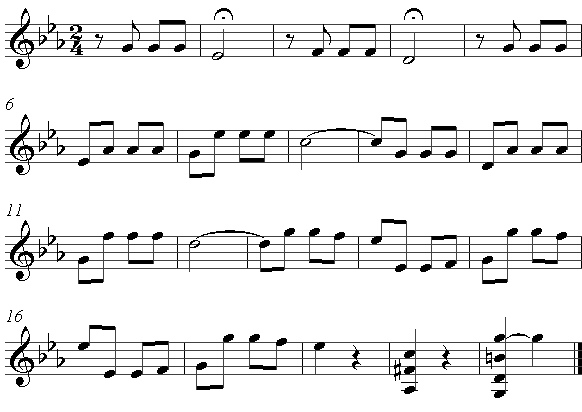
Today, I got an email from the Philadelphia Orchestra (nerd alert – I’m on their mailing list!) advertising a visiting orchestra coming to town and the fact that they’d be playing an all-Beethoven program, including my two favorite symphonies – Eroica and the 5th.  I had a major, all-out nerd attack.  In the span of two minutes, I called my husband, made sure that he was on board with the ticket purchase, ordered us two seats (after memorizing the seating layout in the Kimmel Center, including doing some Google image searches, to make sure the seats were acceptable), and exuberantly ran into another employee’s office telling her about my AMAZING purchase.   Let’s just say that her reaction did not come close to matching my level of enthusiasm.  I’m a classical music nut and I’m proud of it!  I owe almost all of this love to the University of Pennsylvania’ s Department of Music.

As a freshman at Penn, I signed up for a first year seminar called “History of the Symphony.”  I was intrigued by the title and thought it might be a good chance to learn something new.  I sang in select choirs all through high school and was in the shows, plus I enjoyed musical things like Broadway.  My dad is a classical music fan, and I’d always have to listen to classical music in his car when he’d drive me places.  He give me the choice of riding with no music and actually…gasp…talking, or listening to classical music and, to me, the choice was clear.  I’d pretend to hate it, but deep down, I thought it was beautiful.  I liked how listening to classical music stirred my imagination, painted a mood for me, and let me be peaceful and reflective.  I didn’t get to take any classes about classical music in high school, so when I got to Penn, it made sense to me to learn more about it.  I loved my symphony class and before I graduated I took two more music classes, including a music history course and a course entirely on Beethoven.

I’ve talked in this blog before about how Penn is very pre-professional and how I was constantly worried that I didn’t know what I was going to do for the rest of my life.  That’s true – except for the time I spent in music class.  In music class, my fears about what would happen to me, my worries that what I was learning wasn’t applicable to the real world at all, faded away.  I would watch my professor map out a symphony, feeling like I was learning a secret, beautiful code.  I learned what motivated Beethoven to write such deeply meaningful pieces.  I spent hours in the music library, learning how to identify parts of the symphony like the introduction, recapitulation, bridge and coda.  Soon, I was mapping symphonies on my own.  By the end of my classes, I could hear a few seconds of any Beethoven symphony, at any point, and correctly name it.  It was amazing.  I didn’t care how or when I used this knowledge, but for one of the only times in my life I was learning for the joy of learning.  And I was happy.

I didn’t become a music major or even a minor.  I never worked for a symphony or played for one.  But what I gained from my three music classes was so valuable.  I gained a love and knowledge of a true art form, which I will carry with me throughout my entire life.  I learned the power of music to inspire true creativity and emotion.  In learning this, I really think I became a better, more well-rounded person.  When it comes down to it, I think that’s what a good college education should be about.

Leave a comment

Filed under Academics, Alumni Perspective, Elizabeth K., Fine Art, Memories of Penn, The Arts, The Arts at Penn

WXPN and World Cafe Celebrate 20 Years of Musical Discovery

Author: Kim Junod, C’00, MSW C’04

The Penn community has something to be excited about this October. A great piece of our University’s history and culture is turning 20! WXPN’s flagship program the World Cafe with David Dye is celebrating two decades programming all month long. I think all Penn students, faculty, staff and alumni will be surprised to know just how special this program truly is to our community.

The World Cafe has brought something really special to our campus. We house public radio’s leading popular music program. That’s pretty awesome considering that the program first aired out of WXPN’s original location which was a converted row home on 39th and Spruce and was distributed to only five radio stations throughout the country. Today, the program is produced in XPN’s beautiful facility at 30th and Walnut Streets and is nationally syndicated to more than 230 radio stations.

The show has been responsible for bringing so many musical legends to our neck of the woods. Elvis Costello paid a visit to our old station and had to borrow a keyboard from the guys across the street at Pi Lam fraternity. David Dye has interviewed legends like Herbie Hancock, Joan Baez, Pete Seeger, Steve Miller, Tim Robbins, (Penn alum) John Legend, Dave Matthews, Willie Nelson, and Michael Stipe all right on our campus! Now how many Universities can say that!?

We’ve also had many major artists visit the XPN studios for a World Cafe session at the start of their careers. Some of our first timers include Sheryl Crow, Ray LaMontagne, Feist and Adele. Thanks to the World Cafe, the Penn community has some great bragging rights and can say that we heard them first. To check out some more of our first timers, you can visit our 20th anniversary webpage.

WXPN and the World Cafe have served as great learning experiences for many Penn students through their internship program. I started working at XPN as an intern and a few of my colleagues are also Penn grads who started as interns, including our World Cafe line producer Beth Warshaw-Duncan. It’s been an exciting journey working on the World Cafe and I encourage Penn students to continue getting involved with our internship program- if you are interested you can find more info on the internship program here.

Now for the fun stuff… We’re having a month-long party over at XPN and we want you to celebrate the milestone with us!

You can tune into our show Monday through Friday from 2-4 PM to hear some fascinating programming that features the best interviews and artists that have appeared on the show.  You can also visit our home on the NPR Music site to check out these themed programs that we have been broadcasting throughout October or to hear a mix of songs recorded for the World Cafe over the last twenty years. If you love these one-of-a-kind performances, we have created a 20 song sampler for the taking here.

WXPN's Host, David Dye

As much as we are looking back, we are also looking forward. We would love to share another sampler with you- 20 bands we have chosen as up-and-coming talent as a part of our daily World Cafe: Next feature.  You can grab that music here.

We’re going to culminate our month-long celebration during the World Cafe Weekend Celebration from Friday, October 28 through Sunday, October 30 at World Cafe Live. We have some amazing artists coming to visit and pay tribute to the show and David. Throughout the weekend, you can catch performances by the Indigo Girls, John Hiatt, The Little Willies, Feist, Dawes, Amos Lee, Rhett Miller and Susan Tedeschi & Derek Trucks. It’s going to be a blast and we hope you that you can join us. Click here to learn more about the event and buy tickets!

We hope to keep the World Cafe going for another 20 years! We thank all of our fans and the Penn community for supporting us and helping us grow. As a listener supported station, we literally couldn’t have done it without you.

 For more information on what’s happening during the anniversary month, click here. We sincerely hope that you’ll be able to join us as we celebrate this milestone and thank you for your continued support!

Leave a comment

Filed under Alumni Perspective, Fine Art, Guest blogger, The Arts, The Arts at Penn

Art Contest Winner

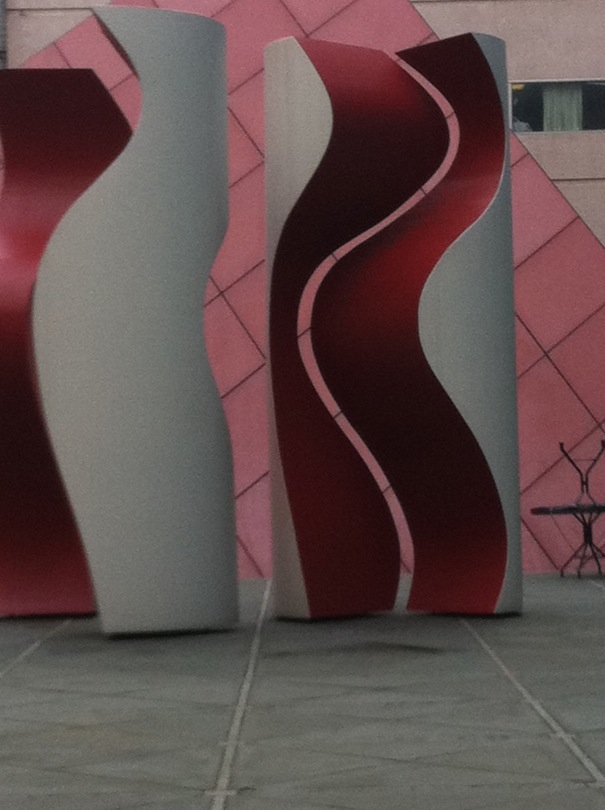
Last week, we asked you to correctly identify both the name and location of the following sculpture on Penn’s campus:

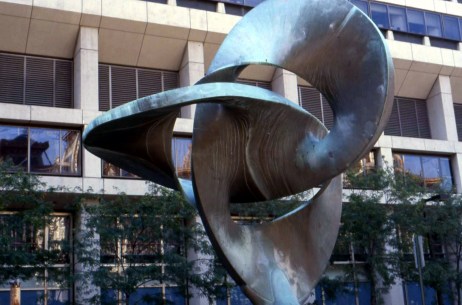
We had a large number of correct responses, but the first to get it right is Lisa Bardfeld Shapiro, C’93. Within minutes of the post, she properly identified the location as Hamilton Walk between HUP and the Med Education Building and the name of the piece as Quadrature# 1 (1977) by artist and Penn Professor, Robert Engman. Professor Engman is also known for Triune, a trifold Moebius strip located near Philadelphia’s City Hall.

In addition, he collaborated with his students to create Peace Symbol (1967) also a favorite sculpture found on Penn’s campus near the Van Pelt-Dietrich Library.

Congratulations to Lisa, who will be receiving  a free Penn T-shirt for her participation. Thank you, too, to our enthusiastic and responsive readers, many of whom also correctly identified this somewhat obscure piece. You can view more of Penn’s art work on campus by going here.
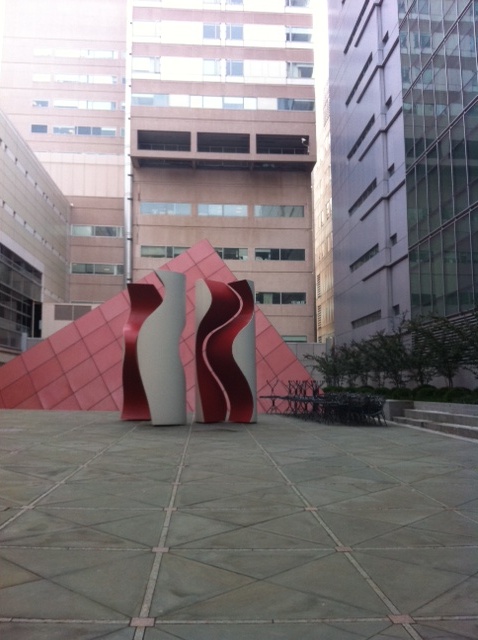
In the meantime, keep checking back for more opportunities to show your Penn spirit and to win!

Here’s the full view of the piece for your viewing pleasure:

Leave a comment

Filed under Aimee L., Campus Life, Fine Art, The Arts, The Arts at Penn

Locust Walk Talk: The Penn Museum

Author: Casey Ryan, C’95

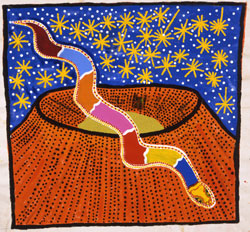
I love the University of Pennsylvania Museum of Archaeology and Anthropology.  One of my favorite reasons is its temporary exhibits.  I profoundly remember one exhibit, the “Track of the Rainbow Serpent: Australian Aboriginal Paintings of the Wolfe Creek Crater.”

In 2005, I was planning to travel to Australia and I was consuming anything I could about the country to be more informed.  I watched Rabbit Proof Fence and re-watched Muriel’s Wedding.  I read Neville Shute’s On the Beach and A Town Like Alice (a.k.a. The Legacy), Bill Bryson’s In a Sunburnt Country, Tim Winton’s Cloudstreet and even Colleen McCullough’s classic, The Thornbirds.  There was even an Animal Planet show that I stumbled upon and watched about a marsupial surrogacy program, which paired human volunteers with orphaned marsupial to recreate a pouch-like environment using book bags to help in there development and growth.  (What a tear jerker. If you don’t cry at folks trying to treat a sick wombat with an infection, you have no heart)! If it was Australia-related, I was there.

In the middle of my building excitement, I learned there was an exhibit of Aboriginal work at the Penn Museum. I was thrilled.  I searched on line for some articles to learn more about Aboriginal Art, and soon visited the Museum.

“Red Rock (Ngaimangaima)” by Daisy Kungah from Billiluna, 2002. Image courtesy of the University of Pennsylvania Museum of Archaeology and Anthropology

The culture of Aboriginal peoples is one of the world’s oldest continuous cultures, art traditions and belief system.  Though interpreted differently group by group, the creation story centers around the Rainbow Serpent, one of the important creative forces in the cosmology, and his travels to create existence during a mystical state called Dreamtiming that transcends time.

Image courtesy of Shreyans Bhansali, C’05, ENG’05

In particular, this exhibit is comprised of works from the Djaru Aboriginal people living by the Wolfe Creek Crater in Western Australia.  The story of a meteorite landing was interpreted as a star falling to Earth.  Wrapped around the light of the falling star is the Rainbow Serpent. The Serpent makes the hole in the new crater upon impact, then he continues to burrow and move underground and through the area to create waterways, landscape features. The Serpent’s movements and creation opened the land up for the Aboriginals’ First Ancestors to come and live.

The Djaru are stewards of this land and due to sacredness of the area custom prohibits them from directly discussing the story. Yet, through painting, using traditional techniques and colors, they can share the stories through art. The art is bold, using bright colors and traditional symbols for water, watering holes, stars and people.  Without speaking, these paintings tell the stories of the traditional way of life for the Djaru.

“Kandimalal (Wolfe Creek Crater) and the Rainbow Serpent” by Boxer Milner from Billiluna, 2000. Image courtesy of the University of Pennsylvania Museum of Archaeology and Anthropology

Thanks to the efforts of the Penn Museum, I had an Australian cultural experience that I wouldn’t have had anywhere in the world as I prepared for my trip.  I gained an appreciation for Aboriginal culture and I didn’t have to leave my figurative backyard to get it.

1 Comment

Filed under Campus Life, Casey R., Fine Art, Locust Walk Talk, Penn in the Summer, The Arts at Penn

Noticing King Solomon

Author: Bart M.

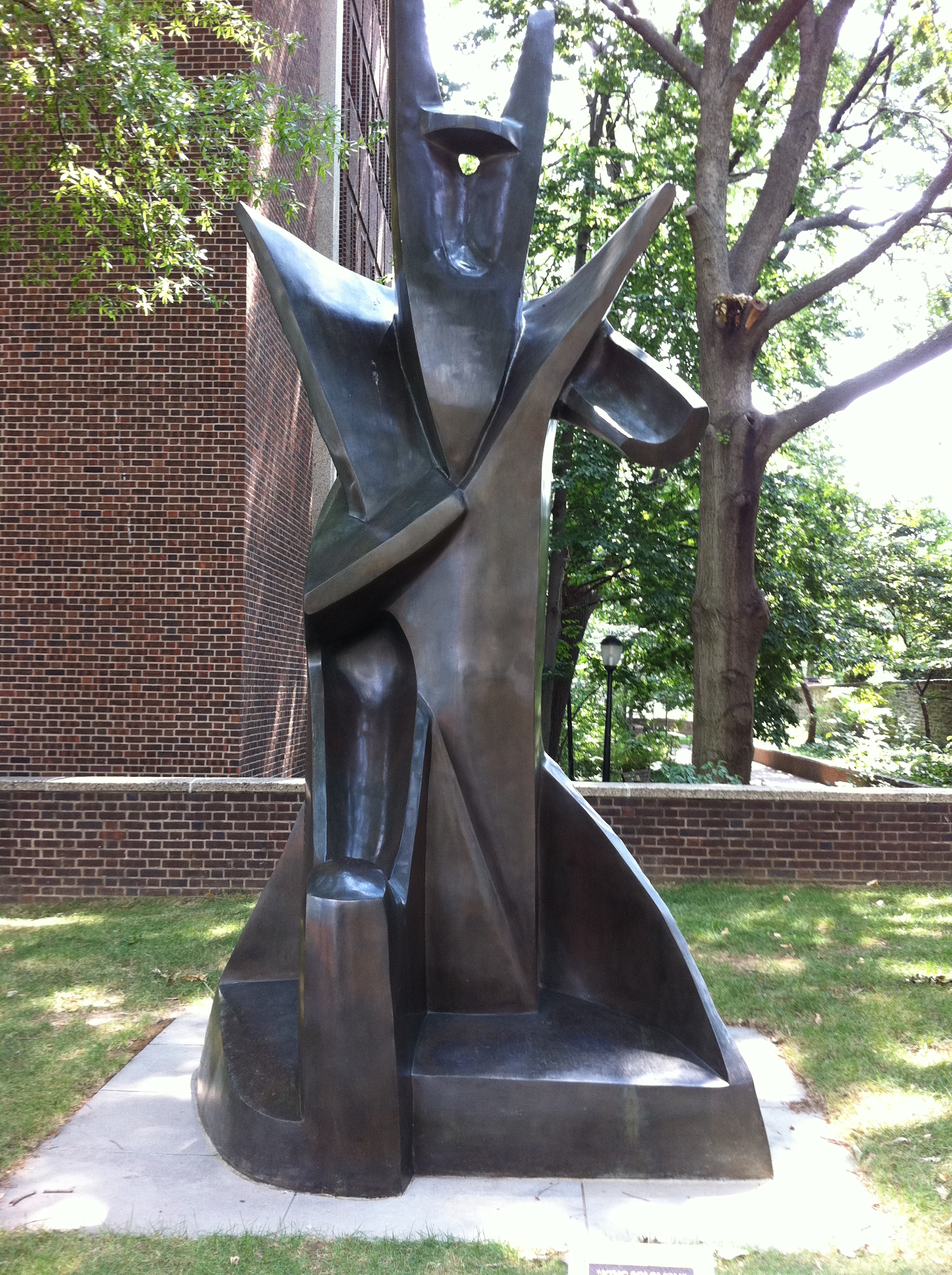
Even though he is fourteen feet tall, I have walked past King Solomon for years and years and barely noticed him. He’s been standing there quietly since my sophomore year at Penn. Until today, I never gavehim much more than a quick glance. This afternoon, I spent an extra minute admiring King Solomon and then I looked him up on Penn’s website to see what his story is.

Truly one of the coolest pieces of art at Penn, the bronze statue King Solomon (1963) was sculpted by Alexander Archipenko and it keeps watch on 36th Street between Locust Walk and Walnut Street (across from the old Hillel and what is now the new Annenberg Public Policy Center). King Solomon  was given to Penn in honor of the inauguration of President Judith Rodin on October 21, 1994 by Mr. and Mrs. Jeffrey H. Loria .

Check out how the cubist shape and form of Solomon mimics/compliments the tree behind it. Not intentional, I’m sure, but cool nonetheless.

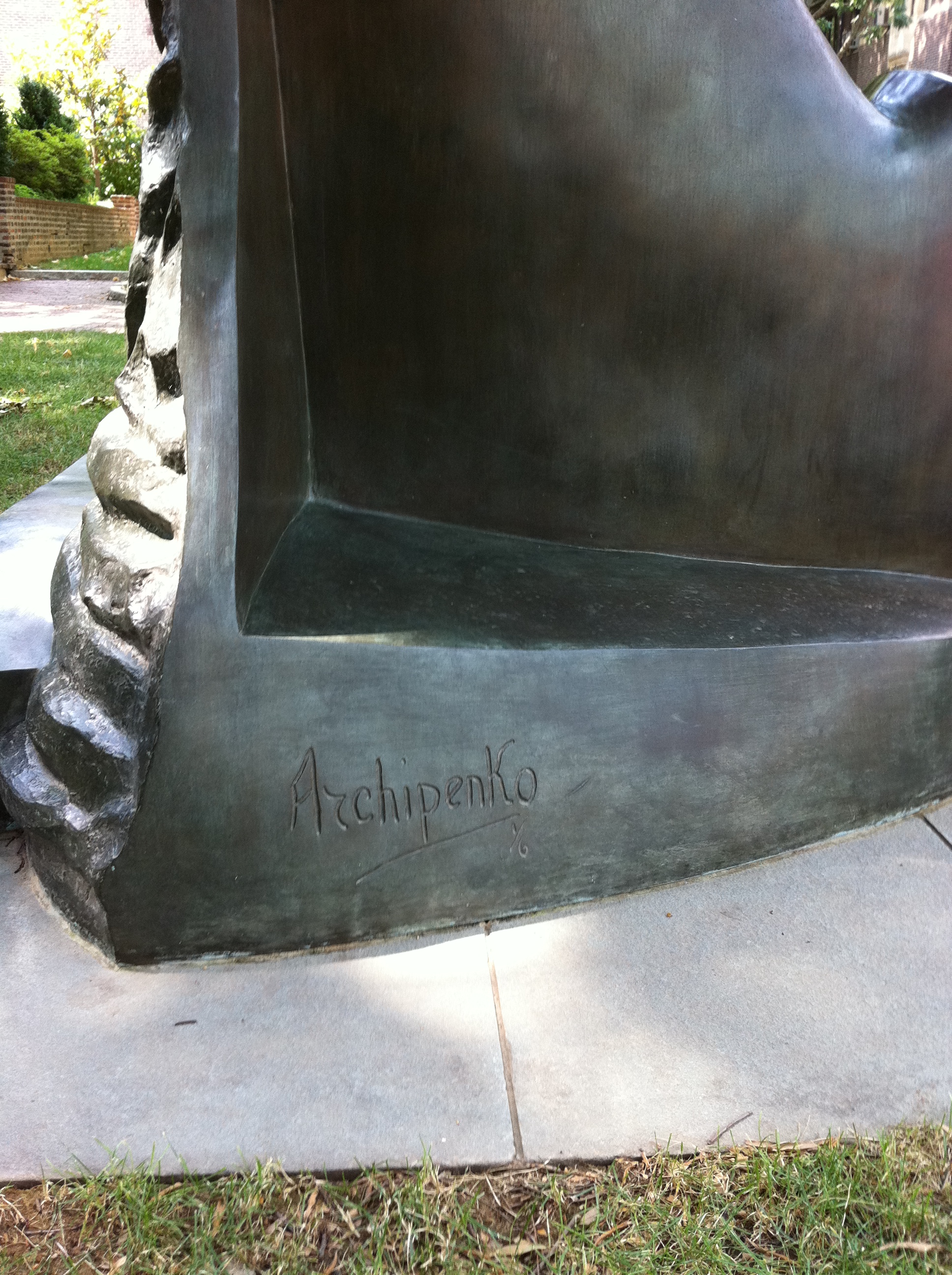
Notice Archipenko’s signature on the left side.

And the plaque at Solomon’s feet:

And here is a view from behind Solomon – something most people have never taken the time to see. The juxtaposition of smooth and rough texture is pretty remarkable. And for a reference point, that is the new Annenberg Public Policy Center just across 36th Street.

And something else I just learned: Archipenko did not normally work on a monumental scale. But shortly before his death in 1964, he completed a 4-foot King Solomon designed for enlargement. Instructions were left with his widow, who supervised the casting of a 14.5-foot, 1.5-ton version in 1968. This is the Solomon that stands on 36th Street. Archipenko’s original plan was for Solomon to be over sixty feet tall.

1 Comment

Filed under Alumni Perspective, Bart M., Fine Art, Historical, The Arts

Penn Fine Arts Abroad

Thanks to a generous gift by Howard A. Silverstein, W’69, and his wife, Patricia Belznak Silverstein, C’81, PennDesign students have been able to participate in the Howard A. Silverstein and Patricia Belznak Silverstein Studios Abroad. Offered every two years, these studios allow a number of undergraduates and graduates from Penn Design the rare opportunity to travel to an exciting, developing city and immerse themselves in its sights and culture.

In 2009, several friends of mine were able to go to Beijing, China where they lived and created work (and blogged). When they returned from the trip, jet-lagged and dazed, I was amazed by the stories, videos and images they shared as they unpacked all their equipment and files–it took every ounce of self-control I could muster not to feel terribly jealous. Several weeks later, I was equally floored at how quickly they were able to turn around work for the gallery show.

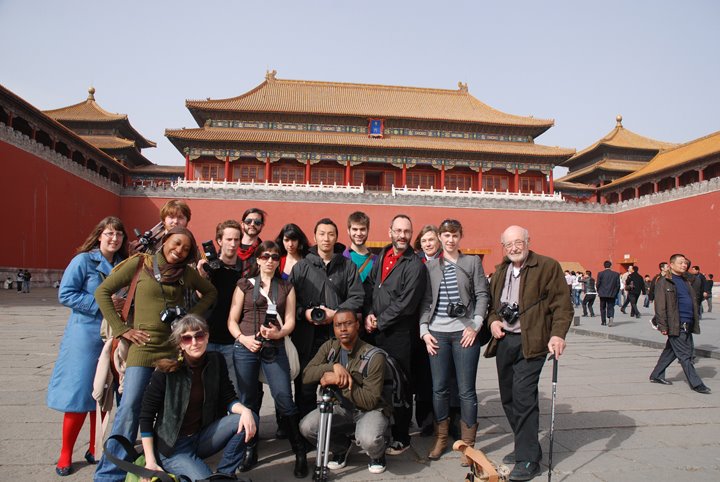
PennDesign in the Forbidden City, Beijing

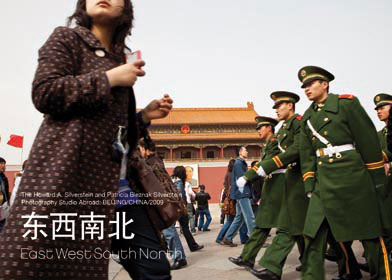
East West South North - show card

The work was surprising, beautiful and inspiring.  The show received a review from the Philadelphia Inquirer, and Penn’s President Amy Gutmann viewed the show with commentary by the artists. Click here to view more photos from her visit to the gallery.

Student describing work to Penn President Amy Gutmann

This year, fourteen undergraduate and graduate students traveled to Mumbai, India to create work for Populous Flows. Again, I was floored by the beauty, color and life in the images and videos. Again, I could really only act like I wasn’t completely and utterly jealous that these students, faculty members and staff were able to experience Mumbai so closely.

Penn Design in Agra, India

The following images were created by a faculty member and a staff member–both of whom I truly admire and respect. The first image was taken with and iPhone and does the piece absolutely no justice. I apologize…

Image from Populous Flows

And amid the hustle and bustle of life and color in the students’ work–to me, this image rounded out the experience, and made it all seem just a bit more human:

Sam Belkowitz - from Populous Flows

Populous Flows is on view at Charles Addams gallery until July 12, 2011. Anyone can view the show 10 a.m. – 5 p.m. Monday through Friday. If you have any interest in photography, art or India, I strongly encourage you to visit!

Populous Flows - Mumbai trip show

2 Comments

Filed under Academics, Fine Art, Memories of Penn, The Arts at Penn, Travel

My Top Penn: Public Art

In 1959, Philadelphia passed a law that called for 1 percent of construction costs to be set aside for fine arts projects. Since then the University has acquired campus art that is displayed inside and outside many of the University building. Throughout campus there are many interesting pieces of art that are the part of the fabric of campus, and I wanted to share with you my favorite 10 outdoor pieces of Public Art.

10.          Quadrature #1 (T. G. Miller Plaza, Hamilton Walk, between HUP and Medical Education Building) – personally, I have likened it to the Medical School’s own Covenant.

9.            125 Years (Hill Square) – this public work has transformed the pathway diagonally crossing Hill Square, aka Hill Field.

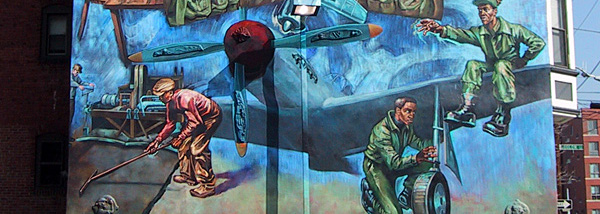
8.            Tribute to Tuskegee (20-22 39th Street – South Wall) – one of the few murals that Penn has supported through this program.

Tribute to Tuskegee

7.            Column + Capital (Hayden Hall Rear Lawn) – this subtle and sometimes unnoticed piece of art is nod to engineering, highlighting the skill of the Greeks and Romans in the middle of Penn Engineering’s buildings.

6.            Solomon (36th Street Walk, South of Walnut street) – this legendary king of Israel both blends in with the grass and flora due to its a green patina and stands out due to its massive size.

Solomon

5.            George Munger (Franklin Field) – Mungermen have left an indelible mark on the football program at Penn  and this homage to Coach Munger is a fitting tribute.

4.            Love (Blanche Levy Park) – this Robert Indiana classic has been a backdrop for many pictures, ranging from wedding save-the-dates to holiday cards.

Love

3.            Ben Franklin – this is a cheat since there are 3 statues of Ben on campus: The prominent Franklin (Blanche Levy Park, in front of College Hall), young Ben Franklin (Weightman Hall on 33rd Street) and the life-sized Ben on the Bench (37th & Locust Walk, South East Corner).

2.            Covenant (Hamilton Village, spanning Locust Walk at 39th Street) – the given name to the large cheery-red sculpture of rolled steel that dominates Hamilton Village, aka Superblock.

Covenant

1.            Spilt Button (Blanche Levy Park at Van Pelt Library) – this one needs no introduction.

To learn more about the Public Art at Penn, visit the PennCurrent article, here and to view a map of public art at Penn, visit Penn’s Facilities Map and check the “Public Art” box.  Are there pieces that you wished I included?  Which ones would you switch out from my list?

In addition, when on campus, art lovers or admirers can learn more about Penn’s outdoor art through the University’s free “Discover Penn” audio walking tour. Launched in 2008 by the Division of Facilities and Real Estate Services, this program provide a number to call, posted on a small, red ground-level sign posted at various sites around campus to hear a short narration about significant University buildings, sculptures, historical events and other points of interest.

1 Comment

Filed under Campus Life, Casey R., Fine Art, The Arts at Penn, Top Ten