Author: Professor Roger Allen, Arabic Language and Literature
[Professor Allen describes his experience as a first-time faculty host on a Penn Alumni Travel trip.]
DAY 1-2
After gathering at Kennedy Airport, we flew overnight by Royal Air Maroc to Casablanca Airport. Thanks to strong tail-winds, we arrived early (about 6.10 a.m. local time), but our guide, Muhammad Dahouac, was waiting outside the customs area when we all emerged. He welcomed us all to his country and took us out of the airport to what was to be our bus for the entire trip, along with its two wonderful adjuncts: Hasan, our driver–his driving skills a model of caution rarely found in Morocco; and (another) Hasan, his helper on everything from unloading suitcases to reversing into improbably small parking spaces. Once everybody and everything had been loaded, we set off for the drive to Morocco’s capital city of Rabat–about a two hour drive up the Casablanca-Rabat autoroute. We stopped for a tea/coffee break on the way (as we were to do most days), and Muhammad begin to fill us in on details of our trip, contemporary Morocco, and the surrounding countryside we were passing.
When we entered the city of Rabat, we were driven to the Tour Hassan Hotel, a wonderful and luxurious facility in the center of the city. I personally took a stroll in the afternoon to refamiliarize myself with the city, but I think many people used the afternoon to get a little rest and sleep after the overnight journey. In the evening we went to a famous restaurant, Dinarjat, in the old city (medina) where we got to know each other a bit better. We were treated to some excellent Moroccan food and watched as the tea was poured for us in the traditional fashion. Making our way back to the bus through the alleyways of the old city, we were being gently introduced to the traditional layout of the Moroccan medina that we were to see later in several other cities.
DAY 3
The tour of the city of Rabat. It was raining (and I learn later that we were at the edge of a very large Mediterranean storm that dumped a year’s worth of rain on Sardinia in a single day, causing massive flooding). We started out at the Royal Palace, with its colorful guards standing by the gate. Moving on, we visited the Chellah, the lovely garden with its combination of ancient Roman remains and medieval Islamic buildings, including the tombs of some saints (and a veritable horde of cats beside a wishing pool). As was to be the case everywhere we went, the tops of columns and other high spots were occupied by colonies of storks (and, in this particular case, egrets as well). From the Chellah we proceeded to the tomb-complex of Muhammad V, the first modern King of Morocco (and grandfather of the present king) who returned from exile in 1955 to rule post-independence Morocco (1956). The mausoleum contains the bodies of Muhammad V, his brother, and the late king, Hassan II (the father of Muhammad VI, the current monarch).
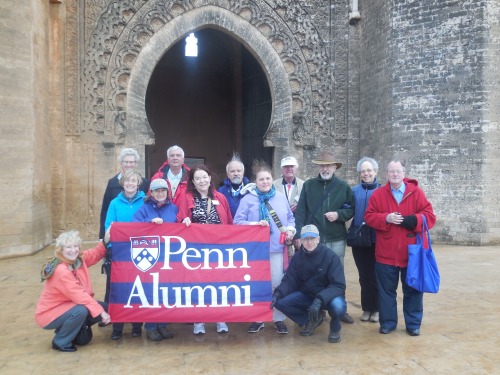
Taking a group photo in the Chellah gardens.
For lunch Muhammad, our wonderful guide, took us to a superb villa-restaurant, BAYT SBIHI, owned and operated by RADIA SBIHI, who welcomed us to her family home and not only fed us a superb meal, but also showed us round the house and displayed here incredible collection of jallabas. The house, in Sale–the city opposite Rabat at the mouth of the Abu Riqraq River, commands wonderful views of Rabat, and, even in the rain, the vistas were marvelous. After this lunch we recrossed the river and went to look at the Oudaya, an old Amazigh fortress complex right at the mouth of the river. Even though access to the ocean-front terrace was closed, we managed to persuade the guard to let us through. We thus were able to look at both the river-mouth and the Atlantic Ocean. Descending the complex via its multiple alleyways, we came across a Gnaua singer plying his trade, and Muhammad joined him in playing the castanets for a short while. We then returned to the hotel.
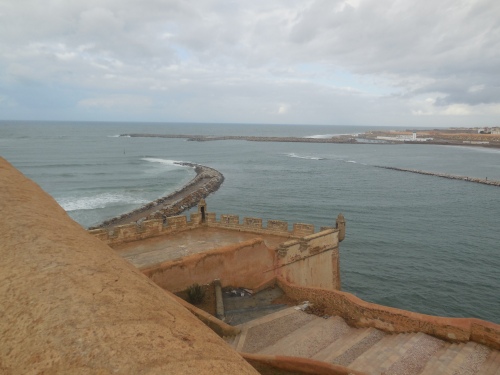
Oudaya and the view of the river mouth into the Atlantic Ocean.
At 5:30 that evening, we had the first of the four lectures that I had arranged. It was an enormous privilege for me and the group that my guest was Ahmed Toufik, the Minister of Islamic Affairs and Endowment in the Moroccan government. I have translated two of his novels, the second of which has only just appeared. Ahmed and I took turns reading from the Arabic and English versions of the second novel (called MOON AND HENNA TREE in English), and following that Ahmed graciously answered questions. With incredible generosity he then invited us all to dinner at a fabulous restaurant on the outskirts of Rabat, VILLA DES AMBASSADEURS, where he joined us for yet another incredible experience in Moroccan cuisine. So ended our first full day in Morocco.
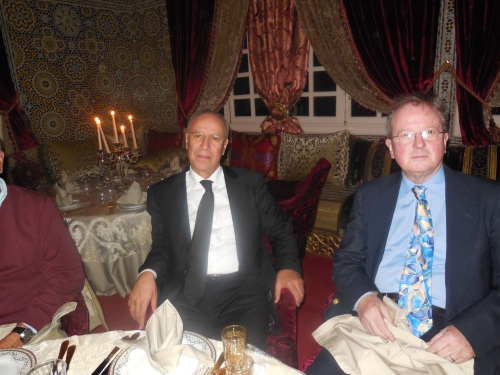
Roger Allen with the Minister of Islamic Affairs, Ahmed Toufik.
DAY 4
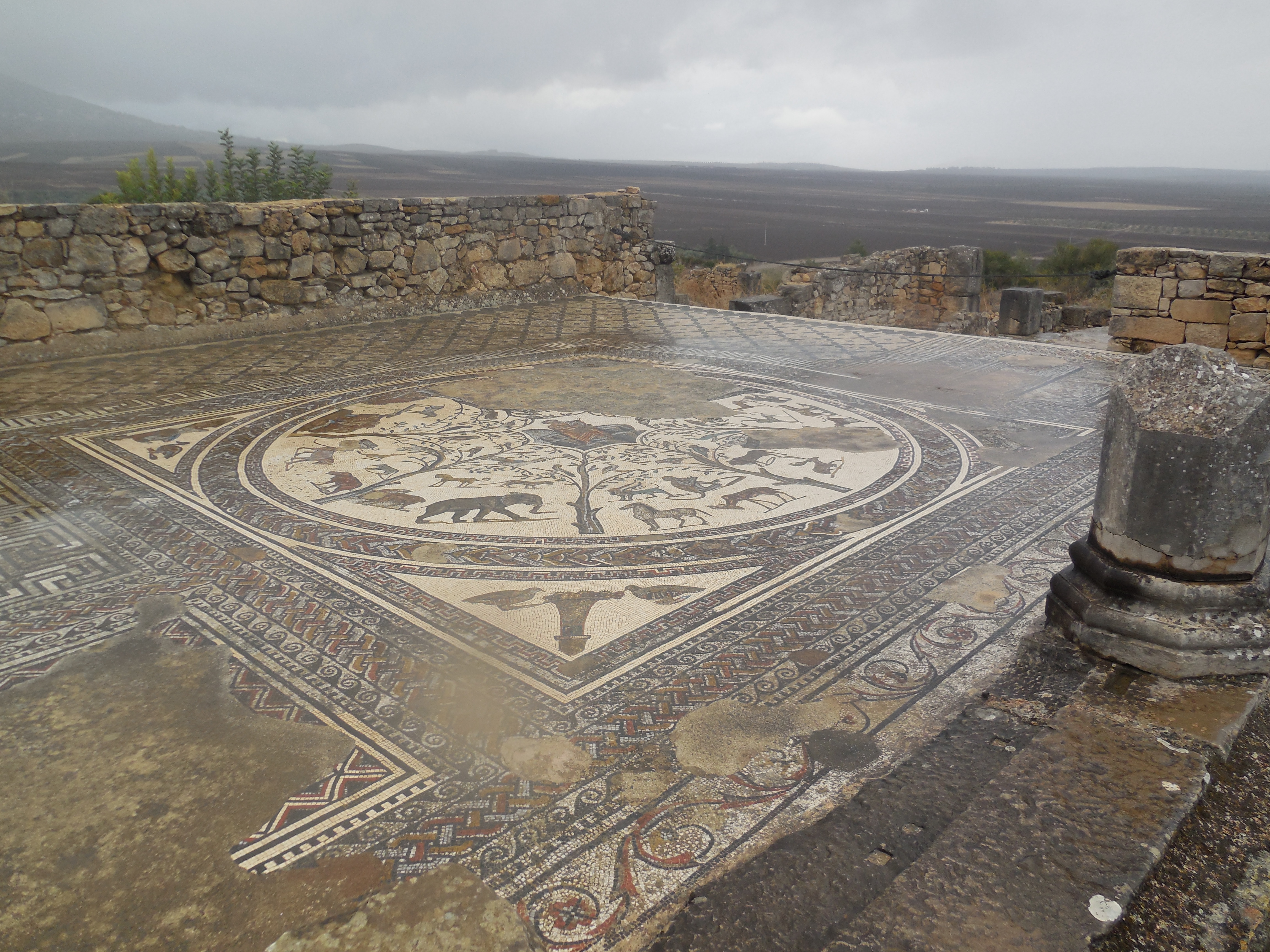
We left the Tour Hassan hotel in Rabat, and traveled by the autoroute, first to the city of Meknes, one of Morocco’s three traditional capitals, this one constructed due to the determination of the then ruler, Mawlay Ismail, to build a capital city of his own apart from Fez (removing much material from other sites in the process). Arriving in the city, we first looked at one of the ceremonial gates before traveling on to the huge granary, with its many storerooms and plentiful arches. Lunch was served as the Didi Palace Riad (yet another wonderful Moroccan meal), after which we visited a mausoleum before traveling on to the huge Roman site of Volubilis, where it was pouring with rain. In no way deterred however (semper fideles, as they say in Latin), we toured the site, admiring its lay-out and especially the fine quality of its mosaics. From there it was on to Fez itself, where we arrived at the Palais Jamai Hotel in the late afternoon. Dinner that evening was in the hotel.
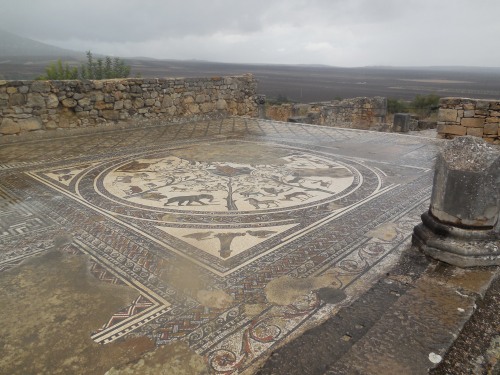
An example of the beautiful mosaics at Volubilis.
DAY 5
We spent the morning exploring the 9th century original city of Fez (Fez al-bali, as it is called)–later additions to the city being the so-called “modern Fez” (12-14th century), and the French-built 19th century city laid out in the Parisian style with broad boulevards. Descending into the medina by foot from our hotel, we learned to listen for the phrase “balak,” meaning “stand clear– a mule, donkey, and/or cart wish to get by.” Our first stop was to a wool-carding facility which also served as a food-market (especially fresh olives). From there we meandered our way through the narrow streets, passing by emporia of every kind. We stopped at several important historical monuments: the Najjarin, the restored headquarters of the wood-carvers guild; the Attarin, a similar shrine connected to the perfumier’s trade, and the Qarawiyyin Mosque-Library complex, the world’s oldest institution of higher learning (founded 860) resulting from an endowment left to two women of Fez by their father which they devoted to constructing the exquisite mosque and library. At the end of the morning we visited a rug-cooperative run by women and were shown a number of truly beautiful rugs of various provenances. Several members of the group purchased examples of the exquisite craftsmanship.
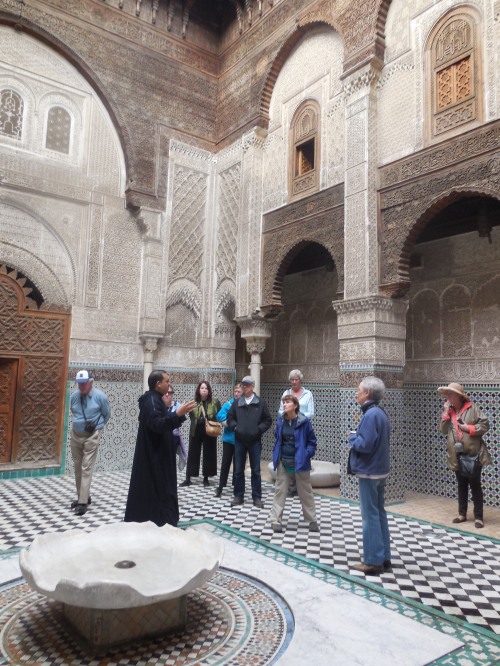
The Attarin in Fez.
Returning to the hotel for lunch, it was time for the second of our tour-lectures. This time I had invited my friend, David Amster, the Director of ALIF (the Arabic Language institute in Fez), to come and talk to us about his ongoing efforts to preserve Fez and its buildings as more and more non-residents are buying up properties in the old city and “converting” them in various ways. As David informed us through various examples and anecdotes, he has been a tireless defender of the beauty of the city and its traditional houses and has scored several notable successes on the way. His presentation provoked a number of questions from the group, and David proceeded to answer them with both authority and humor.
Later in the afternoon we visited some sites in the “modern” city (12th-14th century, that is): the Fez Museum, housed in a lovely old palace with a luxuriant garden. We then walked through the crowded “mellah” (the traditional Jewish quarter) and emerged on the far side to discover that a fire two days earlier had destroyed a complete market complex–the sight of the twisted ruins and the livelihoods lost was not a little sad.
Finally on this day, we drove to the Naji Factory where pottery is manufactured. We were shown the various phases that go into the production of pottery-ware and then spent time in the factory store where most of us purchased some of the wonderful products that were on display.
That evening we went to one of Fez’s most famous restaurants, the Bleue Maison–and David Amster joined us. In a beautiful example of traditional architecture near the square called “Al-Bat’ha'” we were served another superb Moroccan dinner, accompanied by the music of two Gnaua performers.
DAY 6
At 9:30 we left the hotel in Fez and traveled outside the city. Our first stop was at a town called Bahalil where Muhammad, our guide, took us through the winding streets of the town to visit a restored troglodyte residence–underground in order to remain cool during the heat of summer. There the owner, also named Muhammad and dubbed “the intelligent” (!), treated us to his routine, which included a lesson in the preparation and serving of mint-tea (a major characteristic of which is to gradually raise the teapot (or other pouring device) to a great height so as to aerate the liquid). Having tried this myself on several subsequent occasions, I can vouch for the fact that it is not as easy as it looks.
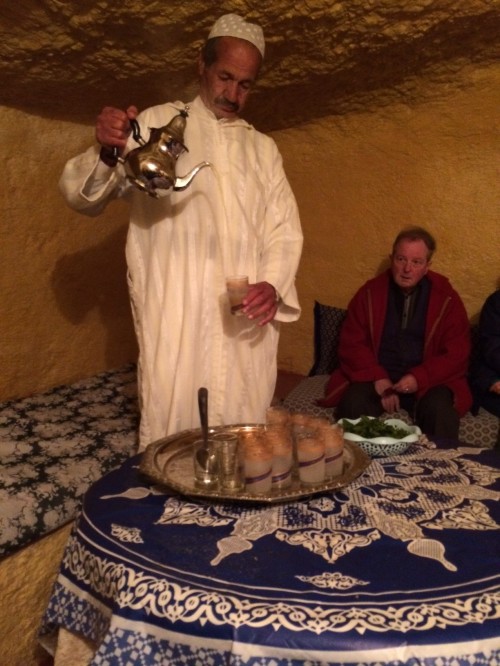
Muhammad pours mint tea from a great height.
Walking back to the bus (and seeing a number of truly beautiful children who were obviously enjoying the sight of us), we moved on to the city of Sefrou, long recognized for the size and importance of its Jewish community. Here too we walked through the “mellah” and visited the synagogue which has been carefully restored. We returned to the hotel for lunch, after which a number of members of our group accepted the invitation of our Fez guide, Ahmed, to return to the medina to make more purchases. For my part, I “took to the waters,” indulging in a swim in the hotel’s heated outdoor pool.
DAY 7
This day involved a long trip to the south in order to reach our destination of Erfoud, close to the Sahara. Driving South from Fez we first stopped at the mountain town of Ifrane, a curious phenomenon for the Middle Atlas region in that it is modeled on the idea of a Swiss village, with red-colored roofs and ochre buildings, not to mention the English-speaking university of Al-Akhawayn (“the two brothers,” a co-operative project of the kings of Saudi Arabia and Morocco). After a cup of tea or coffee, it was on up the mountains until we encountered at one particular spot some of their denizens in the form of monkeys. After a delicious lunch of trout, it was on through a mountain gorge to Al-Rashidiyya, a French-built fortress and finally to Erfoud and the Shergui Hotel where we had dinner. After this day’s long drive, we were now firmly in the Moroccan South-East, close to the desert.
DAY 8
After breakfast, we drove through the town of Erfoud to the neighboring city of Rissani, where, after a brief stop at a ceremonial gateway, we headed for the Tomb of Mawlay Idris and the Ksar [enclosed quarter] of Abna’ Ibrahim, where we were welcomed by the current owner. We then went to a remarkable complex where fossilized rock was turned into beautiful pieces of art, cut, polished, and shaped into a variety of sizes and functions. Many purchases were made….
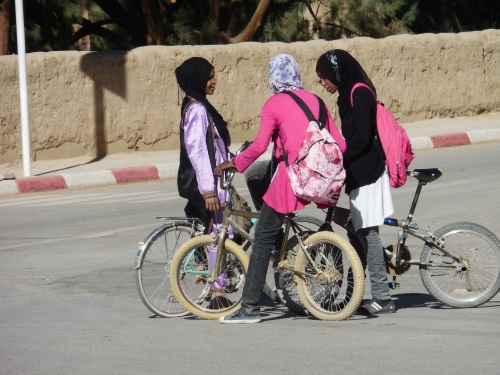
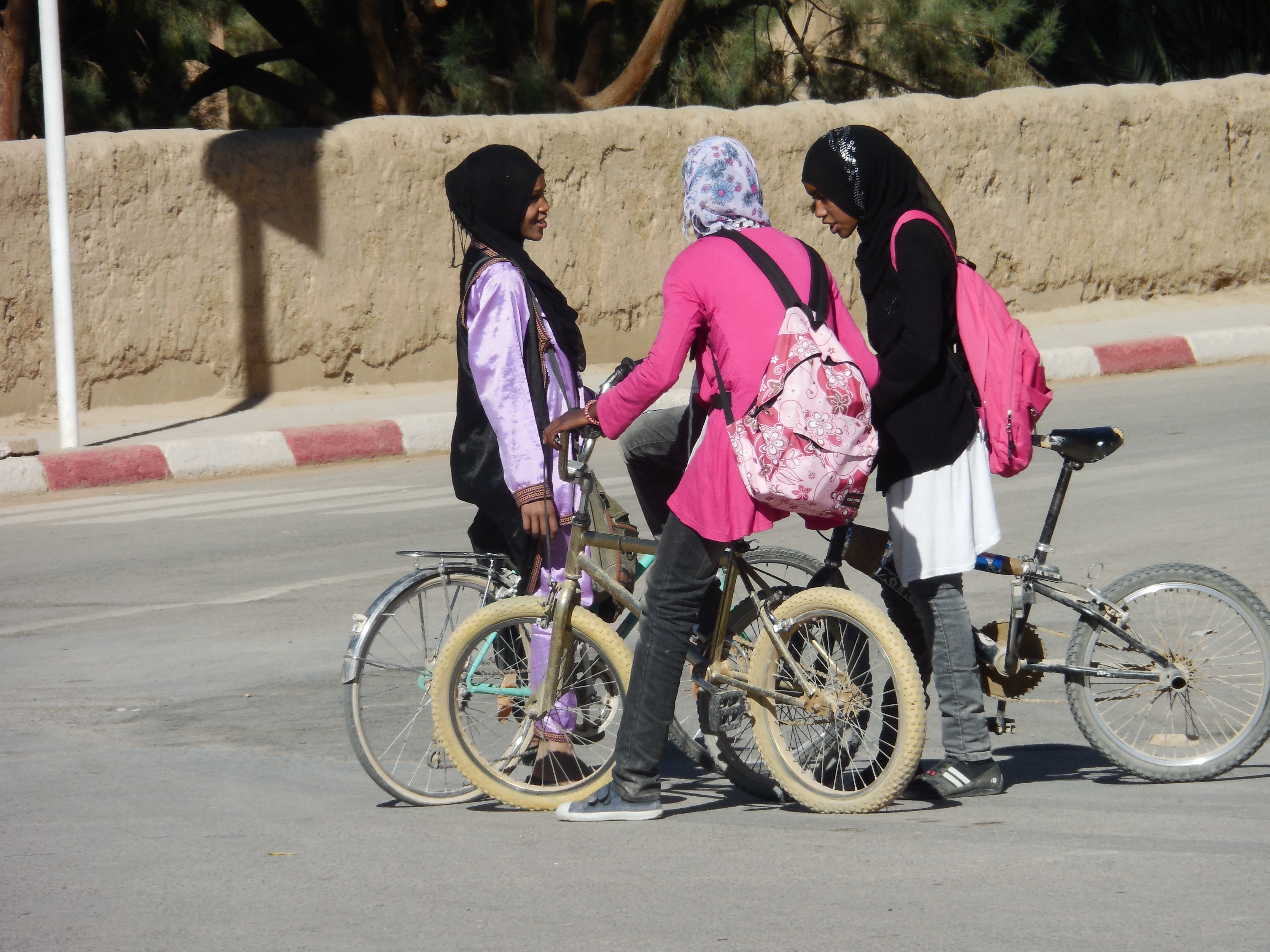
Girls in Rissani.
Back to the hotel for lunch, I proceeded to offer a lecture on the current state of the so-called “Middle East” (who says it’s “middle”?!) and some of the factors that should go into any attempt at understanding what is happening in the various sub-regions and what the primary motivations are. We had a good question and answer session once I had finished my expatiations….
In the mid-afternoon we left the hotel for what is usually one of the highlights of this tour, a visit to the Merzouga sand-dunes and a camel (actually, a dromedary) ride. The entire group duly mounted their riding-beasts, and we set off in caravan formation–nose-to-tail–up an impressively huge set of dunes (some 400+ feet high). I once again discovered why the camel/dromedary is known as “the ship of the desert”! Once at the top (or nearly so), we sat on the edge of the dune and waited for sunset. The entire vista, the shadows cast against the dunes, and the gorgeous light, all were truly memorable. Once the sun had set, we made our way downwards as the sky turned to various shades of red and pink. Once again, dinner was at the hotel.
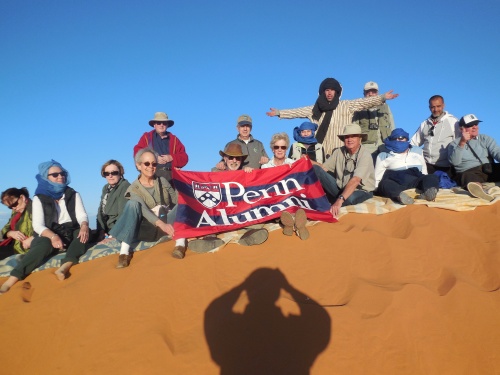
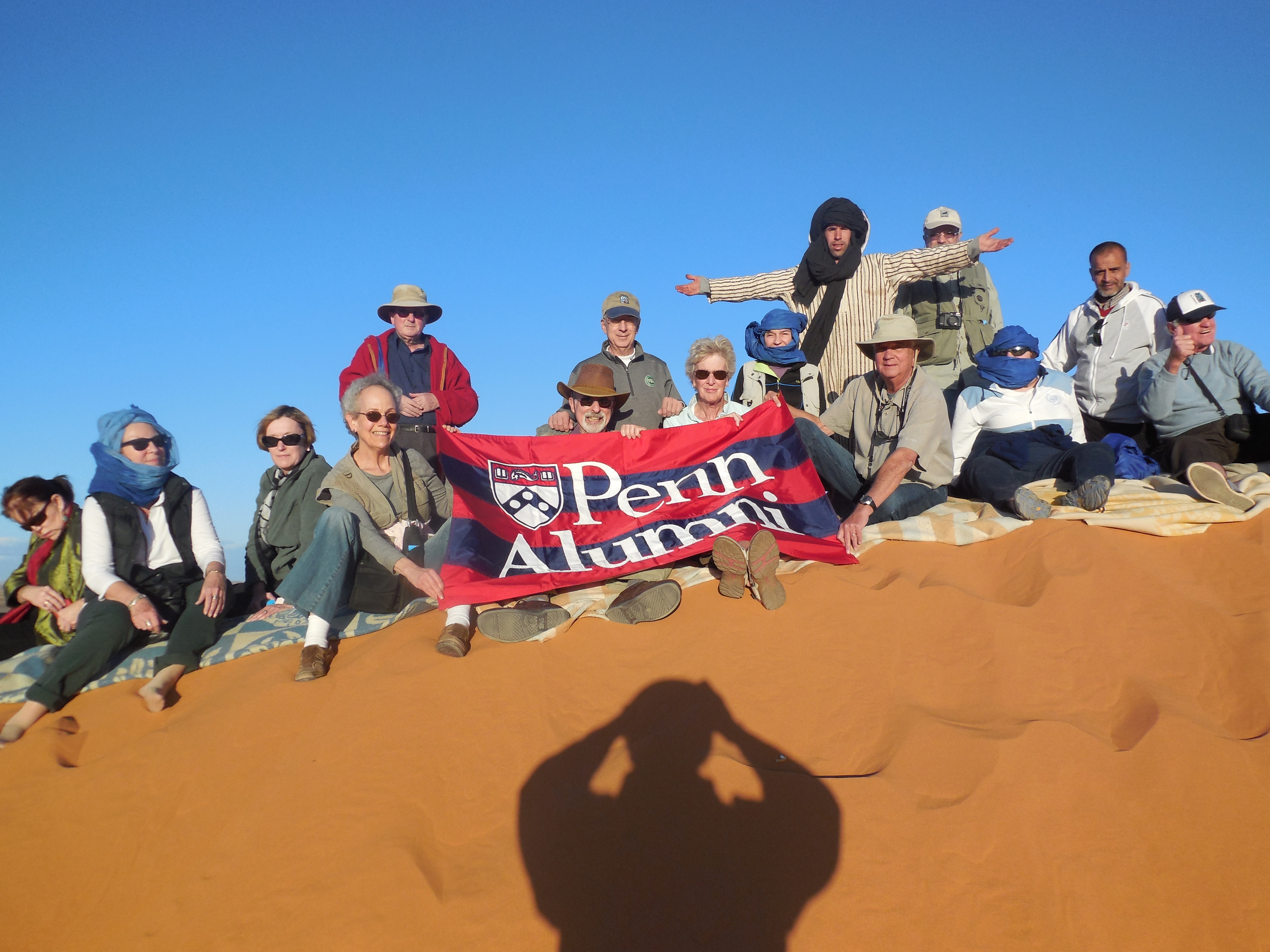
Penn alumni and friends at the top of the dune.
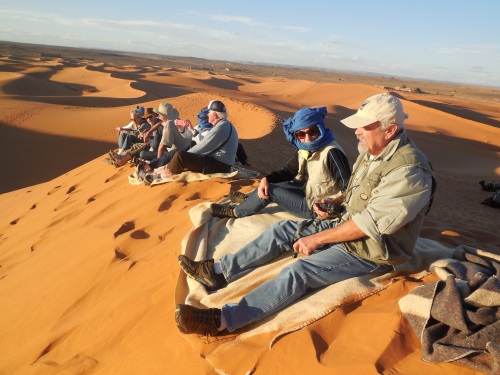
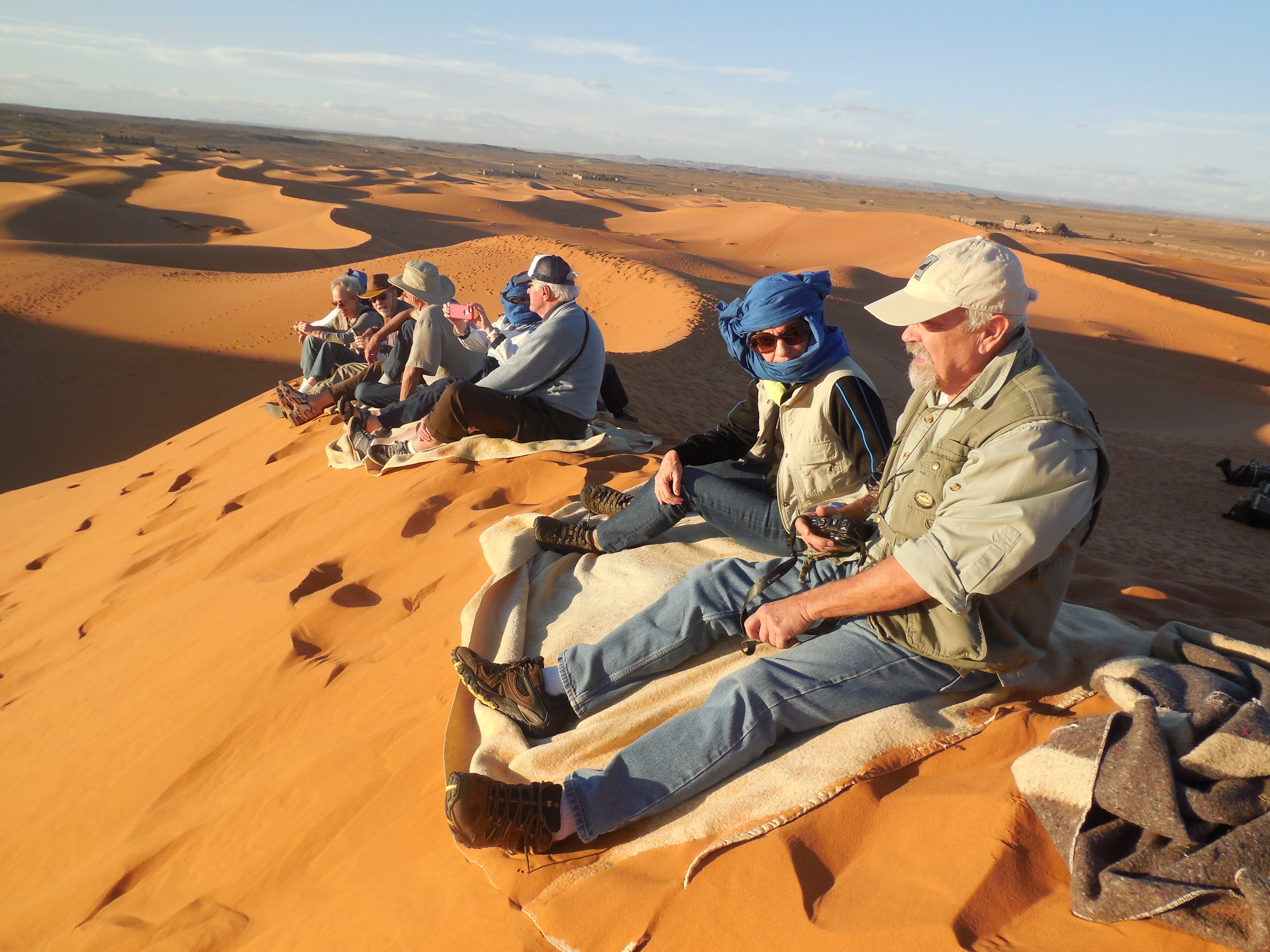
Waiting for the sun to set.
DAY 9
This was another day for a long-distance bus-ride. From Erfoud we traveled to the Tinchir oasis and then into the spectacular Todra Gorge with its narrow defile. We had lunch at a restaurant named Chez Michelle (veal and creme brulée), after which we set out on the long drive to Ouarzazate via Qal`at Mgouna where we were able to purchase some of the primary local product, rose-water. We eventually reached the Berber Palace Hotel in Ouarzazate (the Moroccan version of Hollywood, we gathered) at about 6 p.m.
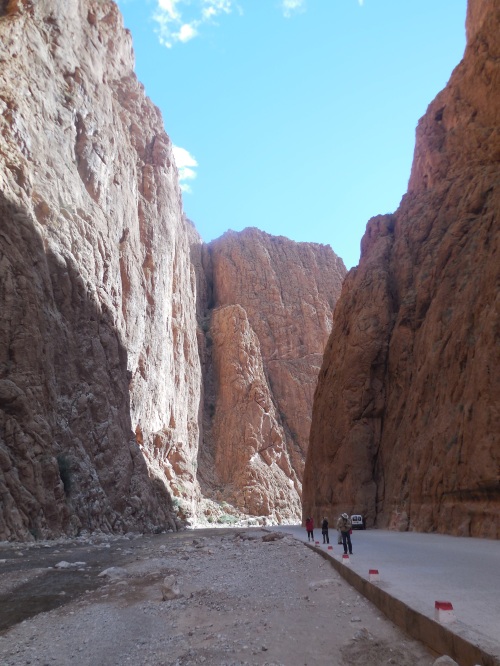
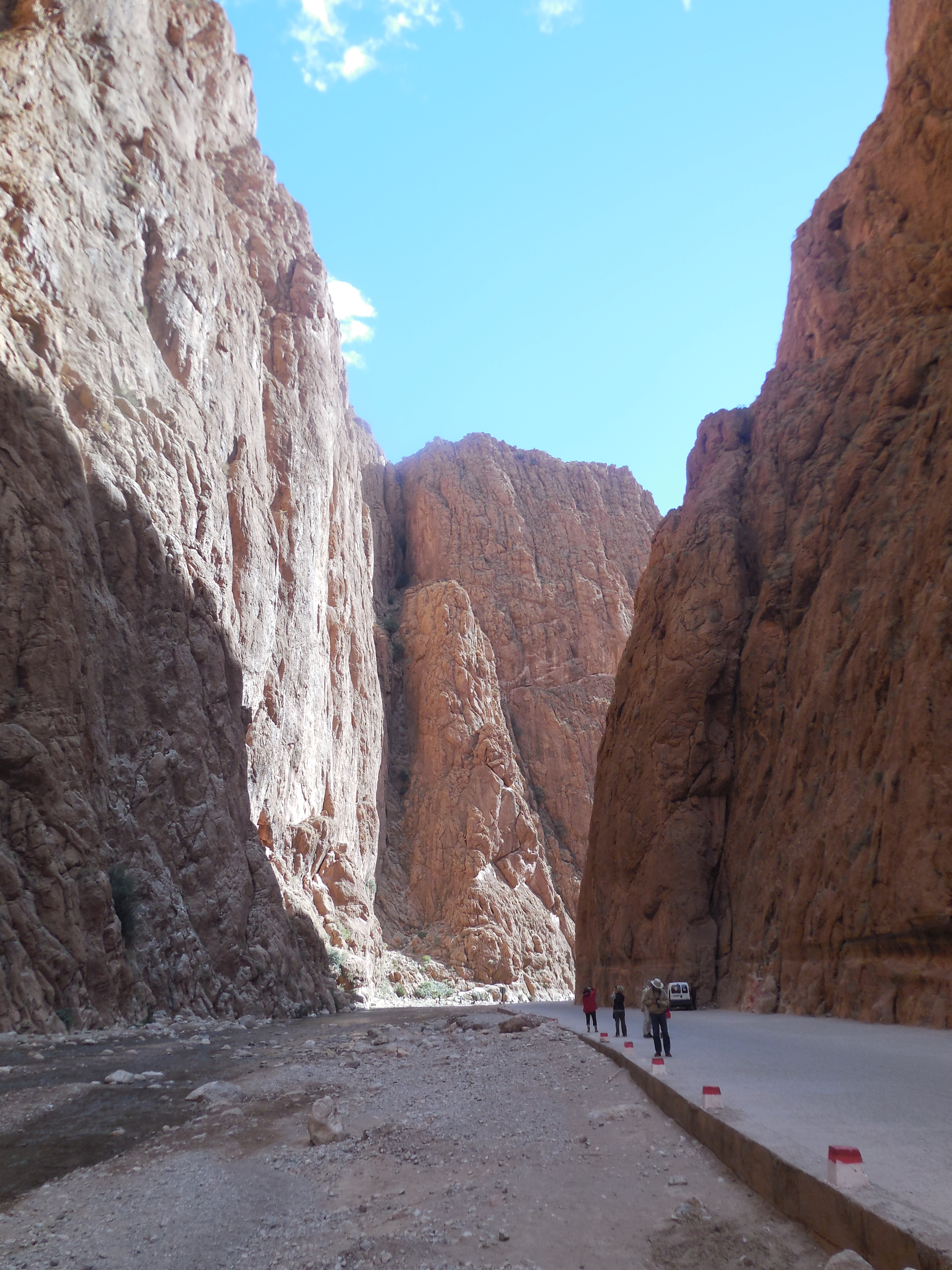
The Todra Gorge.
DAY 10
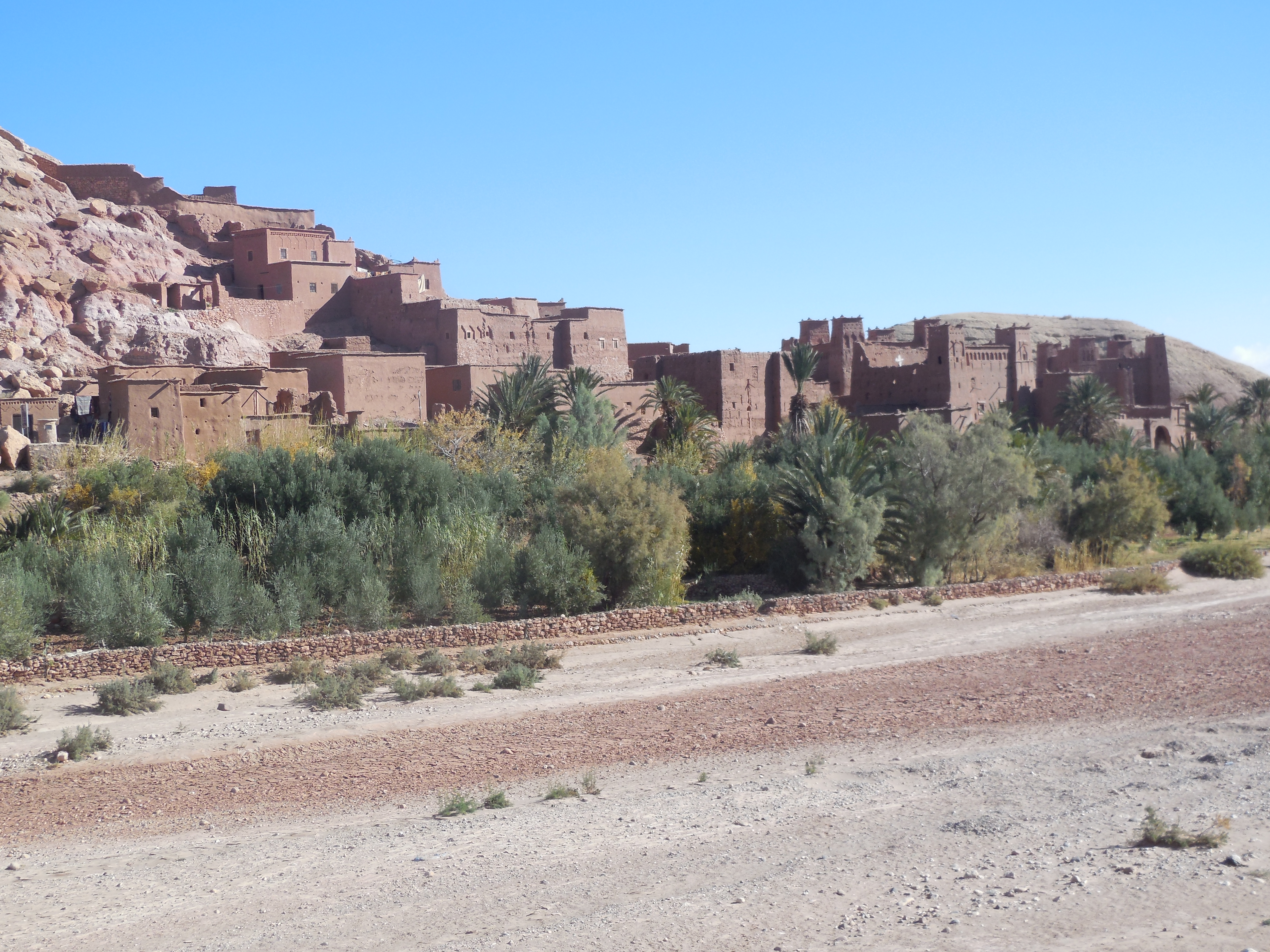
Leaving Ouarzazate at 9 a.m., we were on our way to Marrakesh. Passing by another “kasbah” (Tifoultout), we reached the fabled “ksar” of Ait ben Hadou, situated in a lush oasis with a climb up to the top and spectacular views over the surrounding landscape. This afforded us the experience of a classic type of southern Moroccan Amazigh fortress-town, with winding alleyways (now crowded with stores of a wide variety), all enclosed within a firmly walled structure. We had lunch in a lovely restaurant that looked out directly on to the fortress-town.
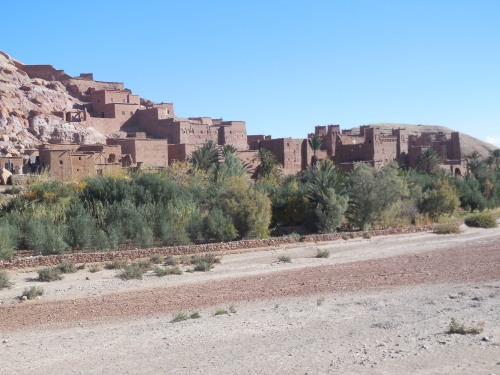
Ait ben Hadou
After lunch we left on another long drive, this one over the remarkable road constructed by the French that traverses the N’Tichka Pass of the High Atlas Mountains; first up the mountain to the top at about 7,000 feet and then–inevitably–down again to arrive at Morocco’s most fabled city, Marrakesh (and yes, the emphasis is on the “rak” syllable–or, if you’re using Moroccan dialect, it’s something like “Mrrksh”!). The Sofitel Hotel turned out to be a luxurious hostelry, in the “posh” part of the city known as “Hivernage.”
DAY 11
We began our visit to Marrakesh with a stop at its most visible landmark, the Tower of the Kutubiyya complex in the center of the city. Following that we made our way through part of the old medina and arrived at the huge ruined complex of the Badi` Palace. Climbing up to a second level, we found ourselves communing with an entire army of storks who were playing their usual games of “knock me off my perch, and I’ll knock you off yours”…. They had also perfected the art of standing on one leg, a useful posture for cocktail parties. Leaving that enormous complex we headed for another palace, this one more modern (19th century), the Bahiyya Palace, with its lovely garden and its series of beautiful mosaic-ed rooms leading to a large courtyard. Then it was back to the hotel for lunch, a buffet consumed in the warm sunshine.
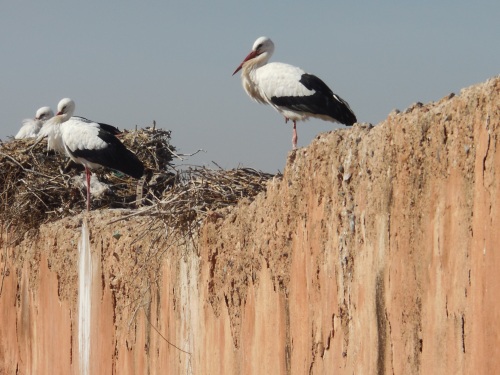
The infamous storks.
In the afternoon we made our way into the truly labyrinthine medina, exploring its many, many craft sub-divisions and paying special visits to a wood-painter and a facility specializing in spices, medicines and perfumes. In the latter we were regaled with all kinds of traditional herbs, spices and medicaments; some of our group enjoyed neck-massages, and many people purchased cooking spices, aromatic plants, and other materials of all kinds. We then continued our meandering through the various segments of this huge bazaar, finally reaching the hub of Marrakesh’s cultural life, the world-famous Jma al-Fna Square, with its multitude of traditional performers–snake-charmers, fortune-tellers, monkey-trainers, and the like; not to mention the enormous array of food-sellers (including sheep- and goat-heads for those so inclined…).
Back at the hotel, I had discovered a white grand piano. With the great Liberace in mind, I gave a short performance on it before we went out to a dinner at a restaurant where I had dined previously: Le Foundouk in the medina, where we all enjoyed a wonderful dinner for which we had readied ourselves by indulging in a fairly lengthy walk from the bus into the medina in order to get there.
DAY 12
On our second day in Marrakesh we set out by horse-drawn carriages to the Menara, the summer-resort built by the rulers as a way of escaping the intense summer heat. Built by the side of an artificial lake it offers splendid vistas of the surrounding countryside (not to mention the Marrakesh Airport close by). The lake itself contains some very large carp who lived up to their reputation as voracious eaters when Muhammad offered them some bread. From there it was on (by carriage again) to the Majorelle Gardens, a lovely enclosure that had originally been planned by the French artist, Jacques Majorelle, in the 1920s and was later taken over by Yves St. Laurent, the French fashion designer, who loved to spend time in the residence there. The complex also contains a wonderful Amazigh (Berber) Museum, full of spectacular examples of the arts and crafts of the indigenous people of the region.
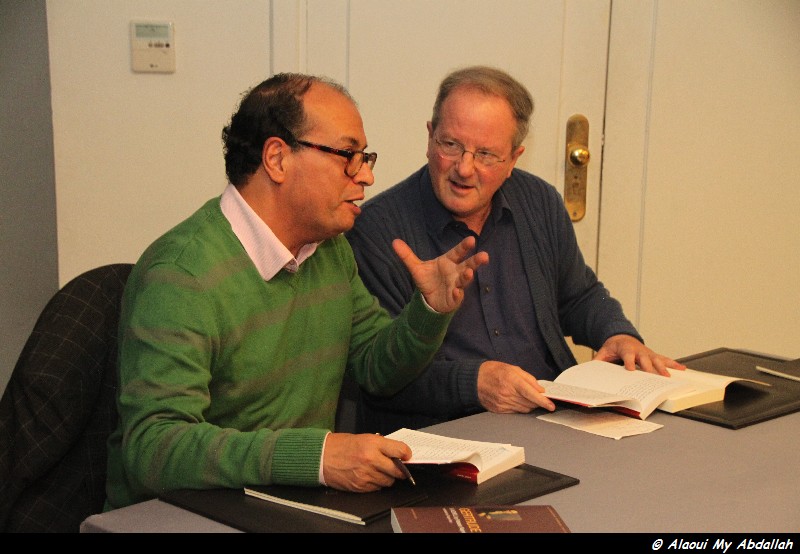
After returning to the hotel for lunch, the afternoon was open for further excursions into the medina in quest of items to purchase. At 5 p.m. the fourth and last of the tour’s lectures took place. I had invited another Moroccan writer, Hassan Najmi, to come and do a joint reading with me of his novel, Gertrude, that I had recently translated (it is due out in January 2014). Unlike the session in Rabat with Ahmed Toufik however, Najmi seems to have informed his colleagues in Marrakesh that he was coming and doing this reading, because just before 5 p.m. a large percentage of the literary establishment of Marrakesh showed up. The session thus turned into what was for me a fascinating translational and trans-cultural experience, with readings in Arabic and English and follow-up questions from both segments of the audience in Arabic and English.
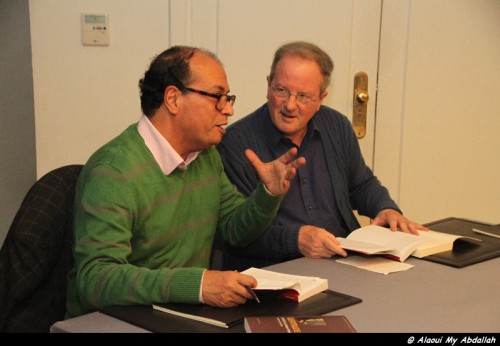
Roger Allen and Hassan Najmi conduct a joint reading of Gertrude.
For our dinner Muhammad had arranged for us to visit another of Marrakesh’s most famous restaurants, Dar Moha, where we were treated to another virtuoso display of Moroccan cuisine.
DAY 13
And so from Marrakesh to Casablanca. This took us up the recently completed autoroute and into Morocco’s largest and most populous city–certainly modern in every way, but also industrial and noisy. While it may be celebrated as a result of the famous movie to which it gives its name, the present-day reality is far different (in fact, the movie itself is far more based on Tangier than on Casablanca).
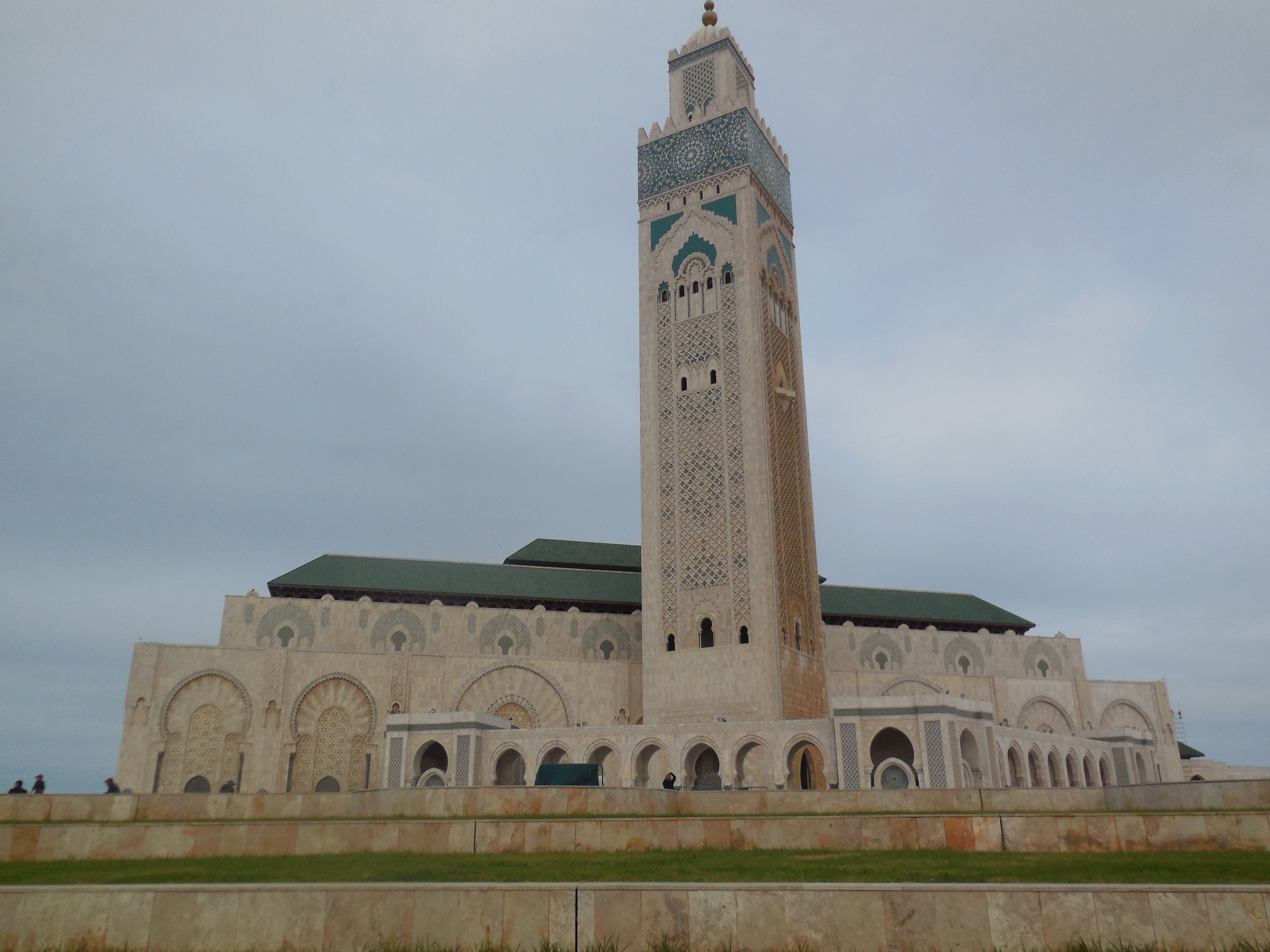
We headed first for the seaside, and had lunch at a restaurant overlooking the Atlantic Ocean. We then proceeded to the Hassan II Mosque, now the most famous and often visited site in the city, where we had been scheduled for a 2 p.m. visit. Let’s just say that opinions on this building and its esthetic pretensions will vary, but it certainly leaves an impression. The bus then took us to the so-called Habus Quarter, which the French constructed in an attempt to replicate the styles of pre-modern Morocco. Finally we made our way to the Kenzi Tower Hotel, a large building in the city center.
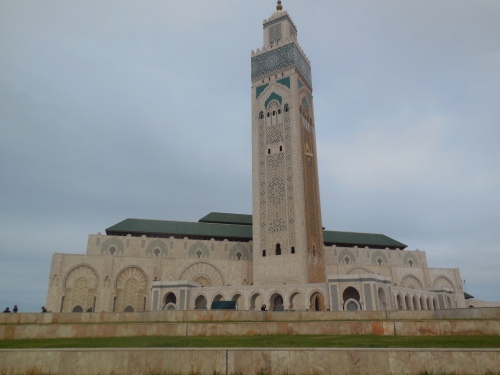
The Hassan II Mosque in Casablanca
Our final dinner was held (on Thanksgiving Day!) in the appropriately named Rick’s Cafe. Following caesar salad and a fish plate, we were offered a delicious cheesecake with fruits. I took this occasion to express our group’s profound thanks to Muhammad, our guide and organizer. This meal was just as wonderful as so many others that we had enjoyed during our visit.
DAY 14
We left the hotel for the airport at 8:30. Since our plane did not take off until 12:30, I wondered at the length of time involved, but clearly Muhammad knew what was coming. While he was as helpful as he could possibly be before leaving us to our own devices, our experience at Casablanca Airport was probably the most negative aspect of our entire trip, but there was almost nothing that anyone could have done about it. The level of security at this airport is taken to truly absurd levels: our baggage was scanned in order to get into the airport; every Moroccan traveler, it seemed, had an overweight bag that had to be opened and partially emptied; regular attempts at queue-barging were pre-empted in Arabic by yours truly; and there was a further security station in order to get into the passport-control. And…some 8 hours later we landed on time at Kennedy Airport and went our separate ways….
**************************
This was a truly wonderful trip; it was well organized, and it is difficult to find sufficient words to express our admiration for our Guide, Muhammad Dahouac, who is not only knowledgeable about Morocco and its history but also considerate and efficient. He was aided throughout the trip by two other wonderful Moroccans, our driver, Hasan, and his assistant, also called Hasan.
Beyond that, I have to say that the members of the group also contributed in a major way to the success of this tour. Many of them had already traveled widely, and everyone blended together and shared experiences in a way that made for some great conversations and a great deal of good humor. Thus does the world go round….
And now I’m not “Neilie Dunn,” but fully done (and only those who were on the trip will know what that’s all about).

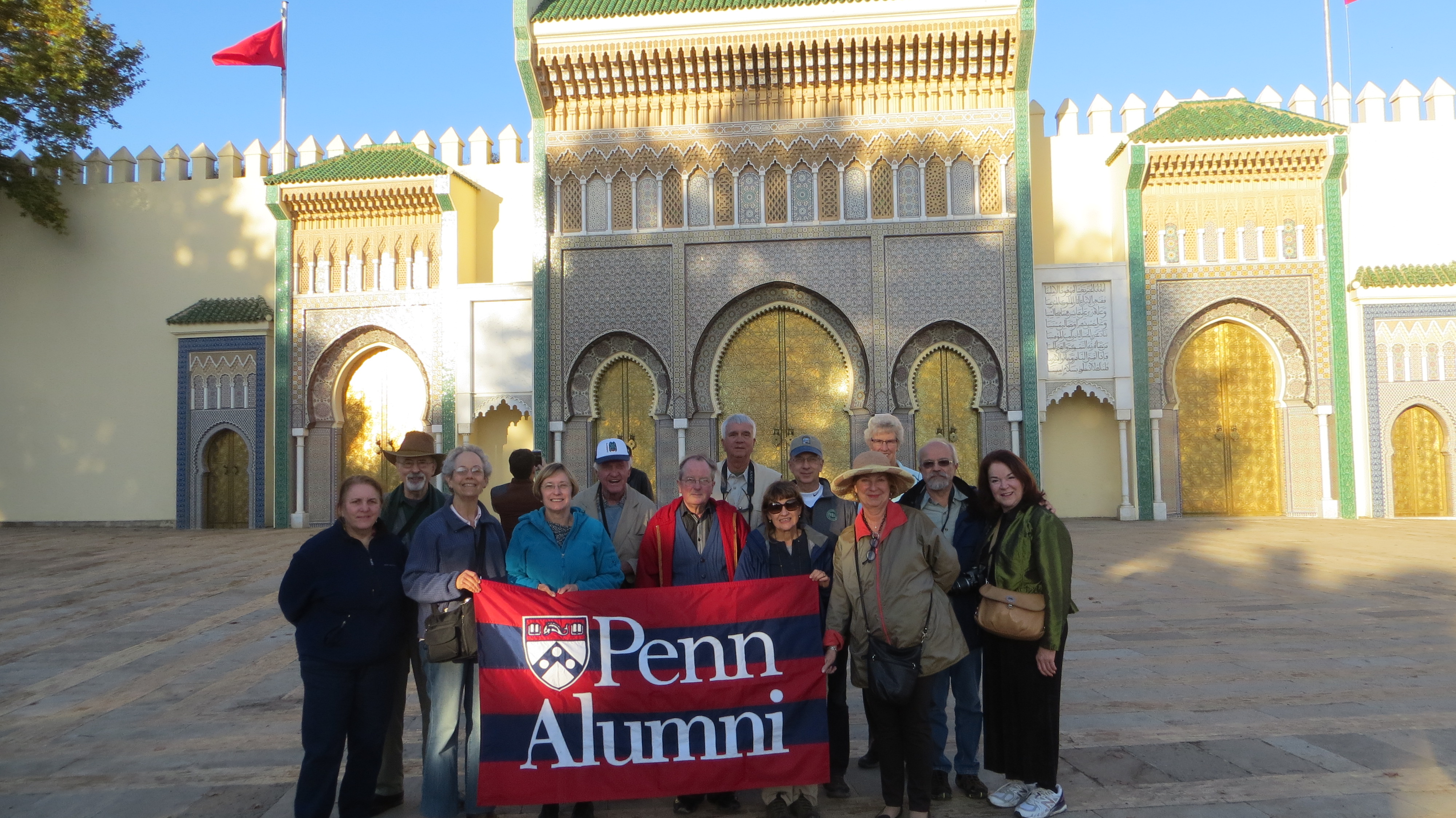
A final group shot at the Royal Palace in Fez. Photo from Susan Croll, CW’68, G’94 and Paul Monasevitch.
[If this blog inspired you to travel with Penn Alumni Travel, check out our 2014 schedule here.]















![Edna 12-9 [2]](https://franklypenn.com/wp-content/uploads/2013/12/edna-12-9-2.png)
![Edna 12-9 [3]](https://franklypenn.com/wp-content/uploads/2013/12/edna-12-9-3.jpg)
![Edna 12-9 [4]](https://franklypenn.com/wp-content/uploads/2013/12/edna-12-9-4.jpg)


 Frankly Penn