Category Archives: Travel

Travels in a Celtic Land

Author: Janell Wiseley

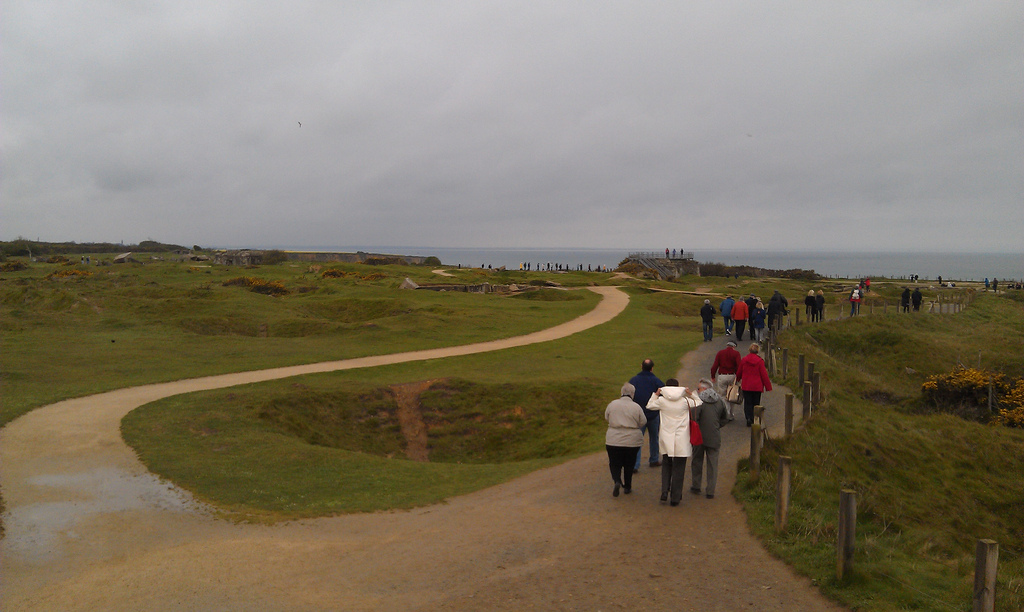
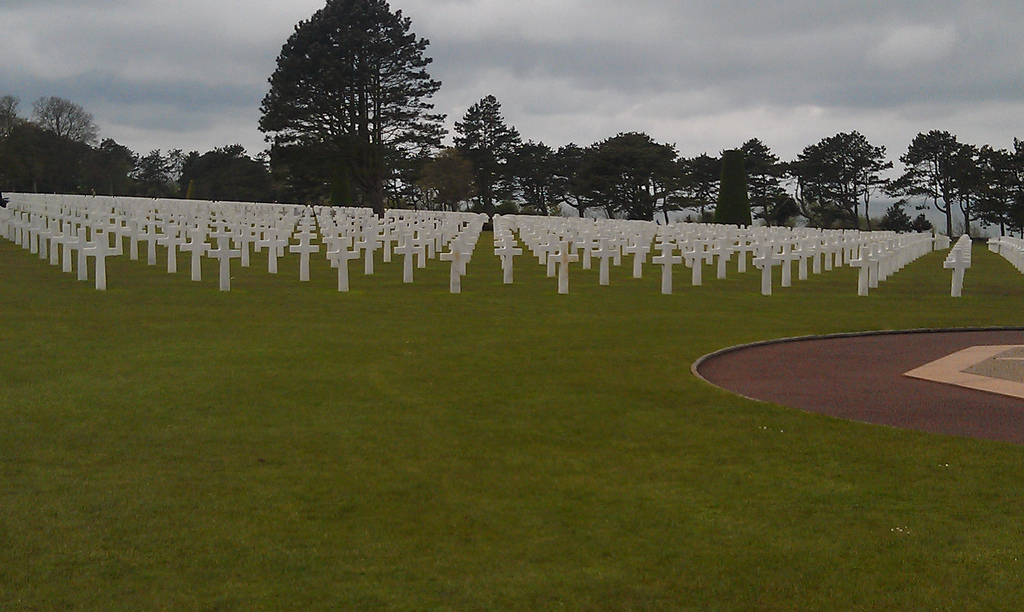
Earlier this year, I had the opportunity to host my second Penn Alumni Travel trip, this one to the Celtic Lands with special guest speaker David Eisenhower,  Director, Institute for Public Service, Annenberg School-University of Pennsylvania.  This trip was memorable in so many ways. I was given the chance to visit so many fantastic out of the way places, I was able to meet Celia Sandys (Winston Churchill’s granddaughter), I listened to David give an impromptu lecture while standing on Omaha Beach, and, best of all, I shared this trip with an amazing group of Penn Alumni (thank you for the scarf Connie)! Check out the photos from some of the places we visited.

Below is just a sampling of the photos taken.

You can also view photos from past Penn trips on Flickr.

1 Comment

Filed under Janell W., Penn Alumni Travel, Travel

Hurrah, Hurrah, A-Antarctica

Author: Nicole C. Maloy, W’95

As Philadelphia finds itself at the beginning of yet another heat wave, and as much of the nation has experienced record heat this summer, I thought I’d take you on a little trip with me through time and space to someplace just a bit cooler. In February 2008, I was fortunate enough to host a Penn Alumni Travel trip to Antarctica. Coolest moment (no pun intended, but it stays): being out on our Zodiac raft when three humpback whales decided to hang out with us. I casually asked the Naturalist driving us if there was any history of whales overturning a Zodiac raft. He shrugged. I tightened my life vest. A few of my video clips of those whales are below. I will never forget this trip, and my temperature has dropped a few degrees just looking at these photos again. May they have the same effect on you.

I love that the coats they gave us match our flag! If they’d been certain other colors, I think some alumni might have braved the cold for this photo.

One of my favorite shots of the trip. This Gentoo penguin chick walked up, stopped and looked at me before moving on.

Molting Adelie penguin chick teaches me a new dance.

This penguin chick walked right up to this guy and stopped. I tried to tell him, but he was too focused on taking photos of the penguins in front of him to hear me. So I started taking photos. Then his wife, approaching with that group on the left, starts pointing down at his feet. Then he looked down…

Oh, hello.

Three humpback whales befriend our raft. The woman sitting next to me is really, really excited about it.

Humpback whales are identified by the patterns on the underside of their tails. One of the Naturalists asked for this video because she didn’t think they’d seen this one before. And here I was thinking it was cool enough just to see it dive!

The ice. I still can’t believe I saw this with my own eyes.

Bottom of the world, Ma!

Leave a comment

Filed under Alumni Perspective, Alumni Programming, Nicole M., Penn Alumni Travel, Photos, Travel

Marvelous Macchu Pichu and Mythic Toga Parties

Author: Gwendolyn DuBois Shaw, Associate Professor of American Art at Penn

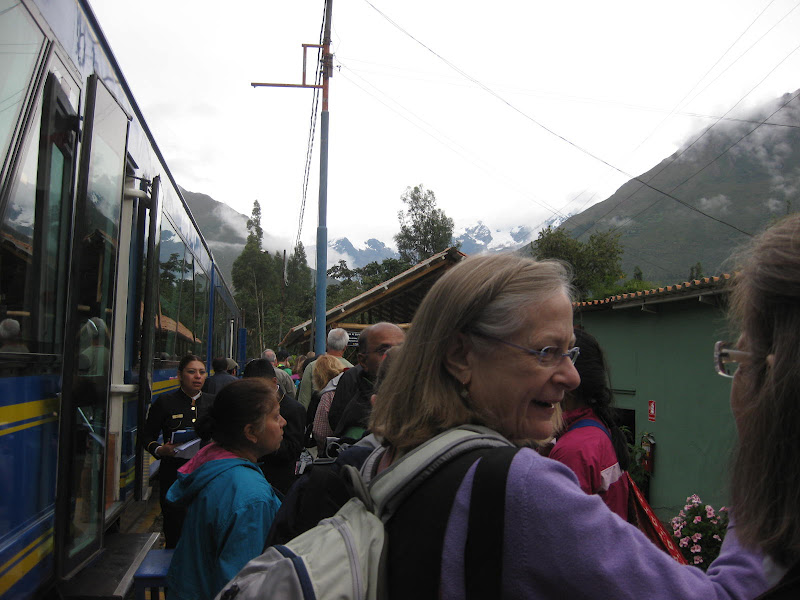
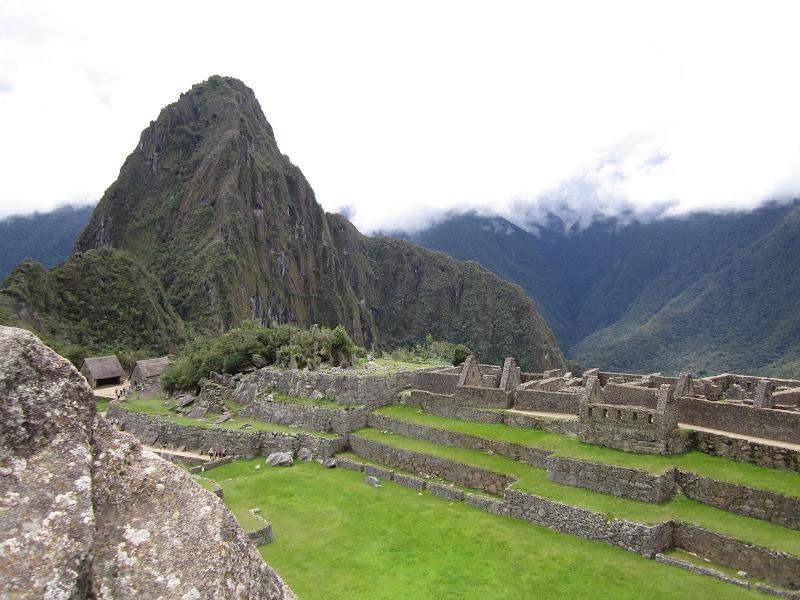
Few places on earth can beat the view from the top of the ancient ruins at Macchu Pichu in the Peruvian Andes!  And few journeys are more demanding than the one that is required of the traveler who wishes to partake of this marvelous vista.  Luckily, the Penn alumni that I travelled with this past spring were able to get there in comfort and luxury, opting for the speed of a first-class Perurail train car and the soft, earth-friendly beds at the Inkaterra eco-resort at the base of the magical mountain citadel.  Back in 1911, when Hiram Bingham and his fellow Yalies made the first recorded trip by white men to the lost city in the clouds, they had a month-long hike on narrow pathways like the one that is known today as the Inka Trail.  Poor Bingham!  He had to sleep on the ground and swat at mosquitoes all day!  True, the insect life there is still plentiful, but today most of the visitors to this magnificent jungle-wrapped ruin opt for the comfy route we took to get there rather than the notoriously rugged back-packing adventure that Bingham first made famous.

Speaking of Bingham, we were astoundingly lucky to have with us a family of Penn alums who were direct descendants of one of the original adventurers who accompanied Bingham on that important trip into the unknown!  Beginning on the first day we were treated to an impromptu viewing of personal family photographs from that fabled trip and stories of expatriate American family life in early twentieth-century Peru to boot!  One day as we drove from the hotel to the city center we got to see the family’s ancestral home in the beautiful Miraflores district – still standing since the 1920s with its grandly walled garden courtyard facing the street. Que Linda!

“Treasures of Peru” was the third Penn Alumni Travel trip that I have accompanied since 2008.  A big part of why I keep accepting invitations to host these PAT trips is that there are always interesting travelers along, something that helps to make each trip all that more memorable.  For example, on the luxurious, six-star, Silversea cruise to the Lesser Antilles in 2011, our Penn group was joined by another alumni group from Dartmouth that happened to include Alpha Delta Phi brothers from the Class of 1963.  These guys and their wives had been writer Chris Miller’s inspiration for the 1978 cult film “National Lampoon’s Animal House.”  You would not believe the things I heard as we cruised from St. Barts to Antigua!  After a few bottles of the MS Silver Whisper’s all-inclusive libations these folks were a serious laugh riot, telling almost unbelievable stories of road trips and epic parties.  I honestly did not think that those crazy stories of Greek life at the pre-coed Dartmouth of the early 1960s could have ever been topped!  That is, not until that night in Peru when I sat glued to my seat, marveling at the stories that my new travel companions were telling me about their blood connection to one of the most famous archaeological expeditions of all time!

I say this sincerely and from a point of experience: on a Penn Alumni Travel trip you can always count on visiting fantastically awe-inspiring places and having unusually interesting people to share your story with at the end of the day.

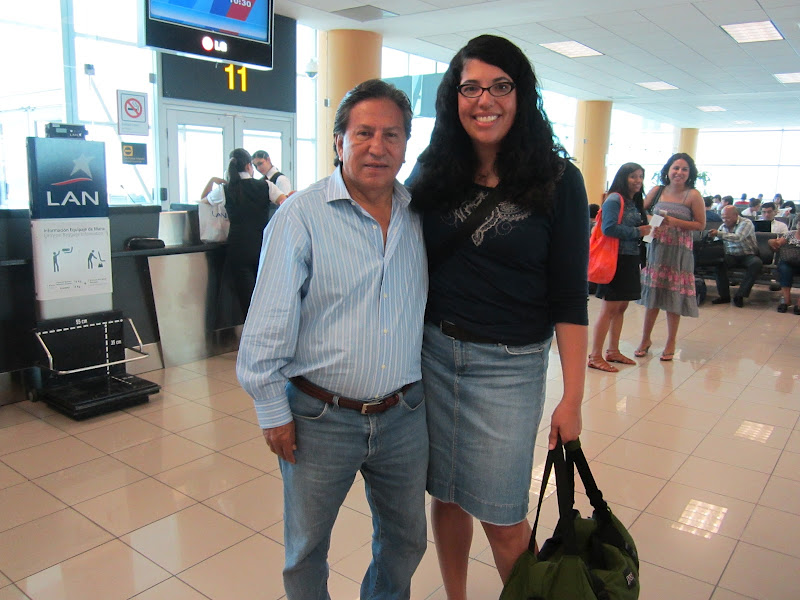
On the Peru trip, our tour director Marco, a native of Cuzco and a resident of Lima, was really first-rate and made his top priority our safety and comfort.  Over the ten days we spent together, Marco proved himself to be not only an endless font of information about the modern country and the historic sites, but also a man with baffling energy reserves and answers to all of the small and large questions that our group posed to him.  Another reason that I love hosting these trips is that the tour directors are always incredibly well-trained, thoroughly pleasant, and professional.  Marco’s wife worked in the Presidential Palace, and he was well acquainted with the country’s leaders, instantly recognizing the past president Alejandro Toledo when we were all waiting for a plane at the airport in Lima!  Marco deserves the credit for this great picture of me with El Presidente!

One of the first places that Marco took us in Lima was the incredibly beautiful Museo Larco Herrera where we were dazzled by the beautiful setting and the stunning ancient artifacts.  From hand-beaten gold jewelry to astoundingly life-like portrait jugs, these remarkable objects all testified to the highly developed cultures that dominated the western half of the South American continent during the pre-Columbian period.  Located in the heart of Lima, the Larco is actually built a top an ancient pyramid.

A UNESCO World Heritage Site,  Lima is characterized by the ruins that seem to crop up around every corner as well as its stunning historic city center, a colonial marvel of Spanish baroque architecture that is marked by its Moorish flavor (a subtle reminder that the fifteenth-century conquistador Francisco Pizarro and his Extremadureño fellow conquistadors were not all that far culturally removed from having been imperial subjects themselves).

While at the Larco we had a truly elegant epicurean experience.  Gastro-tourists take note: Lima is a city blessed with a cosmopolitan appreciation for fine food and fondness for innovative presentation.  Internationally renowned Peruvian chefs such as Gastón Acurio, whose culinary empire oversees the café at the Larco, have made it their mission to not only bring the flavors of Peru to the rest of the world but also to elevate the gustatory options available to their countrymen.  After eating Acurio’s food at the museum, some of the group also dined at his restaurant Chicha in Cuzco.  Muy bueno!

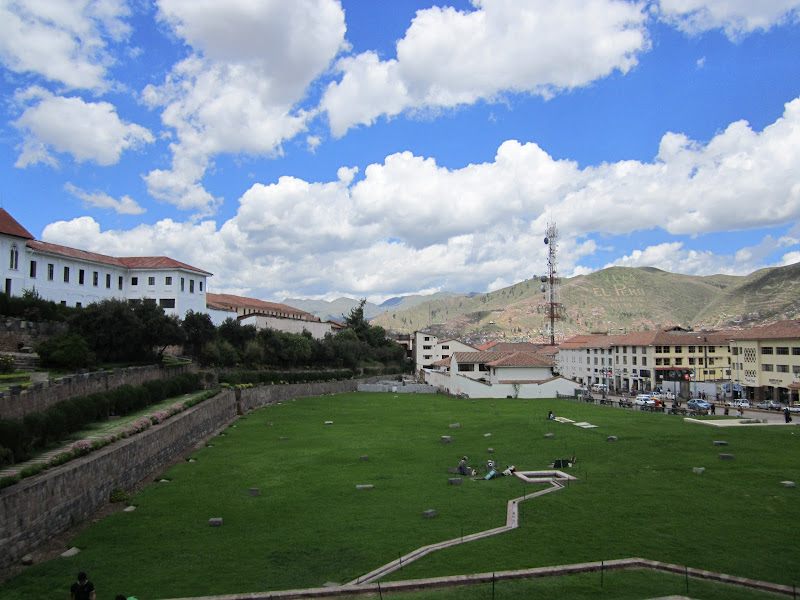
In addition to being home to awesome cuisine (something that I personally find very important for a good trip), Cuzco is also the gateway for the journey to Macchu Pichu.  While coming and going from the famed archaeological sites in the Sacred Valley, we spent several nights in this very welcoming, quaint, colonial city.

Located 11,000 feet above sea level, it takes a little work for a body to adjust to being in Cuzco, and we did well to follow our tour director Marco’s advice in order to avoid debilitating altitude sickness.  This included some of us taking various prescribed medications (ones that we had either brought with us or obtained there), getting lots of rest, and drinking numerous cups of mate de coca, or coca tea.  This lightly flavored (and completely legal – even in the USA) infusion is made from the leaves of the infamous coca plant.  But unlike the plant’s chemically produced derivative cocaine, the natural leaves provide only a mildly uplifting feeling to the imbiber.  Since one would have to drink gallons and gallons of it get any kind of “high”, the main point of consuming the tea while in Cuzco is that it offers considerable diuretic benefits that help to balance the body’s fluid levels and aid in  acclimation to the extreme altitude.  Due to the precautions we took, only a small number of our group felt any ill-effects of being up so high and thankfully everyone was able to participate in the subsequent trip to Macchu Pichu.

Atop the warren of ruins, it was wonderful to sit on the grass, lean against the rock walls, and stare out at Ainu Pichu on the adjacent, steeply rising Andean mountaintop.  I could hardly believe that I was looking at the same remarkable view that Hiram Bingham and his fellow adventurers had seen almost exactly a century before.  The only thing that was more remarkable was the great group I was seeing it with!  It was at that moment that I began to look forward to my next Penn Alumni Travel trip to Pizarro’s homeland of Spain in October 2012 –  Viva España!

2 Comments

Filed under Academics, Faculty perspective, Penn Alumni Travel, Travel

Time to Pack My Binoculars

Author:  Emilie Kretschmar

Penn Alumni Travel is going on safari, and I invite you all to join us! On Facebook and Twitter, that is…

On July 11, I’ll be heading off on my first Penn Alumni Travel trip as a staff host. Although I’m no stranger to travel, I have never been to Africa, and I must admit that thinking about the trip has consumed most of my thoughts these past few weeks. There is so much more to prepare for when you’re going on safari in Tanzania! You have to get vaccinated against scary-sounding diseases like typhoid, yellow fever, and polio; you have to pick-up special malaria drugs; you have to figure out which clothes to take so as not to upset the wildlife…At the same time, there is also so much to look forward to.

During my stay in Tanzania, I plan to live tweet and post to Facebook on the Penn Alumni Travel social media pages. However, when asked about Wi-Fi and Internet connections, the travel company responded with this:

Phone and Internet access will be available at most of the accommodations, but if you need to stay in touch with family or friends back home, there are other options.

So live tweeting shouldn’t be a problem, right? I’m staying optimistic, and I hope you do too. It may not be “live-tweeting,” but perhaps we’ll get up a daily feed. Go to Facebook and Twitter before July 11 and “like” Penn Alumni Travel. With a little luck, you’ll be able to follow us as we do the following (and more):

Stand on the edge of Olduvai Gorge where Louis and Mary Leakey uncovered one of our earliest ancestors. 

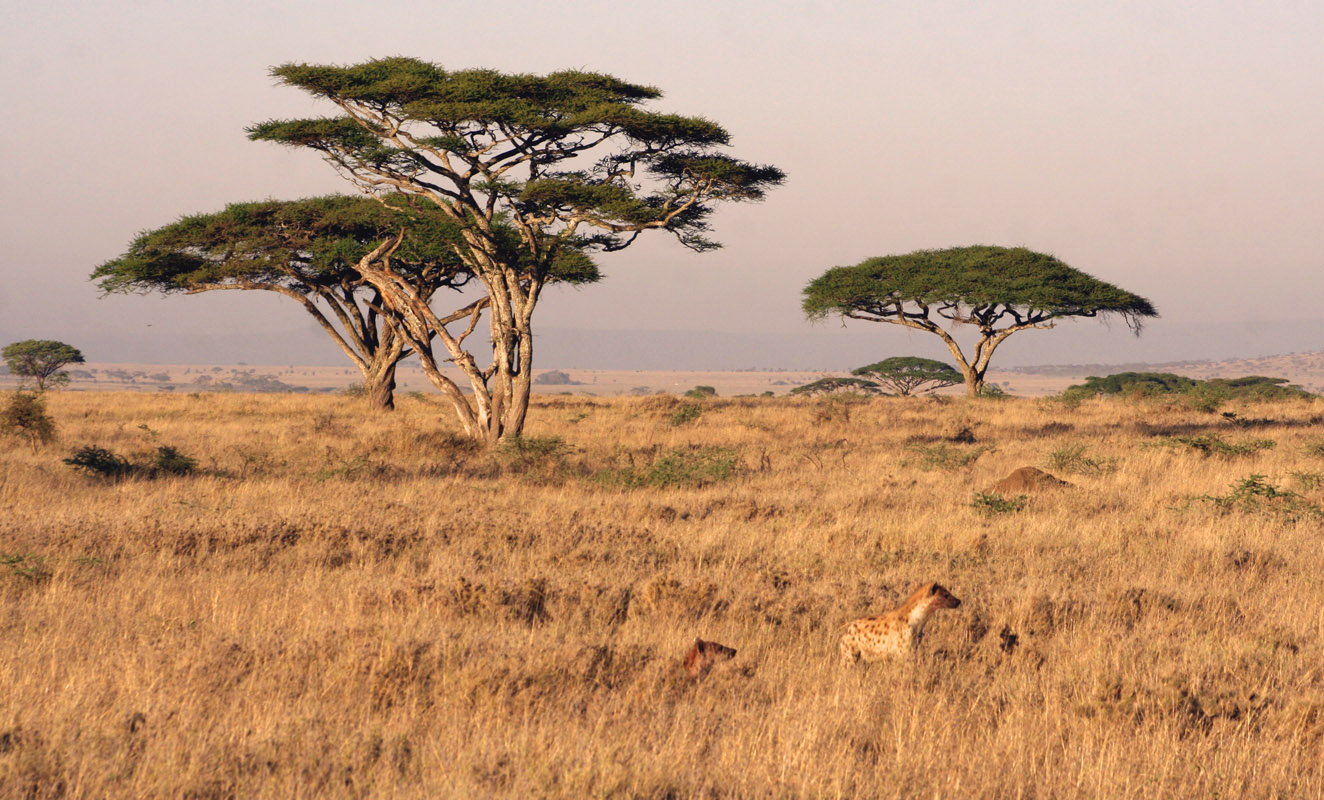
View the Great Migration from the western side of the Serengeti.

Meet local people and learn more about their different cultures during village and school visits.

And if this trip has sparked your interest in Penn Alumni Travel, there is a whole calendar of new trips for 2013. Perhaps you’ll join us for the next Great Migration safari!

Leave a comment

Filed under Alumni Programming, Emilie, Social Networking, Travel

Travel as a Currency of Freedom

Author: Lisa Ellen Niver, CAS’89

Today, George and I depart for our second “big trip.” Four years ago, we left in July 2008 for an eleven-month journey with very limited plans. I was so nervous. We leave this time with so much more experience in our relationship, our travel styles and our knowledge of each other’s dreams.

“Traveling is one way of lengthening life,” according to Benjamin Franklin. When I was at Penn, I always marveled at Benjamin Franklin’s life. He did so many different things from politics to inventing and was also a traveler. I would like to chase as many of my dreams and inventions as Benjamin Franklin did and I know while we are traveling I will have time to explore many new places and cultures.

Our adventure begins in Bali, Indonesia the largest archipelago on the planet. We plan to visit the Toggian Islands of Sulawesi and the Banda Islands. I cannot wait to go snorkeling in the clear blue waters and relax on the gorgeous beaches. We promise to send photos and videos if there is Internet and electricity! Sign up for our newsletter and get an email from us twice a month with our latest news! You can always check our website for our latest posts.

As Andrew Evans says in Ben Franklin, Traveler:  Benjamin Franklin’s example [to us all]: a patriot is someone who travels and broadens their minds through travel.

I wish you a Happy Independence Day and I hope to follow his example and use these travels as a tool for learning, to enhance my teaching and to share it all with you.

Leave a comment

Filed under Alumni Perspective, Travel

Penn Alumni Travel: Dispatches from Abroad

Author: Emilie Kretschmar on behalf of Art Caplan, Emmanuel and Robert Hart Director of the Center for Bioethics

This is a busy month for Penn Alumni Travel. We have Penn alumni and friends traveling to the National Parks, the Italian Lake District, the Baltic Sea countries, the British Isles, and the Adriatic coast. June is certainly a popular time to travel! Director of the Center for Bioethics Art Caplan is traveling as our faculty host on our alumni trip to the Baltic Sea and, thanks to WiFi on today’s cruising ships, is sending us reports from sea. Here is his latest dispatch to our office:

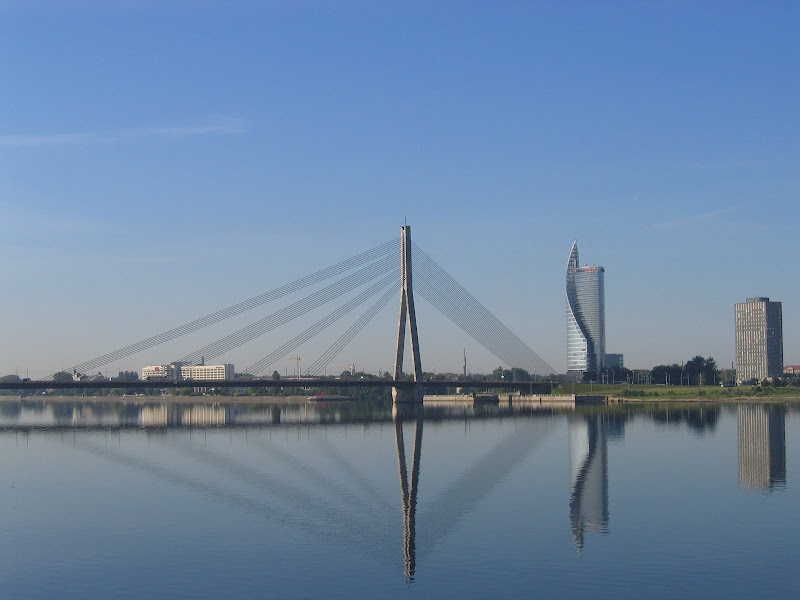
Having a great time. Sixteen alums and spouses on the trip through the Baltics. Heard a very insightful talk by [Mikhail] Gorbachev to lead off the cruise. He counseled patience in dealing with Putin, crony capitalism and corruption issues in Russia today. St. Petersburg is the most beautiful of the Russian cities. The buildings of Peter the Great and his Tsarist successors are stunning. We needed more time at the Hermitage. The Bolsheviks hated this example of exploitation of the serfs and the poor but now, open to the public, they seem more gifts than places that would trigger revolution. On we have gone to Helsinki, Talinn, and the quiet surprise of the trip so far–Riga, Latvia. The Penn contingent agreed to a person that this city is amazing in terms of parks, architecture, and churches. Much of the city escaped destruction in WWII and the Soviets did not succeed in ruining its appearance either.

St. Petersburg

Riga, Latvia

We have had marvelous weather. Calm seas. Had a Penn dinner last night that went into the wee hours. Things may take a turn for the worse tomorrow–I speak to those on the cruise before we see Gdansk, Poland!

I think I can confidently say that Professor Caplan will only enhance the experience with his lecture before Gdansk, Poland. Traveling with your fellow Penn alumni and a Penn faculty host is one of the most rewarding ways to experience the world. If this dispatch has sparked your interest in Penn Alumni Travel, visit us on our website and check out the schedule for what remains of 2012 as well as the newly released trips for 2013. We hope to see you on a future Penn Alumni Travel trip!

1 Comment

Filed under Alumni Programming, Emilie, Travel

Turkey Trot

Author: Larry Silver, Professor of Art History

Late spring is the perfect time to visit the Mediterranean.  Wild flowers are out, and the heat and crowds of tourists have yet to build up.  Consider how many ruins and outdoor experiences Turkey can offer, and you have a great recipe for a relaxing yet stimulating travel experience.

The trip to Turkey through Penn Alumni by Odysseys offered an almost perfect blend of hiking, relaxing, historic sites, and personal time for rug or ceramic shopping and the usual roster of souvenirs (even those seemed better in Turkey).  The bus had internet for the rare long legs between cities!

In fact, Turkey offers much more than Istanbul, and if two days in the city on the Bosphorus was a tantalizingly brief beginning (my one disappointment, since it is such a fascinating place that I could easily stay a week), a rich variety of places and activities lay beyond.  While in Istanbul, the Penn group enjoyed a boat trip on the Bosphorus and a rushed trip through the Spice Market and Grand Bazaar (but as noted above, the good shopping was yet to come…).  Academic experiences cranked up on day two, with visits to the Hippodrome at the center of the city and its fabled attractions: the Blue Mosque, the Islamic Museum (in the glorious former town palace of a former pasha), the incomparable St. Sophia and its gilded mosaics, and the climax, Topkapi Palace, with hilltop views of the Golden Horn and Bosphorus.  This was my turn to offer commentary on the fly and a hotel lecture on both the Byzantine and the Ottoman layers of Constantinople’s rich history.
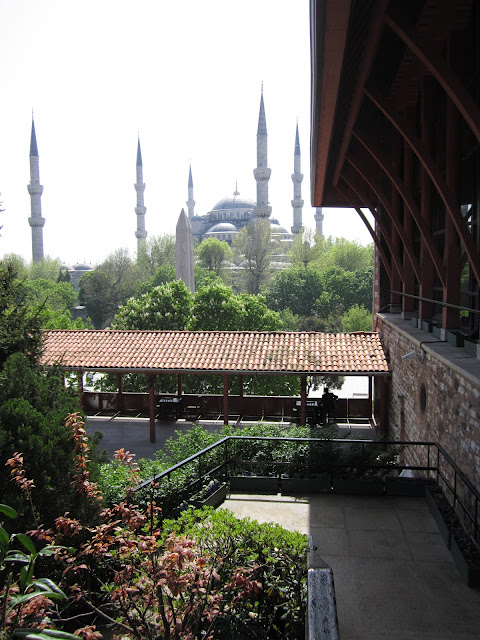
View of the Blue Mosque.

Most of the trip took place on that comfortable, internet-friendly bus, and the moving first stop was the Dardanelles, that narrow inlet, where the tragic war memorials from Gallipoli in World War I offered a modern counterpoint to the vestiges of Troy and ancient battles across the very same strait.  Our guide made an unscheduled stop at unfamiliar Assos, a small fishing village that once was the birth-place of Aristotle himself and still boasts an ancient hillside theater that was shared at sunset only with local goats.

That was the kind of experience that regularly occurred through the thoughtfulness and expertise of our guide, Aydin, a native speaker with limitless knowledge of the thicket of history that constitutes Anatolia from ancient settlements (9000 years old and upwards, which we saw on the last day in Ankara’s hilltop museum) to the modern state, founded in the 1920s by Mutstafa Atatürk (Ankara mausoleum).   Aydin’s pride in his homeland was also spiced with his candor about the Islamist turn of the current prime minister, plus his sense of both the current economic boom and political balancing act between NATO/EU candidacy/Middle Eastern power broker.  We heard about all of the regions of this geopolitical region, and he answered all our questions frankly and knowledgeably, sharing enthusiasm and good judgment (as well as a keen sense of where Americans were coming from) throughout the trip.  He has been everywhere, but still retains his enthusiasm for sharing his homeland.  The best guide I have ever had (with one competitor, in Egypt)–and if he does get his belated law degree, it will be a great loss to Turkey’s international relations, for this man could be a diplomat–or a quiz show contestant on his own country.

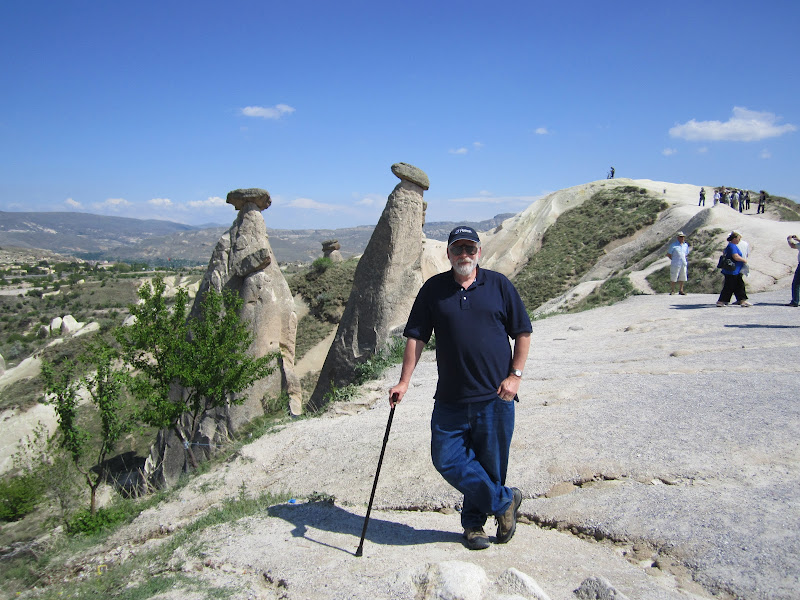
I do not get “ruins fatigue,” but Turkey offers so much to see in that category–more sites from the Roman Empire than Italy or anywhere else, for example–that I can see how someone else might.  The roll call of where we went is impressive enough: the acropolis of Pergamon, the Ephesus of St. Paul, Perge and Antalya, where the Roman sculptures from the theater were among the best preserved and finest any-where (and I had never even heard of the place before this trip).  I tried to sort it out and give some pointers for viewing and visiting enjoyment in a lecture on archaeology in Turkey, especially Hellenistic and Roman monuments.  But there were also major Byzantine sites, such as the church of the real St. Nicholas in Myra and the painted cave chapels in Cappadocia in the trip extension.  Layers everywhere, and so much to see, not least the shrine to Rumi, the great founder of Sufism, in Konya.
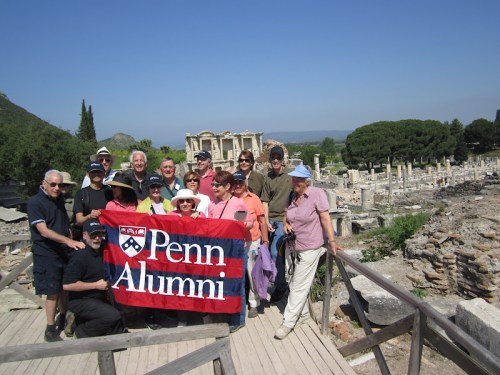
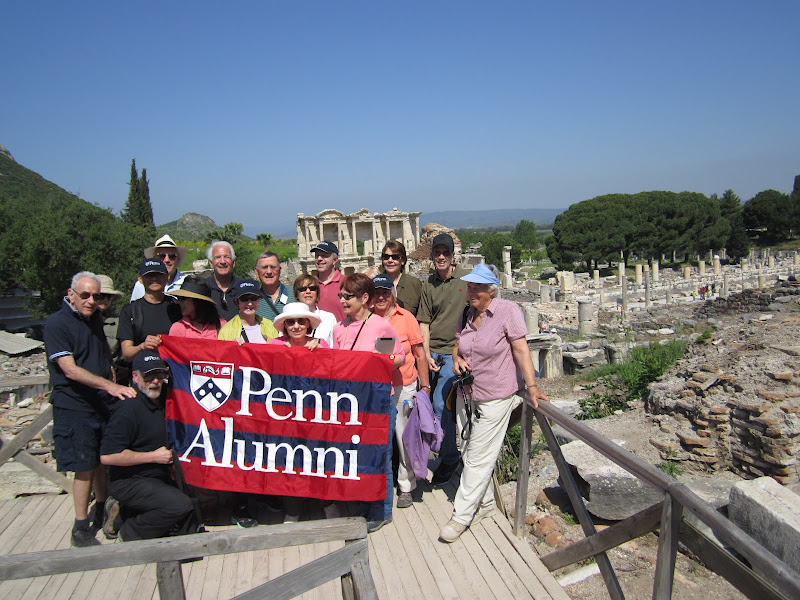
Photo-op in Ephesus.

Not that such expeditions are work, but this trip also offered a relaxation component.  For four nights we slept on motorized sailboats (gullets in Turkish), from which the braver of us swam in cool seas, but under sunny skies we hiked up to herding regions or abandoned monasteries or visited abandoned Greek towns from the population exchanges of 1923 (Aydin, whose own family came to Turkey from the Balkans just before World War I, would clearly like to see more of that same cultural diversity back in Turkey, but that ship has sailed…).  Mostly, dividing our already small group of 16 into two parts on the boats meant that we bonded still more, sharing jokes, favorite books, personal backgrounds, and exaggerated stories, as we traded our books when we finished them.  Update on technology: 3 of the couples had Kindles, and several made good use of iPads, including the camera function, which enabled instant mailing of on-the-spot postcard-like images back home.
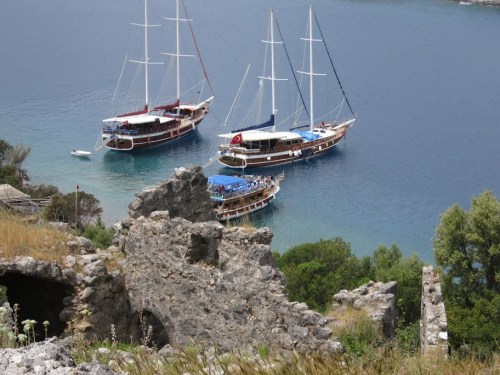
The Gullets.

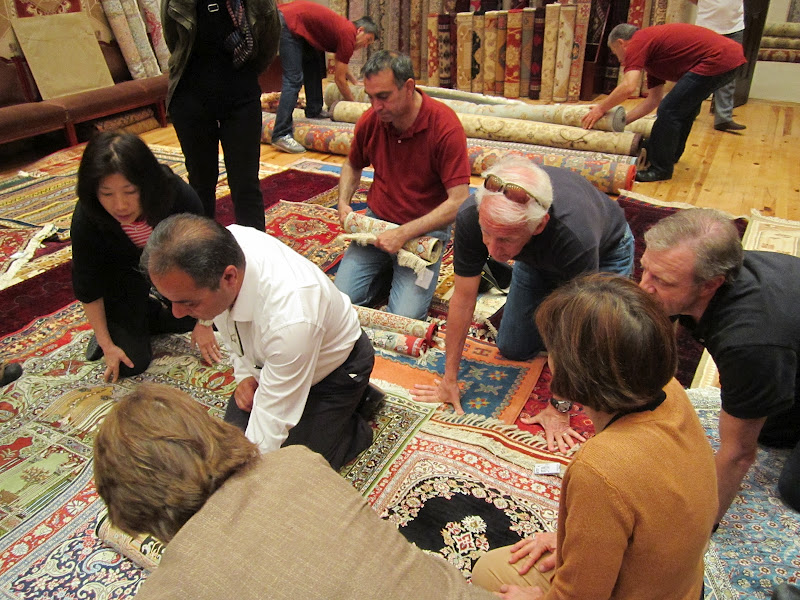
Indeed, this was a tight-knit and cordial group by early days on the trip, and it helped that most of us were alumni of the 60s or 70s, some retired and some still very much in the office.  The small size of the group and its good spirits made for a relaxed and pleasant atmosphere.  Odysseys deliberately tries to keep its groups small and this one was all-Penn (except for a ringer couple from Houston), in part this time because of the sailboats.  We did our part for the local economy, whether at kiosks outside the archeological parks or in the smaller towns where we stopped or else at the two big crafts stops of the trip: a rug-weaving (and selling) shop near Ephesus and a late stop at the studio of a master potter in Cappadocia.  Both places were glad for our bus; we, in turn, besides the purchases, learned a lot about how Turkish carpets are woven and dyed, or how pots are thrown on a traditional wheel.
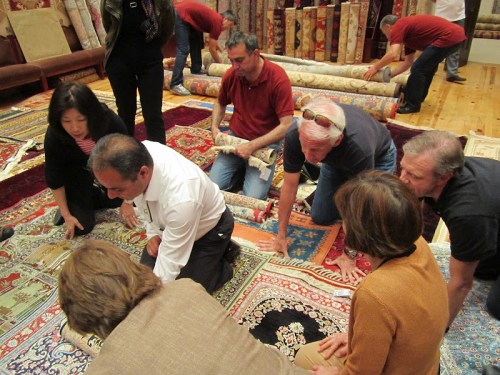
Taking in a rug weaving shop.

Ultimately, good food (Turkish cooking uses basic ingredients, much grilling but also fresh vegetables and fruits) and beautiful scenery will be memories that last.  Our comfortable hotels ranged from the humble seaside inn of Assos to a luxury Turkish chain (Rixos) and a handsome Swissotel.  In Antalya we even stumbled onto the world archery championships, while many of us sampled the heritage of a Turkish bath and massage.  In Cappadocia, those of us on the extension took an exhilarating collective balloon ride over the unique, moonlike eroded landscape.


Taking in a rug weaving shop.

All in all, Turkey was a most memorable Penn Alumni Association trip.  Small group bonding, good accommodations and guide, beautiful scenery, and a mix of physical activity and delightful indolence.  Enough history and archaeology with a learned guide to feel intellectually stimulated (not to mention having a Penn art history professor around, either to help explain or to take some of the mystery out, occasionally irreverently), but not so much that you could not take time out for a chat, a read, or a shopping excursion.  Add to those ingredients perfect weather most of the time, wildflowers, and no spats or injuries, and we have a lot behind our photo souvenirs to remember from two remarkable weeks in modern and ancient Turkey.  Speaking as that Penn professor, I would eagerly recommend this trip to those who are interested, and I look forward to accompanying another Penn group on a trip like this one!

Professor Larry Silver in Capadoccia.



1 Comment

Filed under Academics, Faculty perspective, Travel

Travel Photo Contest Winners

Author: Emilie Kretschmar

Penn Alumni Travel is a great way to see the world, make new friends, and learn about fascinating new peoples and cultures. But traveling on a Penn trip is also the perfect chance to hone in on your photography skills and bring a landscape, a culture, or a monument to life. We recently hosted our second annual travel photo contest and, with all the amazing entries, it was difficult to pick a winner. In the end, we named Robert Chewning, WG’76, the grand prize winner for his photograph of hippos in the Serengeti.

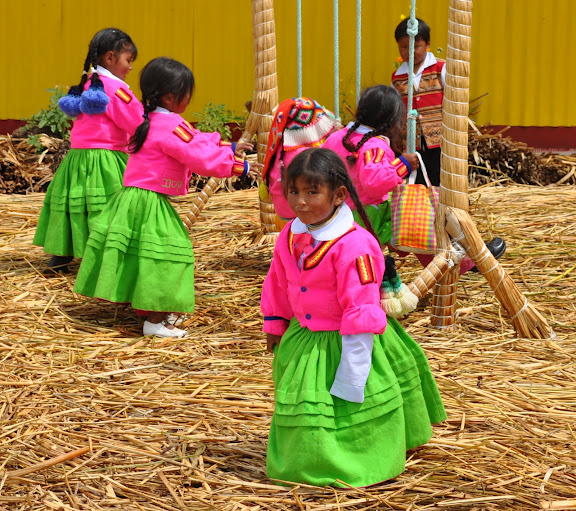
Other prizes were awarded to Robert Bartholomew, C’63, GAR’65 for his picture of school children in Peru.

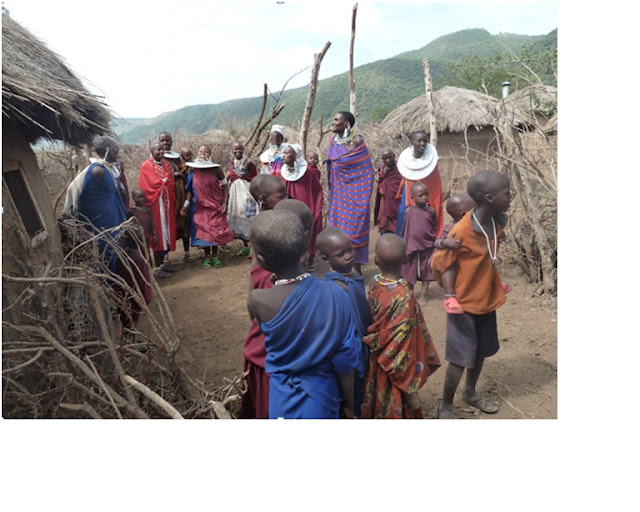
Alice Freed, CW’68, GR’76 for her picture of a Maasai village in Tanzania.

Jack Swope, ME’56 for his image of an impala in the Maasai Mara.

And Julia Moore Converse for her fish sculpture picture in Peru.

A great travel photograph is both beautiful and inspirational and, if these photographs inspire you to travel, check out Penn Alumni Travel’s website (link to: ) for more information about upcoming trips. You can also like us on Facebook and share your own beautiful travel shots!

Leave a comment

Filed under Alumni Programming, Penn Alumni Travel, Photos, Travel

Penn Alumni Travel: Reflections on Vietnam

Author:  Bruce Kuklick, Professor of American History, Penn

This past spring, I spent two weeks as lecturer-host on a Penn Alumni Travel tour of Vietnam. I teach at Penn, and among my areas of expertise is the War in Vietnam.  While the tour was not designed with the war in mind, we hit every spot that I have lectured about in my classes and professional appearances – Hanoi, Haiphong, Hue, Da Nang, Saigon, and the Me Kong Delta. Our group of 21 was diverse in its political views and backgrounds but always friendly, and above all eager to learn from actual experience what the country was about, and not incidentally the impact of the United States on Vietnam.

We had an absolutely terrific in-country guide, Quang Nguyen. Quang was friendly, fluent in English, more than knowledgeable, and catered to our needs 24/7; he was philosophical about the War, which he vividly remembered as the youngest of 11 children who with their parents left a comfortable life in Hanoi to start over completely in Saigon.  He recalled the years of the War as “the empty-hand years.” With Quang we toured colorful markets, ate at great restaurants where he ordered the local specialties for us to enjoy, and went on several river boat adventures with stops along the way at floating markets, pagodas, and a fruit farm where we were served a ‘fruit’ tea and treated to a concert with traditional instruments.  All of our accommodations were gracious, luxurious, and picturesque.  Yet despite the well organized and comfortable travel to fascinating sites, I cannot say that this tour was exactly a holiday or a vacation.  At least for me, it was too filled with painful reminders of the consequences, both for Vietnam and for America, of American policies and decisions during the Cold War. These reminders often colored my perception of what we saw, and I am still trying to figure out the complex set of feelings about the United States and Vietnam with which I came home. But for those very reasons the trip had a compelling importance for me and for my wife. Our visit to Vietnam was what we call a life experience, and, in fact, we are beginning to think about ways that we might someday go back.


Bruce Kuklick is a member of the Department of History at the University of Pennsylvania. His historical interests are broadly in the political, diplomatic, and intellectual history of the United States; and in the philosophy of history. He has won all the major teaching prizes given by the University, including the Senior Class Award.

For more information about the Penn Alumni Travel program, visit www.alumni.upenn.edu/travel


1 Comment

Filed under Academics, Faculty perspective, Travel

Remembering Travels to Egypt

Author: Kiera Reilly, C’93

Penn Alumni Travel visited Egypt in January 2010. Given the Penn Museum’s strong collection in Egyptian antiquities, coupled with leading researchers and professors, we wanted to include Penn professors on our program. We were lucky to have the husband-wife team of Penn Egyptologists Jennifer Houser Wegner , Ph.D., C’91, and Joe Wegner, Ph.D., G’89, and their son Alexander join us. Joe is Associate Curator, Egyptian Section, Penn Museum and Associate Professor, Department of Near Eastern Languages and Civilizations. Jen is Associate Curator, Egyptian Section, Penn Museum and Adjunct Assistant Professor, Department of Near Eastern Languages and Civilizations. They gave lectures during the trip and provided additional insight as we visited the ancient sites.

Our group had a wonderful time exploring the ancient antiquities of Egypt, and we were fortunate to also have a local alumna meet us in Karnak when we toured the temple there. She showed us some closed to the public areas and explained how they are trying to preserve and put the temple back together (large portions of it are just piles of rocks).

At the end of our trip, when we were back in Cairo, we met with Dr. Zahi Hawass, Ph.D., G’93, GR’87. Dr. Hawass at the time was the Secretary General of Egypt’s Supreme Council on Antiquities.

When the revolution happened in Egypt earlier this year, our group was very concerned about our guide and her family. I remember during the trip when she was asked about politics and government she would tell us that no one really pays attention because “nothing will change.” Mubarak’s son was being groomed to take over for him and things would continue as they are. What a difference a year makes! As the news developed, we all sent her messages, worried about her and her family living in Cairo. Her first message to us sounded desperate and fearful about what was happening. Then a few weeks later when Mubarak had stepped down, her tone was much more jubilant and hopeful.

Hopefully, we will be able to return to Egypt one day and explore once again its many wonders, but this time with a democratic government.

Cairo Mosque – the group at a mosque in Cairo

Travelers in front of the tombs at Abu Simbel

At Karnak, legend has it that you walk around the scarab several times (I think 8) for good luck

The Karnak temple is only partially preserved. We were taken back to this section where everything is just in pieces. Archaeologists are trying to figure out how to put it back together.

Close to Karnak is Luxor temple – we finished our tour there at dusk.

The famous Pyramids at Giza, and also the Sphinx.

We were not allowed to take a group photo with our Penn banner in front of the pyramids, so we took individual shots.

At the end of our trip, fellow alumnus Zahi Hawass came to speak to our group and autograph one of his books.

Our group at the traditional galabia party (that’s the outfit we’re wearing) on our ship on the Nile.

The Karnak temple – this shot was taken mainly to capture the woman with a burqa walking by

4 Comments

Filed under Alumni Perspective, Kiera R., Penn Alumni Travel, Photos, Travel