Category Archives: Academics

Turkey Trot

Author: Larry Silver, Professor of Art History

Late spring is the perfect time to visit the Mediterranean.  Wild flowers are out, and the heat and crowds of tourists have yet to build up.  Consider how many ruins and outdoor experiences Turkey can offer, and you have a great recipe for a relaxing yet stimulating travel experience.

The trip to Turkey through Penn Alumni by Odysseys offered an almost perfect blend of hiking, relaxing, historic sites, and personal time for rug or ceramic shopping and the usual roster of souvenirs (even those seemed better in Turkey).  The bus had internet for the rare long legs between cities!

In fact, Turkey offers much more than Istanbul, and if two days in the city on the Bosphorus was a tantalizingly brief beginning (my one disappointment, since it is such a fascinating place that I could easily stay a week), a rich variety of places and activities lay beyond.  While in Istanbul, the Penn group enjoyed a boat trip on the Bosphorus and a rushed trip through the Spice Market and Grand Bazaar (but as noted above, the good shopping was yet to come…).  Academic experiences cranked up on day two, with visits to the Hippodrome at the center of the city and its fabled attractions: the Blue Mosque, the Islamic Museum (in the glorious former town palace of a former pasha), the incomparable St. Sophia and its gilded mosaics, and the climax, Topkapi Palace, with hilltop views of the Golden Horn and Bosphorus.  This was my turn to offer commentary on the fly and a hotel lecture on both the Byzantine and the Ottoman layers of Constantinople’s rich history.
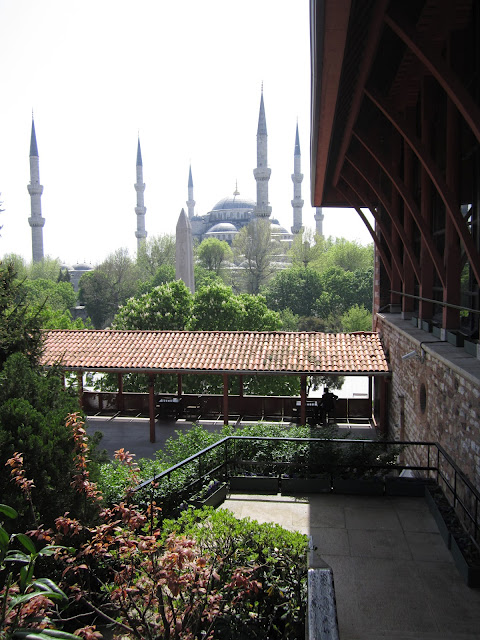
View of the Blue Mosque.

Most of the trip took place on that comfortable, internet-friendly bus, and the moving first stop was the Dardanelles, that narrow inlet, where the tragic war memorials from Gallipoli in World War I offered a modern counterpoint to the vestiges of Troy and ancient battles across the very same strait.  Our guide made an unscheduled stop at unfamiliar Assos, a small fishing village that once was the birth-place of Aristotle himself and still boasts an ancient hillside theater that was shared at sunset only with local goats.

That was the kind of experience that regularly occurred through the thoughtfulness and expertise of our guide, Aydin, a native speaker with limitless knowledge of the thicket of history that constitutes Anatolia from ancient settlements (9000 years old and upwards, which we saw on the last day in Ankara’s hilltop museum) to the modern state, founded in the 1920s by Mutstafa Atatürk (Ankara mausoleum).   Aydin’s pride in his homeland was also spiced with his candor about the Islamist turn of the current prime minister, plus his sense of both the current economic boom and political balancing act between NATO/EU candidacy/Middle Eastern power broker.  We heard about all of the regions of this geopolitical region, and he answered all our questions frankly and knowledgeably, sharing enthusiasm and good judgment (as well as a keen sense of where Americans were coming from) throughout the trip.  He has been everywhere, but still retains his enthusiasm for sharing his homeland.  The best guide I have ever had (with one competitor, in Egypt)–and if he does get his belated law degree, it will be a great loss to Turkey’s international relations, for this man could be a diplomat–or a quiz show contestant on his own country.

I do not get “ruins fatigue,” but Turkey offers so much to see in that category–more sites from the Roman Empire than Italy or anywhere else, for example–that I can see how someone else might.  The roll call of where we went is impressive enough: the acropolis of Pergamon, the Ephesus of St. Paul, Perge and Antalya, where the Roman sculptures from the theater were among the best preserved and finest any-where (and I had never even heard of the place before this trip).  I tried to sort it out and give some pointers for viewing and visiting enjoyment in a lecture on archaeology in Turkey, especially Hellenistic and Roman monuments.  But there were also major Byzantine sites, such as the church of the real St. Nicholas in Myra and the painted cave chapels in Cappadocia in the trip extension.  Layers everywhere, and so much to see, not least the shrine to Rumi, the great founder of Sufism, in Konya.
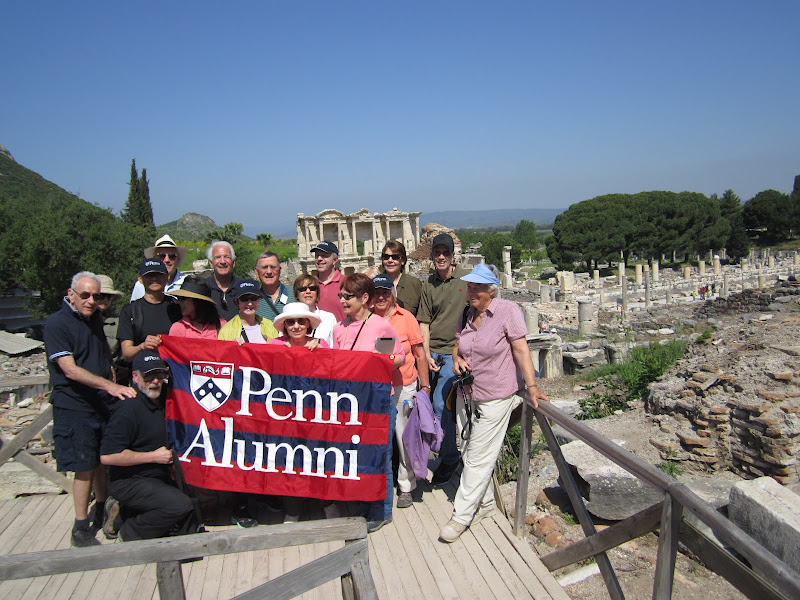
Photo-op in Ephesus.

Not that such expeditions are work, but this trip also offered a relaxation component.  For four nights we slept on motorized sailboats (gullets in Turkish), from which the braver of us swam in cool seas, but under sunny skies we hiked up to herding regions or abandoned monasteries or visited abandoned Greek towns from the population exchanges of 1923 (Aydin, whose own family came to Turkey from the Balkans just before World War I, would clearly like to see more of that same cultural diversity back in Turkey, but that ship has sailed…).  Mostly, dividing our already small group of 16 into two parts on the boats meant that we bonded still more, sharing jokes, favorite books, personal backgrounds, and exaggerated stories, as we traded our books when we finished them.  Update on technology: 3 of the couples had Kindles, and several made good use of iPads, including the camera function, which enabled instant mailing of on-the-spot postcard-like images back home.

The Gullets.

Indeed, this was a tight-knit and cordial group by early days on the trip, and it helped that most of us were alumni of the 60s or 70s, some retired and some still very much in the office.  The small size of the group and its good spirits made for a relaxed and pleasant atmosphere.  Odysseys deliberately tries to keep its groups small and this one was all-Penn (except for a ringer couple from Houston), in part this time because of the sailboats.  We did our part for the local economy, whether at kiosks outside the archeological parks or in the smaller towns where we stopped or else at the two big crafts stops of the trip: a rug-weaving (and selling) shop near Ephesus and a late stop at the studio of a master potter in Cappadocia.  Both places were glad for our bus; we, in turn, besides the purchases, learned a lot about how Turkish carpets are woven and dyed, or how pots are thrown on a traditional wheel.
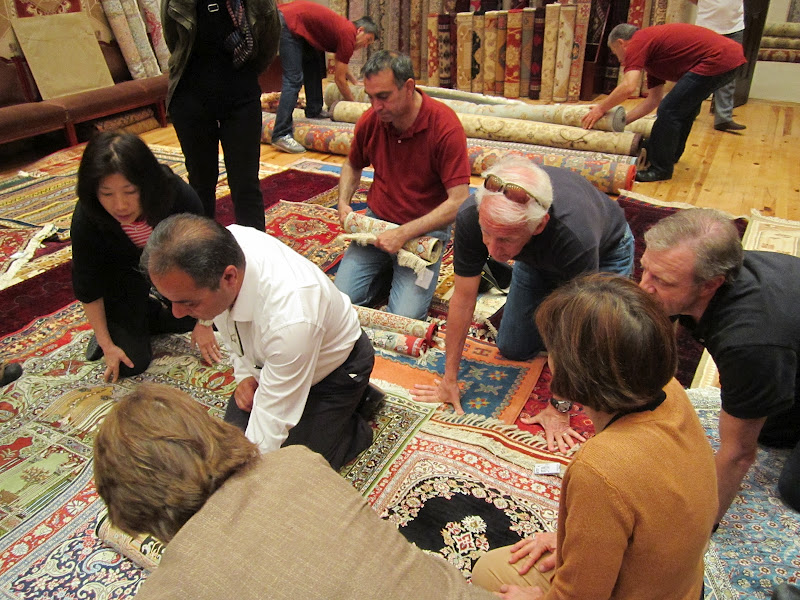
Taking in a rug weaving shop.

Ultimately, good food (Turkish cooking uses basic ingredients, much grilling but also fresh vegetables and fruits) and beautiful scenery will be memories that last.  Our comfortable hotels ranged from the humble seaside inn of Assos to a luxury Turkish chain (Rixos) and a handsome Swissotel.  In Antalya we even stumbled onto the world archery championships, while many of us sampled the heritage of a Turkish bath and massage.  In Cappadocia, those of us on the extension took an exhilarating collective balloon ride over the unique, moonlike eroded landscape.


Taking in a rug weaving shop.

All in all, Turkey was a most memorable Penn Alumni Association trip.  Small group bonding, good accommodations and guide, beautiful scenery, and a mix of physical activity and delightful indolence.  Enough history and archaeology with a learned guide to feel intellectually stimulated (not to mention having a Penn art history professor around, either to help explain or to take some of the mystery out, occasionally irreverently), but not so much that you could not take time out for a chat, a read, or a shopping excursion.  Add to those ingredients perfect weather most of the time, wildflowers, and no spats or injuries, and we have a lot behind our photo souvenirs to remember from two remarkable weeks in modern and ancient Turkey.  Speaking as that Penn professor, I would eagerly recommend this trip to those who are interested, and I look forward to accompanying another Penn group on a trip like this one!
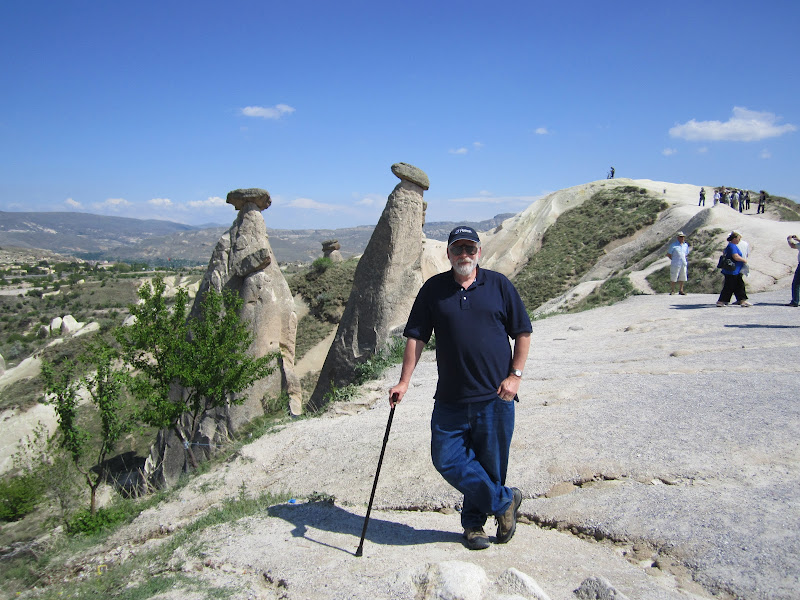
Professor Larry Silver in Capadoccia.


1 Comment

Filed under Academics, Faculty perspective, Travel

Penn Alumni Travel: Reflections on Vietnam

Author:  Bruce Kuklick, Professor of American History, Penn

This past spring, I spent two weeks as lecturer-host on a Penn Alumni Travel tour of Vietnam. I teach at Penn, and among my areas of expertise is the War in Vietnam.  While the tour was not designed with the war in mind, we hit every spot that I have lectured about in my classes and professional appearances – Hanoi, Haiphong, Hue, Da Nang, Saigon, and the Me Kong Delta. Our group of 21 was diverse in its political views and backgrounds but always friendly, and above all eager to learn from actual experience what the country was about, and not incidentally the impact of the United States on Vietnam.

We had an absolutely terrific in-country guide, Quang Nguyen. Quang was friendly, fluent in English, more than knowledgeable, and catered to our needs 24/7; he was philosophical about the War, which he vividly remembered as the youngest of 11 children who with their parents left a comfortable life in Hanoi to start over completely in Saigon.  He recalled the years of the War as “the empty-hand years.” With Quang we toured colorful markets, ate at great restaurants where he ordered the local specialties for us to enjoy, and went on several river boat adventures with stops along the way at floating markets, pagodas, and a fruit farm where we were served a ‘fruit’ tea and treated to a concert with traditional instruments.  All of our accommodations were gracious, luxurious, and picturesque.  Yet despite the well organized and comfortable travel to fascinating sites, I cannot say that this tour was exactly a holiday or a vacation.  At least for me, it was too filled with painful reminders of the consequences, both for Vietnam and for America, of American policies and decisions during the Cold War. These reminders often colored my perception of what we saw, and I am still trying to figure out the complex set of feelings about the United States and Vietnam with which I came home. But for those very reasons the trip had a compelling importance for me and for my wife. Our visit to Vietnam was what we call a life experience, and, in fact, we are beginning to think about ways that we might someday go back.


Bruce Kuklick is a member of the Department of History at the University of Pennsylvania. His historical interests are broadly in the political, diplomatic, and intellectual history of the United States; and in the philosophy of history. He has won all the major teaching prizes given by the University, including the Senior Class Award.

For more information about the Penn Alumni Travel program, visit www.alumni.upenn.edu/travel


1 Comment

Filed under Academics, Faculty perspective, Travel

A Thousand Thanks, and Farewell to Penn!

Author: Mari Meyer, GED ’12

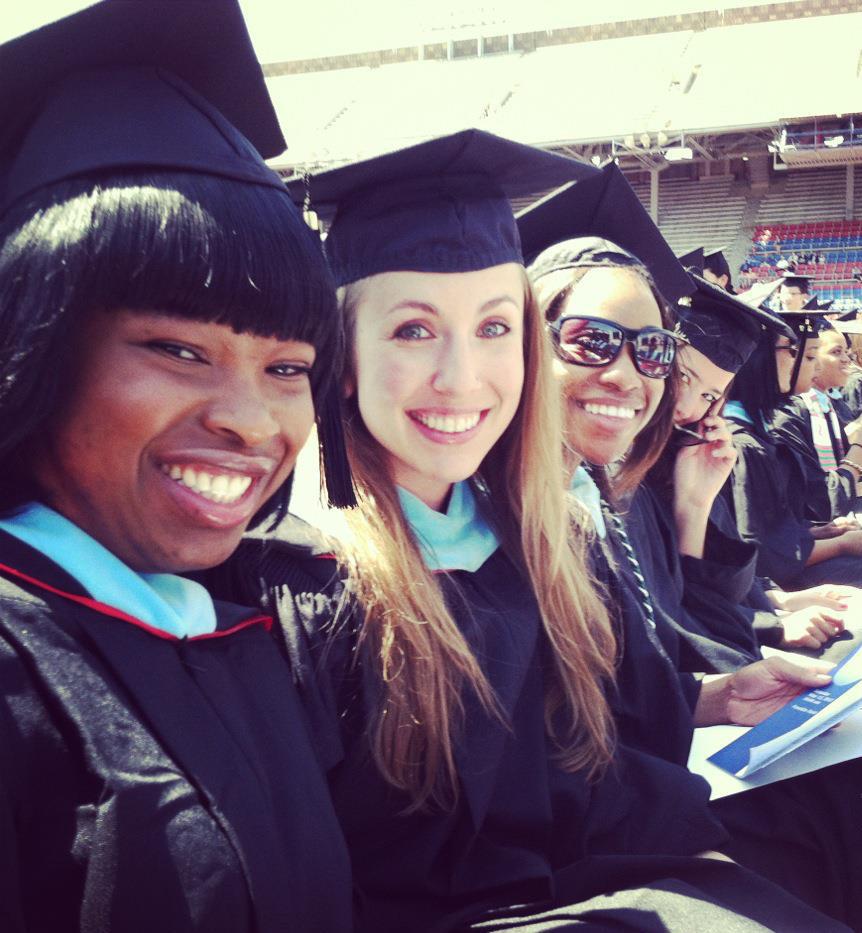
WE DID IT!!!  We graduated! We rented our gowns (and returned our gowns); we collected our “diplomas” and strutted our stuff down Locust Walk. All I can say is, it feels SO GOOD!

Of course I couldn’t have made it to this point in one piece without the incredible support and love from family, friends, faculty and the one of a kind colleagues I’ve met here at Sweeten Alumni House. I will sincerely miss you all, but now that I’m an alumna, you’re stuck with me for good!

My big brother helping me with my hood.

My internal monologue: “Don’t trip. Don’t trip. Don’t trip…”

Diplomas in hand…

My dad was so proud and he wanted to make sure everyone knew it. Yep, that was me at age 4.

The most memorable walk of my life.

The after-party.

The after party! (caption: “The after party!”

Leave a comment

Filed under Academics, Alumni Perspective, Alumni Programming, Alumni Weekend, Commencement, Mari M.

Life After the Third Degree

Author: Mari Meyer, GSE, C’12

Just six months ago, I was writing about my strategic, if not artistic, return to studenthood. I have to admit, being a graduate student has had its perks: my family and friends foot the bill for brunches and lunches out of unadulterated pity; I can use my studies as an excuse to procrastinate in all other aspects of my life (i.e. vegetable eating, room cleaning, hair washing, etc.); I am assumed to be smarter and, in general, more important in the world despite my affinity for tabloid magazines, scrapbook making, and the unofficial, anthropological study of college kids.

Sorority pledges I spied on the Quad this week. Hard not to notice them!

My program at the Graduate School of Education lasts for only one year. That is to say: one academic year. Meaning, of course, two semesters. Which really means: a measly nine months. And I graduate in less than two! You may wonder, “How does one become a Master of anything in nine months?”

The answer is simple:  I take five classes each semester—with some of the most intelligent and accomplished professors and colleagues I’ve ever met—while working 20 hours a week at Sweeten Alumni House (and worrying about the project I oversee here an extra 10 hours on top of that).  When I’m not in class, or at the office, I am meeting with fellow grad students for group assignments that can span weeks, and because we all have schedules like this, our meetings do not even begin some evenings until 10 PM.  Of course, I spend most of my time reading, and writing papers, and reading some more. It is highly possible that I have read more in this program thus far than I did throughout four years of college. But I’m not talking about just any reading; I’m talking about the kind of reading that requires re-reading, often. The kind of reading that needs to be chewed like steak, that needs to be tasted and digested and metabolized —the kind of reading that you need to work through sentence by sentence, often with dictionary in hand.  I have never in my life felt more moved by and thus exhausted by what I’ve immersed myself in on paper. Oh, yes, and then the rest of the time I have to sleep, exercise, eat, and occasionally call my parents to thank them for giving me life

Thanks, Mom!

The real answer to the question, though, is that I don’t think one can become a true Master of anything in nine months. I often wonder if it is possible to become a Master of anything in an entire lifetime! But rather than thinking of this as a depressing concept, I find it incredibly exciting.  You know that feeling of letdown after a great vacation? You know the one, when everything you wanted to see you saw, everything you wanted to do you did, and then some.  The question of, “now what?” always creeps in, and you fall into that anticlimactic slump that leaves you right back where you started.  To become a Master implies a sort of end point, a kind of completion of a journey that in reality is, or at least ought to be, endless.

Who would have known that ten years later I’d be graduating with a third degree?

Though I have learned a tremendous amount—an infinite amount really—about the field within which I hope to find employment and the topics for which I am most passionate and committed personally, I am so thankful to know that I cannot know it all.  It is a relief, at least to me, that there will always be more to explore: more answers to find, more challenged to take on, and more paths to navigate without certainty of where they may lead.

My adventure working at an elephant refuge in Thailand in 2007.

Having said this, I am now back on the job market. And I am no fool. Being privileged enough to receive a Master of Science in Education from Penn will provide me with more opportunities that I could have ever imagined. It also instills in me a deep sense of gratitude and a responsibility for using this privilege and the learning that has come from it wisely, conscientiously, and justly. Will I feel like I have mastered my field by this coming May when I throw my hat in the air? Probably not—and maybe that’s just the hopeful “I’m a lifelong learner!” geek in me. And though there’s always a Ph.D, or an Ed.D, or some other buffet of degrees to dabble in if I start to get hungry for academia again—I have to admit, at least for now, that there’s nothing I look forward to more than reading mindless magazines and glitterizing unfinished scrapbooks all summer long instead!

Leave a comment

Filed under Academics, GSE, Mari M.

CBI?

Author: Jonathan Cousins, SEAS’14

Penn is full of acronyms – OCR, SPEC, UA – the list goes on and on, especially in engineering, where acronyms seem to be the order of the day.  From SEAS to each major (MEAM, CBE, ESE, etc.), you can hardly get through a day without using acronyms.  This week, I was introduced to a new one – CBI.  While a typical Penn student might think College Board I______, or something along those lines, the CBI is actually an acronym more closely associated with NCAA and NIT.  Yes, the CBI is the College Basketball Invitational, the postseason tournament that Penn is currently competing in.

Most people, including myself, had never heard of the CBI before this week – and most of those people still don’t know what it is.  It is a fairly new tournament, started in 2008, whose distinguishing feature is that the championship round is a best-of-three series.  When I heard that Penn was going to participate, I was not sure whether to be excited or upset.  After all, this news came on the heels of the painful loss to Princeton last Tuesday that kept us out of a playoff game for the Ivy title. But I got a ticket for last night’s game against Quinnipiac – and I was among the few who did.  Almost the entire upper bowl was empty, and the student section was more sparsely filled than over spring break, which is saying something.  Two of our seniors, Tyler and Mike, were out with nagging injuries that have plagued them throughout the season.  All-in-all the atmosphere was that of a meaningless preseason game. But Penn put together a good effort, shooting almost 50% from beyond the arc and playing well defensively and they went on to win the game.

Here is where I insert a plug for the second round game. Having won the first game, Penn now plays Butler in the second round, at home on Monday. If the name Butler rings a bell, they probably ruined your bracket at some point during the past two years, as they went to the Final Four the past two years.  Yes, that is the Final Four in the NCAA tournament, against the best teams in college basketball.  This year has been a down year for them after they graduated some of the upperclassmen that fueled their previous tourney runs.  But if that history is not enough of a draw, perhaps you have heard of the Hinkle Fieldhouse.  “Indiana’s Cathedral of Basketball” as it is described on Wikipedia, not to be confused with our own Cathedral of College Basketball, the Palestra.  Even if Hinkle doesn’t ring a bell, you may have seen it as the stadium used in the classic basketball movie Hoosiers.

I think this game will attract more campus attention, and I encourage anyone that can make it out to the Palestra on Monday to be there.  It should be a great game, and any trip to the Palestra is a special, unique experience.  I’ll be there, Row 2, behind the basket amongst the Red and Blue Crew. Looking forward to it!

2 Comments

Filed under Academics, Athletics, Jonathan C., Student Perspective

It’s Thank Your Favorite Professor Day!

Author: Nicole Maloy, W’95

A year or so ago, near the Penn bookstore, I spotted the professor of my favorite course ever at Penn. I debated whether or not to bother him, especially as he wouldn’t have remembered me from the large lecture I had taken with him so many years before.

But what professor wouldn’t want to know that a former student really enjoyed that class, and remembers it well over a decade later? How can that not be a positive addition to someone’s day? So, I walked over, introduced myself, told him, and thanked him. Didn’t hurt a bit. And yes, he was very pleasantly surprised.

So, fellow alumni, I ask you: what was your favorite course at Penn? Who was your favorite professor? Why not send a little note to say what you appreciated about the course, or the professor, that you still remember so fondly as an alum? Today would be a great day for you to make someone else’s day.

If the professor you have in mind is still teaching at Penn, you should find an e-mail address here.

(HOLD MUSIC)

Prof still at Penn? Fabulous. Now you can send a message, just because. Prof no longer at Penn? He or she may be teaching somewhere else these days. Do a search. It’s worth a shot.

If you’re inspired to spread more good cheer after that, or if you can’t find your professor without crossing into stalker territory (please don’t cross into stalker territory), then why not redirect your efforts to finding and thanking a favorite teacher from your years prior to Penn? You can also use this energy to tell some key people from your present just what, and how much, you appreciate about them. No need to wait a decade or more for that!

3 Comments

Filed under Academics, Alumni Perspective, Memories of Penn, Nicole M.

My Life as a (Pretend) Wharton Student

Kayleigh Smoot,C’13

Even though I am happily studying psychology in the College, I sometimes wish I were studying business at Wharton. The aura of Wharton is very strong at Penn and something about being a business student seems glamorous to me (although my disgruntled Wharton friends would definitely disagree).

Maybe it’s the beauty of Huntsman Hall, home to some of the nicest classrooms on campus. Or, it could be the fact that a majority of Wharton undergrads go on to become incredibly successful leaders of society. So, since my sophomore year, I have made a point of taking at least one Wharton class a semester.

Wharton classes are genuinely different from College classes. Professors cold call on students, name tags are required, and group projects are usually a given. This semester in particular I am taking MKTG 211: Consumer Behavior. The main purpose of the class is to get into small groups and come up with a strategic marketing plan for Microsoft’s Window Phone. Our final presentations will be made in front of some of Microsoft’s high level executives; I find this to be both exhilarating and terrifying.

But, I believe this blend of classroom and real life is probably the best way to learn. So, in my last few semesters at Penn, I will probably continue to take an occasional Wharton class, if only to have an excuse to keep up the illusion of being a (pretend) Wharton student.

1 Comment

Filed under Academics, Kayleigh, Student Perspective, Wharton

Happy President’s Day!

Author: Aimee LaBrie

I didn’t realize until today that the 9th United States President, Mr. William Henry Harrison, was a graduate of the University of Pennsylvania. Sadly, he only held office for 32 days, before falling victim to complications from pnemonia.

Here are five other surprising facts about this distinguished alumnus:

1. At age 68 during the time of his inauguration, he was the oldest president elected into office until Ronald Reagan’s election in 1980.

2. He was also the last president to be born before the United States Declaration of Independence was written.

3. His inaugural address was the longest and the coldest in history–lasting nearly two hours in the bitter March wind (could this have been why he died of pnemonia one month later)?

4.Last President born as a British subject, before American independence.

5. His grandson, Benjamin Harrison, was the 23th President of the United States.

For more interesting info about President W. Harrison’s campaign against Van Buren and ultimate election, courtesy of the History Channel:

http://www.history.com/flash/VideoPlayer.swf?vid=6031377701

Leave a comment

Filed under Academics, Aimee L., Historical, Uncategorized

Taking a gamble on Network Roulette

Author: Lisa Vaccarelli, C’02, GED’10

These days, there are a plethora of new technologies out there touting themselves as the next great social networking tool.  As a consumer, it can be hard to know which ones are worth your time – and, in some cases, your money – and which will go the way of MySpace.  Here at Penn, we don’t necessarily have the answers, but we do have the opportunity to give our alumni the chance to try out some of these networking platforms within the safety of the Penn Alumni community.

This month, Penn is offering up one such opportunity.  On February 22, Penn Alumni and Career Services are hosting Network Roulette for Penn alumni and students in the media and entertainment industries.  In this virtual speed-networking session, alumni will be randomly matched with students interested in the media and entertainment industry. Each pair will be given 6 minutes to chat and share their questions and experiences. At the end of those 6 minutes, participants will be paired immediately with a new match. At the end of the event, each student and alumnus will have made 10 new connections.  It’s a truly unique opportunity for alumni to share career-related guidance and advice with current Penn students.

Click here for more information about Network Roulette and to sign up for the February 22 event.

Leave a comment

Filed under Academics, Alumni Perspective, Alumni Programming, Alumnni Education, Lisa V.

There’s a Penn Program for That

Author: Amanda D’Amico

Iowa, New Hampshire and South Carolina – oh, my!

The Republican primary is heating up. The candidates in the Republican field have a lot to say, and it’s clear they’re each looking to differentiate themselves from each other. Their differences in opinion help voters choose, but their disagreements over basic facts are downright confusing.

But don’t worry – there’s a Penn program for that.

FactCheck.org, a project of Penn’s Annenberg Public Policy Center, is a non-partisan service that analyzes statements by political players – candidates, politicians, etc. – and separates fact from exaggeration. According to FactCheck.org‘s mission statement, the organization reviews “TV ads, debates, speeches, interviews and news releases” in an effort to “increase public knowledge and understanding.” I check the RSS feed from this site each day, and I find it particularly useful as the primary season kicks into full swing.

But I’m not the only one who loves this Penn program, as it was named one of the “25 Sites We Can’t Live Without” by Time magazine in 2006. Here are a few other accolades FactCheck.org has received:

  • Named one of the 10 sites that “are changing the world” by World E-Gov Forum in 2006;
  • Named one of the “20 Best Political Websites” by PC Magazine in 2008;
  • Received a Clarion Award in the Online Media category from the Association for Women in Communications in 2009;
  • Received the Sigma Delta Chi Award from the Society of Professional Journalists in 2010; and
  • Won three Webby Awards for Best Politics Site from the International Academy of Digital Arts and Sciences in 2008, 2010 and 2011.

As the primary season moves forward and rolls into the general election, I hope more people will turn to Penn and FactCheck.org for accurate analyses of the race. I know I’ll be there.

Leave a comment

Filed under Academics, Amanda D.