
Author: Professor David Wallace, Penn Department of English
Our Penn Alumni Travel group met up at Venice on Friday June 21st to sail down the Adriatic, along the Dalmatian coast, and to visit the beautiful seaside cities of Croatia, mostly, and Montenegro. Our vessel was L’Austral, a French ship based in Marseilles with French officers—and a French chef, French baker, and French pastry maker. Following the mandatory lifeboat drill, we set sail at 6:30 PM, when the colors of Venice, lit by western light slanting across the lagoon, are at their most beautiful.

Beautiful Venice
After dinner, we were able to observe the sun setting magnificently into the ocean behind us, reassuring proof that we were heading due west.

I gave the first of the lectures offered on this cruise, calling it “On Heading East Out of Venice. ” Attendance at this and all other lectures during the week was remarkably high; our highly-educated alums were clearly thirsty for knowledge, and keen to open discussions that carried on all week. One very timely question was: how do the people of Croatia feel about joining the European Union next week? We resolved to try and find out by asking as many questions of our guides, and the people we met, as possible. Another question: What is at stake in the term “Dalmatian coast’?” Italians have long mixed with Slavs in this region, and many of them clearly believed, up to World War II, that “Dalmatia” should properly be seen as part of a greater Italian, once Roman, Empire. I thus talked of the ways in which this coastal strip had long been fought for between rival powers, and that its location midway between the empires of Rome and Constantinople, western Catholic and Eastern Orthodox Christianity, made this inevitable. So, although more recent conflicts involving Croatia, Serbia, and Bosnia continue to grab the headlines, the medieval coastal cities that we were to explore, I suggested, will be marked by signs of more ancient struggles.
The weather during this trip was beautiful; warm but not oppressively so, with a gentle wind and just one thunderstorm late in the week. The water was so calm that you had little sense of motion: indeed, sometimes you needed to look out of the window to realize that the boat was actually in motion. But the passing landscapes were so beautiful it was always a good idea to check.

We sometimes docked in harbors and sometimes dropped anchor offshore; small boats or “tenders” moved us easily to the quayside. The coastal colors of the houses were stunning, especially when set against clear blue skies.
Our first port of call was Split, where two of our Penn alums had a most happy rendezvous: Eric and Katherine Gall met up with their son, Dan. Eric, a distinguished physician, works full time (after retirement!) in Tuscon, Arizona. Katherine is Croatian, and their son Dan has settled in Split and married a local girl while working for a Human Rights organization. Dan joined us for the visit to the marvelous Meštrović museum, and the family made plans to meet up after the cruise.

The Galls meet up in Split.
At Split, we explored the remains of the vast palace of the Roman Emperor Diocletian, which faces the harbor. Diocletian spared no expense in building this palace, using the lustrous white stone from the island of Brač, and importing marble from Greece and Italy, and columns and sphinxes from Egypt. Some 3,000 people lived here in some 220 buildings; there were 16 rectangular guard towers. Diocletian was born locally of parents who may have been slaves, and he worked his way up through the Roman military. He ruled as Roman emperor for twenty-one years, but decided to return to his native Dalmatia for his retirement. He was one of the few Emperors of the third and fourth centuries to die of natural causes, and the first in the history of the Empire to retire voluntarily; and he retired to Split.
Diocletian was a notorious persecutor and torturer of Christians: in Serbian mythology he is remembered not as Diocletian but as Dukljan, the adversary of God. Christianity did make progress in Dalmatia, and in c. 347 CE one of the most influential figures in Christian history was born there. This was St Jerome, who was to translate the Bible into Latin in a form, the Vulgate, that was to be standard for Christendom for a thousand years, and for Roman Catholics even longer. The Roman and Roman Catholic status of Split thus seemed very strongly established as we walked among the ruins of Diocletian’s palace.
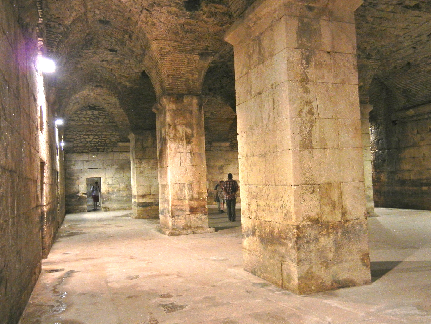
The ruins of Diocletian’s palace.
But Slavic claims to the locality were made firmly evident by a giant modern statue, located strategically right by the Golden Gate of Diocletian’s palace. The toe of this huge statue, we discovered, is well worn, because rubbing it brings good luck.

The figure represented below is Gregor Ninski: he’s holding a book with one hand, and making a defiant gesture with the other. He was a bishop who conducted Catholic church services in the Croatian language, rather than in Latin, following an Assembly in the year 926.
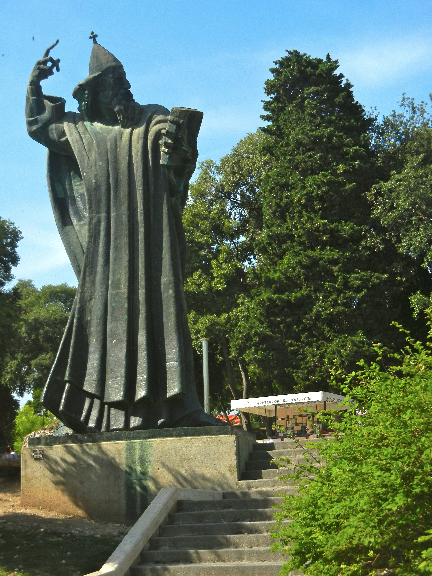
The earlier Croats had accepted the authority of the Byzantine empire, governed from Constantinople, but under Charlemagne, who was crowned Holy Roman Emperor at Rome in 800, they were intensively exposed to Roman Catholic Christianity; there were mass baptisms in the ninth century. Croatia today is still predominantly Roman Catholic (88 %); 4.4% of Croatians are Serbian Orthodox, with 5.2% unaffiliated.
Catholics will know that Roman Catholics had to wait a long time to hear mass celebrated in their own, native languages: until the 1960s, in fact, and Vatican II. So this was a precocious bid by Gregory of Nin to let Croatians have their own liturgical language, and of course, Rome did not approve. Gregor also wanted to weaken ties with Rome, to establish a church governed chiefly by local Croatian bishops, and to make the archbishopric of Split the effective center of religious authority. He celebrated mass in the local language, and also advocated married clergy and opposed the Roman alphabet, preferring the use of Glagolica, the local script (the term comes from the verb glagoliti, which means ‘to speak’).
Glagolitic script is first associated with the saints Cyril and Methodius from the Greek city of Thessaloniki. They were sent south by the Emperor of Byzantium in 862 to make converts to Greek Orthodox Christianity among Slavs. Some of their followers traveled further, into Dalmatian and Croatia—where their script, Glagolitic, was adopted and slightly modified. It was this script that Gregory of Nin wanted to substitute for the usual Latin of the Roman Catholic church. What’s amazing is that eventually this was allowed to happen: not in Gregory’s lifetime, but 300 years later. It was in the year 1248 that Pope Innocent IV gave the Croats of southern Dalmatia the unique privilege of using their own preferred script and liturgical language for the Roman Catholic rite—and eventually, this privilege spread right along the coast. Some of the Glagolitic missals or liturgical books were even produced in Rome. This is something that the papacy really did not allow anywhere else before Vatican II, in the 1960s. This is why Gregory of Nin is revered as a pro-typical nationalist leader of the Croatian people.
I think, then, that the placing of that statue of Gregory of Nin by the Golden Gate of Diocletian’s palace, at Split, was a piece of genius. It says, yes, the heritage of Rome forms a vital part of our identity, and we are pleased to acknowledge our local Roman emperor, who grew up right here. But we are also Catholic Slavs who won the right, long before any other nation in Roman Catholic Europe, to worship on our own terms, in our own language: we have written our own history in our own language in a script that we invented.
We had thus seen and learned a great deal on our first full day. We were very happy to gather as a group of Penn alums for cocktails in the beautiful evening light, after visiting Kotar, and then to have dinner together.

Penn Alumni with faculty host Professor David Wallace.
Our explorations at Split helped us make sense of everything seen later in the cruise. The further south we sailed, we realized, the more Mediterranean and easy-going things felt, and the more observantly religious. Locals along the way told us that, yes, they might well cheer for the Croatian football team (which had recently beaten Serbia), but that life along the Dalmatian coast was very different from that in Zagreb, the capital. And since these coastal towns are back by very high, almost impenetrable mountains their life really did unfold along the coast. Thus to visit these beautiful small cities by boat was really the only way to travel, the only way to make sense of them, to experience them as people had for thousands of years.
The southernmost point of our voyage brought us to Kotor, Montenegro, a beautiful and ancient city in a proudly independent land. The cathedral of St. Tryphon is a beautiful Romanesque space, with gold-winged angels.
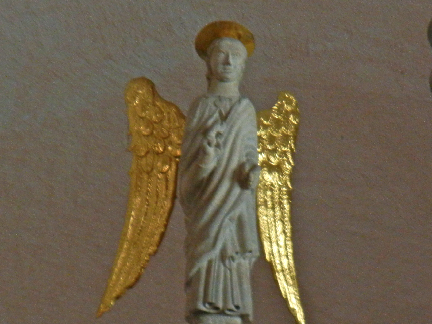
Gold-winged angel in the cathedral of St. Tryphon.
Steps lead from the edge of the city upwards to a fortress, from which the flag of Montenegro proudly flies.

It was possible to look down from this great height and spot our boat in the bay, tiny in the distance.
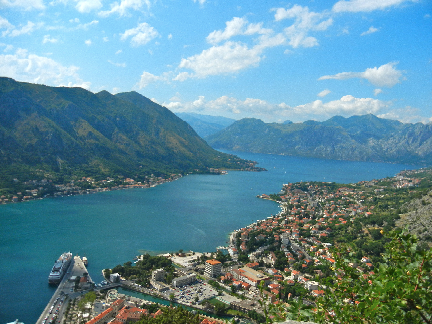
View of Kotor, Montenegro.
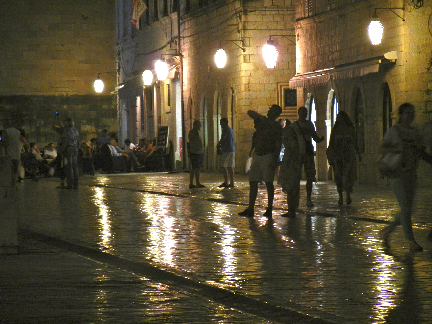
We arrived at Dubrovnik, for many centuries known as Ragusa, late on the same evening: it was possible to go ashore and explore the city by night. I went ashore with Penn alum (and west Philadelphia native) Bob Tollen, and his wife, Bryn Mawr alumna, Ellen. The polished marble of the streets was illuminated by the streetlights, giving the romantic effect of water. We made the formal tour the following day.
At some of our stops the locals told us of rather panicked preparations for EU membership: such as the cutting down of woodland and the planting of vines, before the EU forbade or put a quota on wine production. On the journey back west, between coastal towns, there was a remarkably informative “village meeting,” in which three locals spoke of recent history and speculated on the future. It was noticeable that the older two speakers were nervous about joining the EU, but the youngest of them, a teacher, seemed more optimistic; and his pupils, too, he said, were more excited than alarmed. Croatians are clearly worried about losing measures of protection for their traditional industries, such as shipbuilding. But the clearest demonstration of entrepreneurial spirit was shown by young girls at Rovinj, our last port of call, who were selling spectacular sea shells they had collected themselves; they must have been about eight years old.
All the Penn alums showed great loyalty in coming to my last lecture—given at 9:15 PM, after the captain’s farewell banquet. I tried to help us imagine what it might mean to approach Venice as travelers from the past, hoping for the right wind, knowing that if we made it back we would achieve great prestige in our communities: for not all travelers who headed east from Venice were expected to return, and those who intended to sail had to settle their affairs before leaving home. I proposed the music used by Viscont in his film of Thomas Mann’s Death in Venice as appropriate for heralding our arrival: the adagio from Mahler’s fifth symphony. And I ended with a collective pop quiz on everything learned over the last week, in lectures and from local guides. I threatened to have the captain turn the boat around should the alums flunk this test, but they passed with flying colors. The weather finally turned cloudy and cooler, but we arrived safely and our marvelous journey along the Dalmatian coast was at an end. When stories about Croatia began appearing the following week, as it joined the European Union on July 1st, we all felt able to empathize with its hopes and fears. And we know that, whatever the future holds, they are blessed with coastal towns of ancient pedigree and stunning beauty: even washing on a clothes line looks poetic:

[Penn Alumni Travel will be heading back to the Dalmatian Coast and the Adriatic Sea next year. Click here for more information about our Adriatic Antiquities cruise (June 26-July 9, 2014) with Classics Professor Ralph Rosen. Professor David Wallace will also be joining us next year as a faculty host on the tour, In the Wake of the Vikings (June 13-21, 2014).]


















 Frankly Penn